
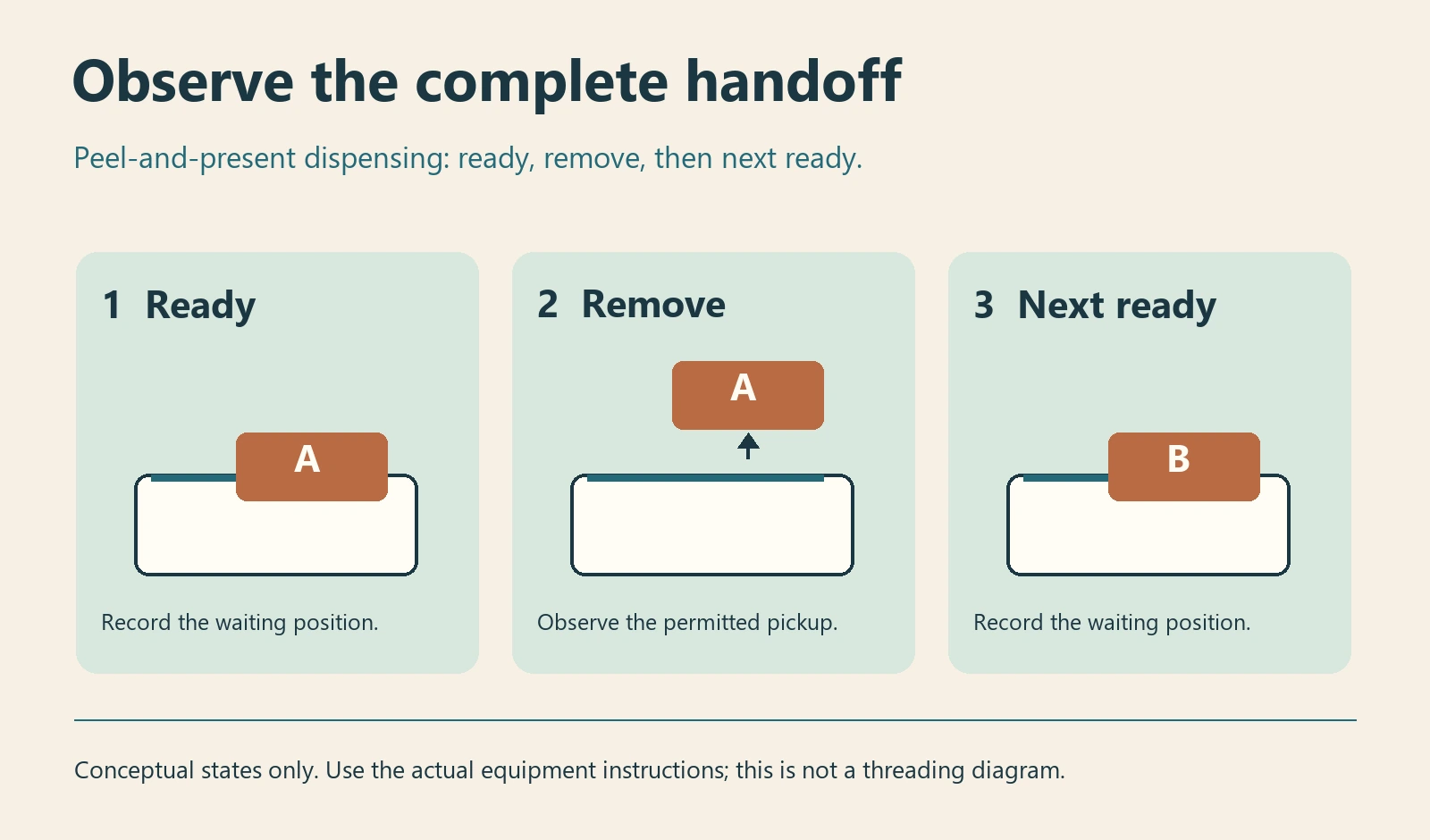
Before releasing printed rolls for a powered bench dispenser, check three connected states: the label waiting for pickup, its removal by the operator, and the next label waiting in its place. A roll fitting the spindle answers only the mounting question. The purchase decision also needs evidence that the complete converted roll supports this handoff on the actual device.
This review suits a gift or promotional packing station where a dispenser presents a label and a person applies it. Keep the application surface and adhesive requirements separate. Successful presentation does not establish that the label will hold on the package.
Identify the dispenser and resolve conflicting information
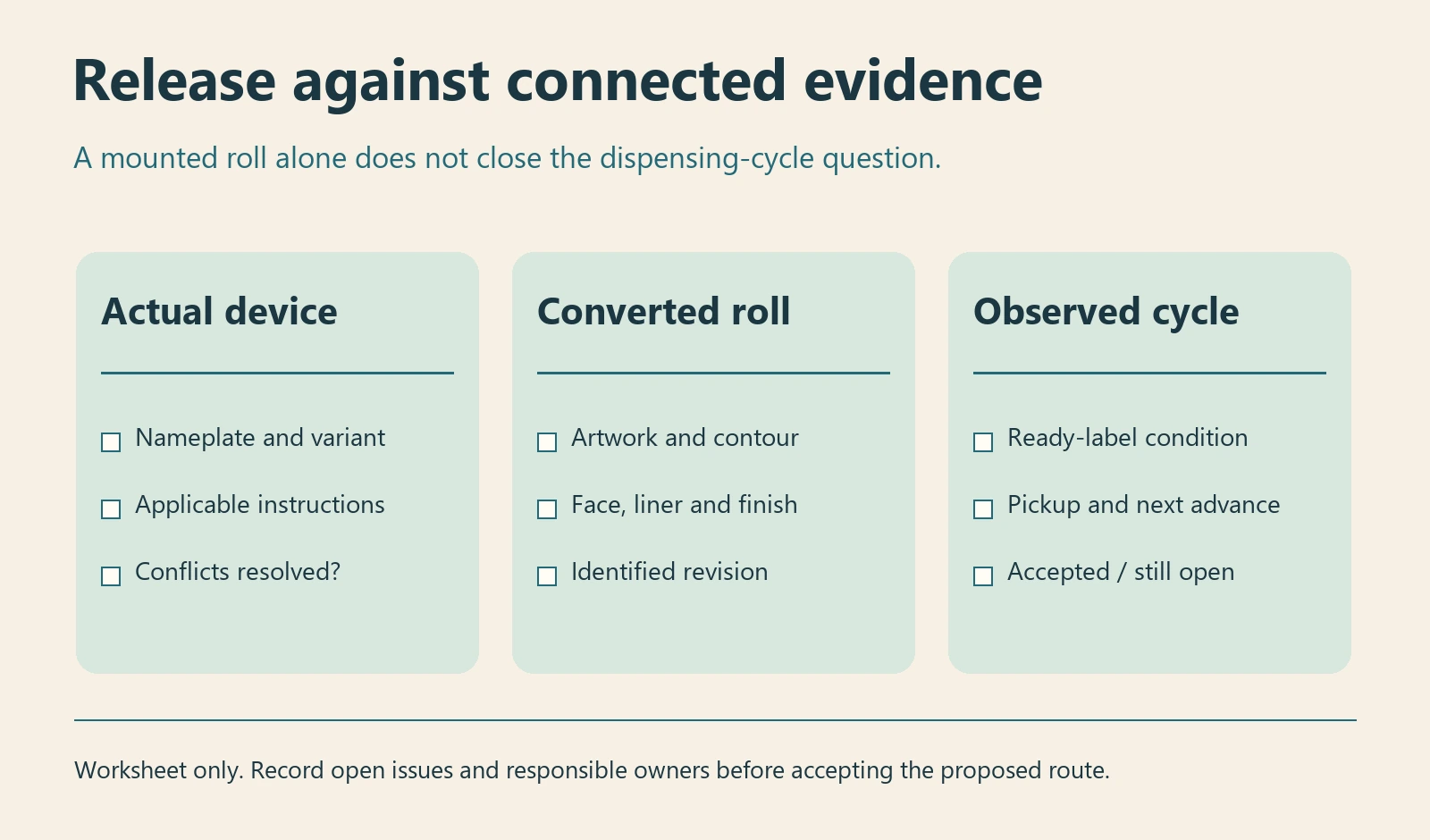
Record the nameplate, fitted sensing arrangement where relevant, and the manual applicable to that unit. Ask the equipment owner to provide the current requirements for roll dimensions, liner, label geometry and operation. A distributor’s family name or an old web search result may describe a different configuration.
A real documentation conflict shows why this step matters. The Labelmate USA LD-100-U product page lists opaque and transparent label types. However, the manual linked from that page, checked November 19, 2026, says the unit is not for transparent labels and refers to opaque labels. These statements should be resolved with the provider for the particular unit before relying on either as a compatibility instruction.
This example does not establish whether a particular ZC roll works on that equipment. It illustrates the information gap a buyer should close. Keep the provider’s clarification with the device identity and proposed roll. Leave compatibility open when the applicable instructions cannot be established.
Start with the waiting label
Have the responsible operator prepare the station under the applicable manufacturer instructions. Procurement should observe the result, leaving threading, adjustment and maintenance to authorized personnel. Use a representative converted roll with the actual artwork, contour, face material, liner and finish identified.
Record what remains supported and what is exposed while the label waits. Can the intended person identify the design and take it using the permitted motion? Does the presented part remain in the required state until pickup? Note any curling, unintended release or contact that interferes with the task, without assuming its cause.
Include the real package support, gloves and available hand where relevant. A demonstration with both hands free can miss the difficulty of holding a gift box at the same time. If the problem is finding a starting edge on a backed sticker, the peel-access guide addresses that construction decision. Here the question is what this dispenser presents and how its cycle continues.
| State | Record and release question |
|---|---|
| Ready | Identify the label, exposed portion and support. Is the intended pickup available while it waits? |
| Remove | Record the removal action and unintended contact. Can the operator complete the maker-permitted pickup in this task? |
| Next ready | Record what advances and where the following label stops. Does the next cycle begin in the agreed state? |
| Stop or restart | Record the relevant state after an approved interruption. What must the owner confirm before returning to the task? |
Watch the removal-triggered advance
Labelmate’s product description explains its peel-and-present sequence: a label waits at the front for removal, then the next is presented. The useful procurement observation therefore includes what happens after the hand removes the first label. This is more specific than a photograph of one neatly exposed label.
Ask the operator to include the relevant pickup and restart conditions in an agreed observation plan. Record a missed advance, more than one label moving, or a following label stopping unexpectedly against the actual roll and device identity. Preserve the affected sample and a safe observation record. Do not translate one symptom into a universal request for a darker mark, a wider gap or a weaker adhesive.
The web sensing guide covers the drawing and detection requirement if that is the issue returned by the equipment reviewer. A sensing change, liner substitution or shape revision needs its own supported review. Increasing machine speed is not a procurement remedy for an unresolved next-label state.
Keep the evidence tied to the complete roll
An unprinted test strip can support a limited investigation, but record which parts differ from the proposed order. A different liner, contour or printed sensing area can leave the final presentation question open. Identify which versions and constructions the agreed review actually covers.
Keep core, outside diameter and winding requirements alongside this cycle record. The roll-direction guide supplies that drawing task. It should agree with the representative roll rather than becoming a separate attachment that nobody checked against the trial.
If observations are timed, retain the actual task, interruptions and comparison conditions. A dispenser feed specification does not establish the station’s finished packages per hour. The operator still has to identify, pick and place the label, support the package and deal with changes.
Accept a bounded route or retain a practical alternative
Release the roll only against the agreed construction, applicable equipment requirements and accepted observations. Record unresolved states and their owners. If a correction is proposed, keep its revision and repeat the affected observations before treating the earlier evidence as current.
A simple holder with manual peeling or a sheet format may remain suitable when the powered route adds an unresolved step. Compare the actual packing task through the roll-versus-sheet guide. Neither option wins from a piece count alone, and neither should be silently substituted for the route used in the buying plan.
For a printed roll-label review, send the device nameplate and applicable manual, final artwork and dimensions, proposed construction or an existing identified roll, and ready/remove/next-state observations in a dispenser-handoff enquiry. Include quantities and the unanswered compatibility question. Confirm any representative sample work under the project-specific sample policy.