
If a sticker quotation includes a cutting-die or tooling charge, first ask whether it refers to a distinct physical tool. Then confirm who owns it under the agreed terms, who holds it and what access is available for a later order. Payment for a job does not by itself supply that complete asset record.
This review applies when a physical cutting die is actually part of the proposal. Some production routes may not use a separately retained die for the buyer’s design. If the quoted line covers preparation or another setup task, record that scope instead of inventing a physical asset that should be waiting on a shelf.
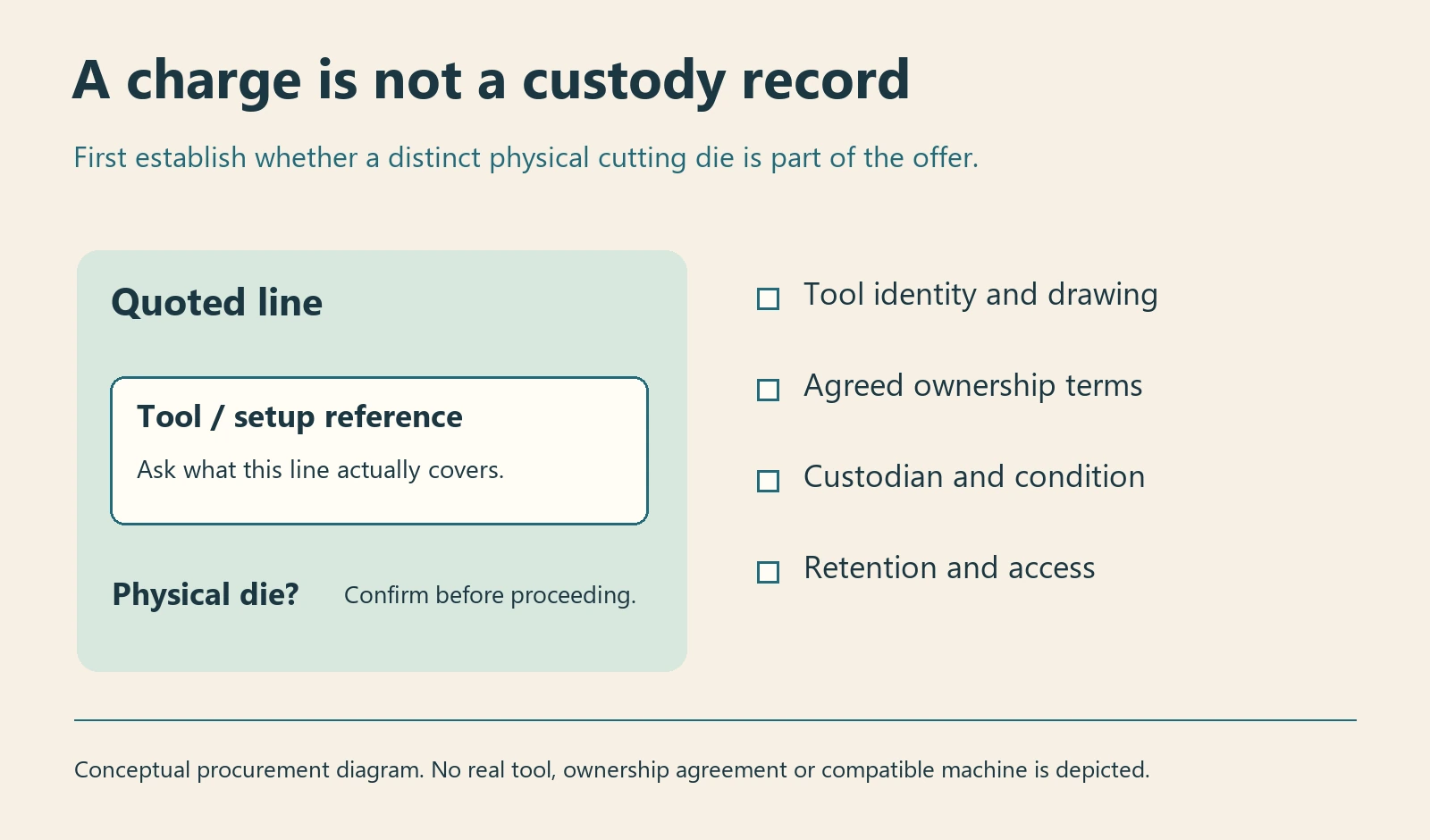
Identify what exists before discussing reuse
Connect any physical tool to a supplier reference and the accepted contour revision. Record what the supplier says it covers: for example, which finished outline and production proposal. Keep the drawing separate from the physical item. Receiving a cutline file does not prove that a die has been made, retained or inspected.
The setup-charge comparison asks what a charge buys and when it is charged again. Here the additional decision is custody and access: can the relevant tool be located, who can authorize its use, and what must be confirmed before relying on it?
A prior order number is a useful starting reference. Ask the custodian to connect it to the actual tool or explain that the current record does not establish one. Equal sticker width and height are not enough to identify the same contour or production arrangement.
Separate agreed ownership from the party holding the item
Request the applicable written terms rather than inferring ownership from the presence or absence of a separate fee. As a provider-specific example, section 11 of Shanahan Printing & Graphics’ conditions of sale retains preparatory materials unless separately purchased, even when their cost appears in the job price. That is its own published arrangement, not a rule for all printers or a statement of ZC Labels’ terms.
Ask what has actually been agreed for this order. The owner and physical custodian may differ. The person paying for a repeat may also need another party’s authorization to request release or transfer. Resolve that arrangement through the responsible parties; this worksheet does not interpret a disputed contract.
| Record field | Question to settle |
|---|---|
| Tool identity and drawing | Which physical item and accepted contour does the reference identify? |
| Ownership arrangement | What written agreement states the relevant rights? |
| Custodian and location reference | Who can locate it and confirm its present status? |
| Permitted access | Who may request reuse, collection or a proposed transfer? |
| Retention and disposition | What period, notice, charges or disposal arrangement has actually been accepted? |
| Condition and receiving process | Who assesses whether the item is suitable for the proposed next job? |
Keep condition and retention in the repeat-order decision
A storage confirmation is not a statement that a tool remains suitable for every later use. Ask the responsible production party what condition or suitability review is needed. Record any changed construction, contour or production route alongside the reuse request.
RotoMetrics’ flexible-die care guide, published by Maxcess, treats its flexible die as a precision product and gives product-specific handling and protective-storage instructions. That is a reason to preserve a real custody and condition record. It is not a cleaning recipe for another tool, a storage guarantee or evidence that ZC uses that product.
Ask the custodian which retention arrangement applies and how the buyer will learn of a proposed disposition where notice is agreed. Do not assume indefinite free storage. Equally, do not invent an annual retention fee or expiry period if the actual offer has not established one.
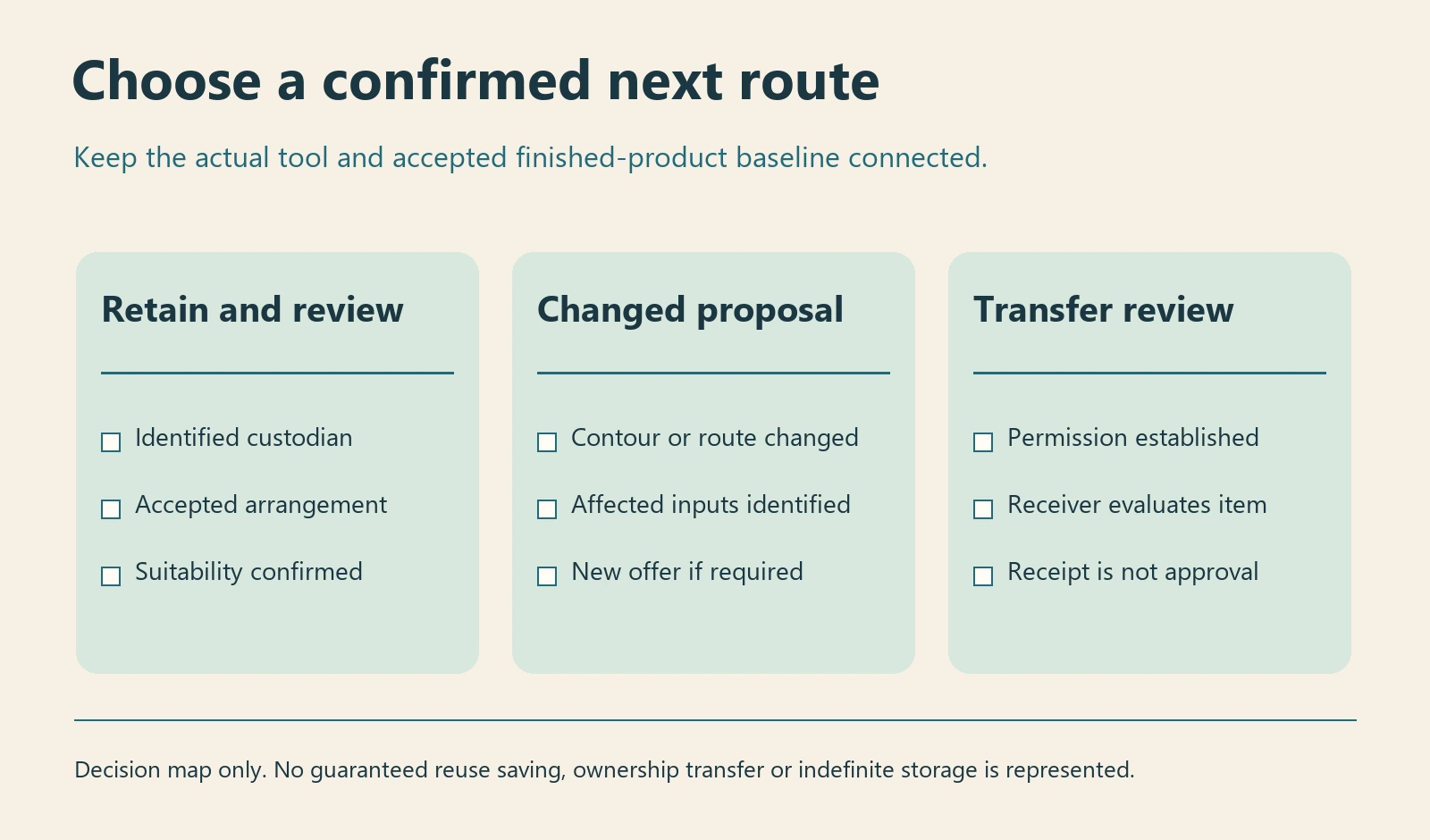
Review transfer as a separate request
If a buyer proposes moving a tool to another production provider, establish permission and the item’s identity before arranging transport. Ask the proposed receiver which technical information and condition evidence it needs. Keep its acceptance separate from a shipment or collection acknowledgement.
Ownership, permission to collect and suitability for another production setup are different questions. A parcel receipt does not establish machine compatibility. The receiving specialist must evaluate its proposed route; do not promise that an existing die can move between machines or suppliers without change.
The second-source guide controls the finished sticker baseline and approved differences. Retain that comparison even when a physical tool is available. Shared tooling alone cannot approve a changed face material, adhesive, print appearance or supplied format.
Choose the next order route from confirmed information
Keeping a suitable tool with a confirmed custodian may support a repeat where the relevant inputs remain accepted. A changed contour or production proposal may require a new quotation. An authorized transfer may be worth evaluating when the receiver confirms a viable route. Compare the actual charges and consequences rather than assuming any option is free.
Use the production-route comparison where repeated and changing artworks need different proposals. If no distinct physical die is part of the job, preserve the accepted files and repeat-order requirements instead. The custody worksheet should end there.
For a custom die-cut sticker enquiry, send the actual quoted tooling/setup line, accepted contour revision, prior order or tool reference if available, and the intended repeat or authorized transfer request through a tooling-scope enquiry. Ask what asset and access arrangement, if any, can be confirmed for this project. No ownership transfer, storage period or future fee waiver is promised by this guide.