
The project contains one large label order and several artworks. One version carries most of the quantity; others may change after a product review. Procurement asks which printing process wins at the total volume. That total hides the question most likely to change the comparison: what is actually being repeated, and for how long?
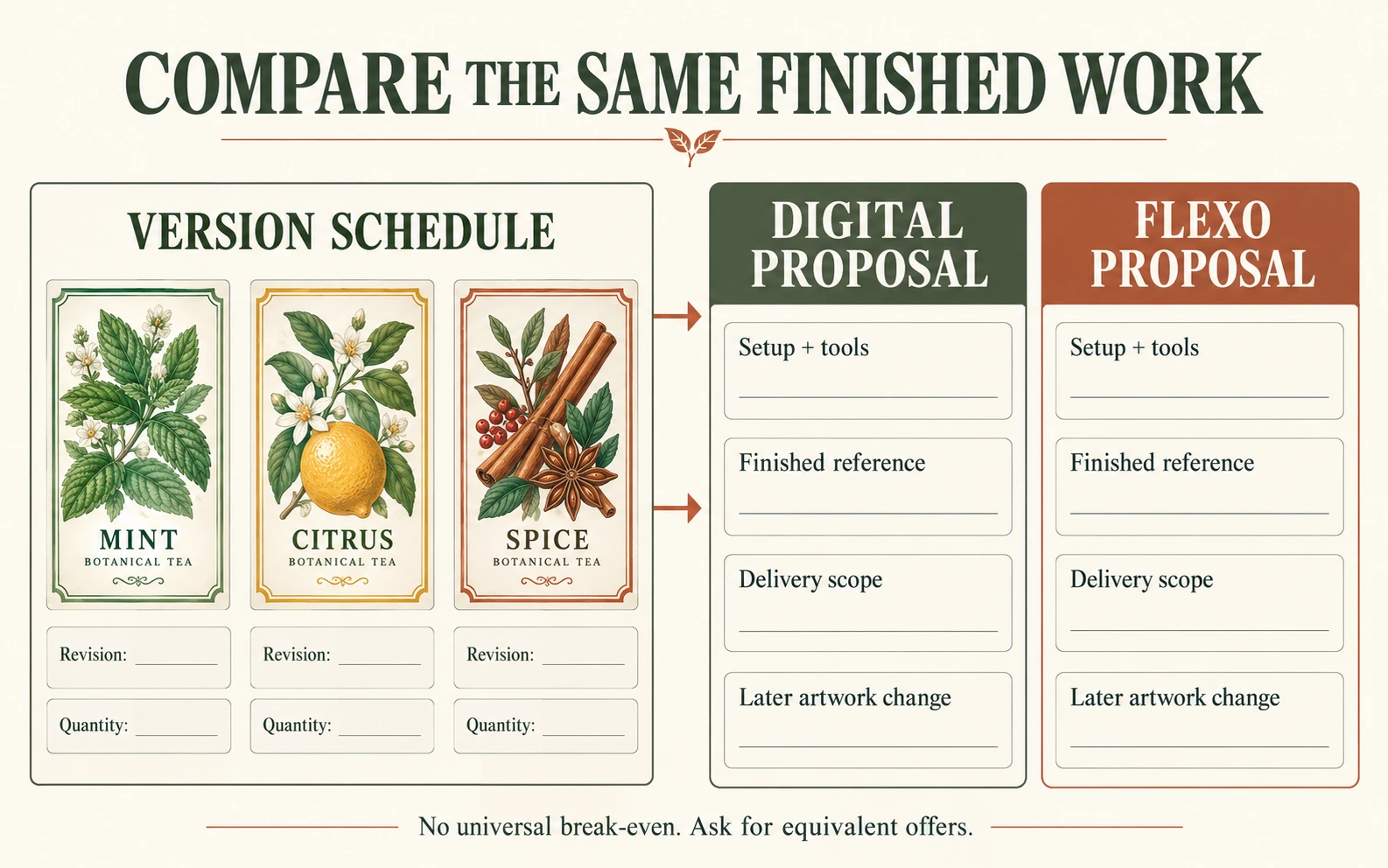
Compare digital and flexographic proposals against a version schedule. Keep quantities per released artwork, likely revisions, required construction and finishing visible. Ask for equivalent quotations rather than a universal break-even number. The process choice should follow the work being bought, including the cost of changes the buyer can realistically foresee.
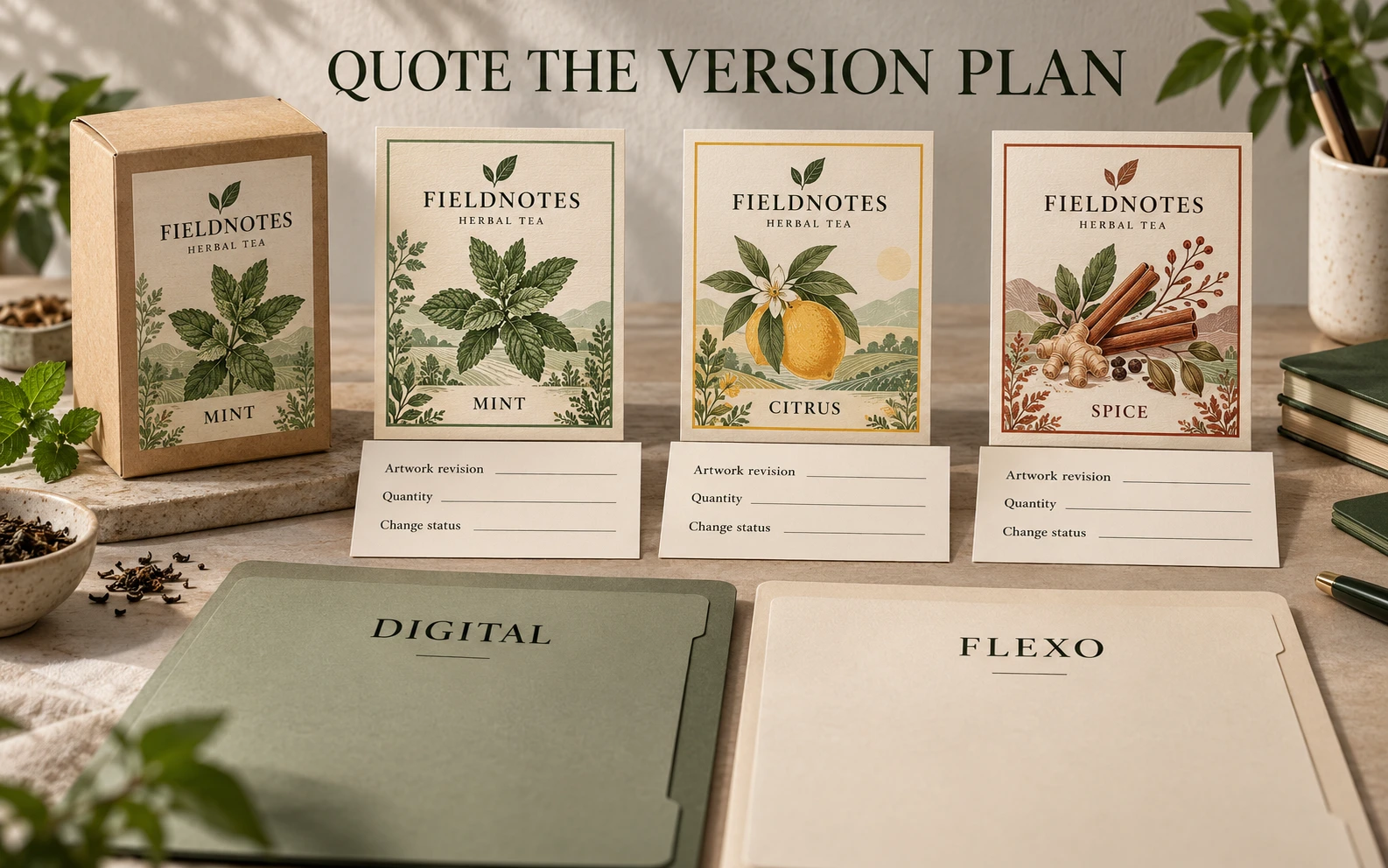
Split the order before choosing the process
List each artwork with its revision and required quantity. Distinguish a stable repeated design from an unresolved version. If a common background is shared but product wording differs, keep those final artwork variations identifiable rather than assuming that they are one printing job.
State whether the order is a single delivery or part of a repeat program. A forecast is useful context, but it is not an authorized purchase quantity. Ask the supplier how it treats future repeats, separate releases and revisions in the actual offer.
An illustrative schedule could contain one established design and several small test-market versions. This is a planning scenario, not a real customer order. A supplier may propose one route for all versions or different routes for different work. Compare the consequences explicitly; splitting can create additional reference, packing and appearance-control work.
Ask what setup the proposal contains
Hally Labels' process comparison describes image-carrying flexographic plates and a different reimaging route on its digital equipment. Those are useful distinctions when asking about artwork changes and setup. Its prices, service terms, equipment and performance statements are not ZC Labels' terms or capabilities.
Ask each supplier which artwork-dependent tools or setup items are included, which can be reused and what happens if the artwork changes. Avoid interpreting digital as no tooling of any kind: cutting, finishing or other production steps can still have their own requirements.
Confirm ownership and reuse conditions where a tool is relevant. An earlier invoice does not establish that a tool suits a changed dimension or new process. Have the supplier identify what the proposed repeat actually preserves.
| Comparison field | Information to keep the same |
|---|---|
| Artwork | Named released revisions and quantity per version |
| Construction | Face, adhesive and required protective finish |
| Appearance | Accepted color and decorative-effect reference |
| Converting | Final cut, supply format and equipment requirements |
| Commercial scope | Setup, tools, packing, delivery and exclusions |
| Later changes | Which artwork or quantity changes trigger a new offer |
If the proposals differ in material or finish as well as printing route, record that difference. A lower number may describe another finished product, so it cannot be attributed to the press choice alone.
Preserve the appearance requirement across routes
Use the actual final-size artwork, including the smallest important detail, broad solid areas and any white or decorative print requirements. Ask which reference represents each proposed route. A sample produced by one process does not automatically establish the appearance of another.
The color-reference guide explains the controlling appearance decision. Retain that reference when comparing processes, while recording any limitation of a stock sample or approximate proof. Do not describe an unreviewed substitute as identical because the electronic file is unchanged.
Where only part of a range changes route, compare the pieces together in their selling or packing context. The buyer may accept a defined difference or decide it disrupts the range. That is an appearance tradeoff to make openly, not an assumption that every process must always look different or always match.
Keep variable data and finishing in the complete route
If each piece changes, state what changes and who controls the data. Ask whether the proposal prints all content in one route or combines stages. A process name alone does not specify record validation, code quality or the association between a printed identity and a package.
The variable-data release guide covers those information controls. Here the purchase decision is whether the proposed production route and commercial scope address the actual mix of static and changing content. Keep the authorized file and accepted data fields with the relevant proposal.
Likewise, confirm how cutting, protection and embellishment are performed in the quoted scope. A print comparison that stops before the finished delivery can hide differences that matter more than the image-forming stage. Do not assume every decorative option is available on every proposed route.
Compare a plausible revision, not an invented guarantee
Ask what would change if one artwork were revised before a later release. The supplier can identify which existing setup remains usable and which items need a new offer. Keep that response conditional on the actual change rather than converting it into a guaranteed price for unknown future artwork.
Balance the quoted production amount with the risk of holding outdated stock and the work of releasing smaller quantities. Larger stable runs can be sensible; a changing version can justify another allocation. Obtain actual terms instead of stating that digital is always cheaper below a fixed count or flexo always wins above it.
For a print-route comparison enquiry, send the version schedule, released and unresolved artwork status, quantity by design, expected repeat context, construction requirements, appearance reference, supply format and destination. Use the roll-label project route to ask which available process can meet that brief. The useful comparison is two offers for the same finished work, with the consequences of changes visible before the order total chooses the process on everyone's behalf.