
One supplier sends a peel result. Another quotes tack. A third says its adhesive is stronger without naming a method. The buyer lines up the largest numbers and tries to choose. That comparison has skipped the question that makes a number useful: what was measured, on which construction, under which conditions?
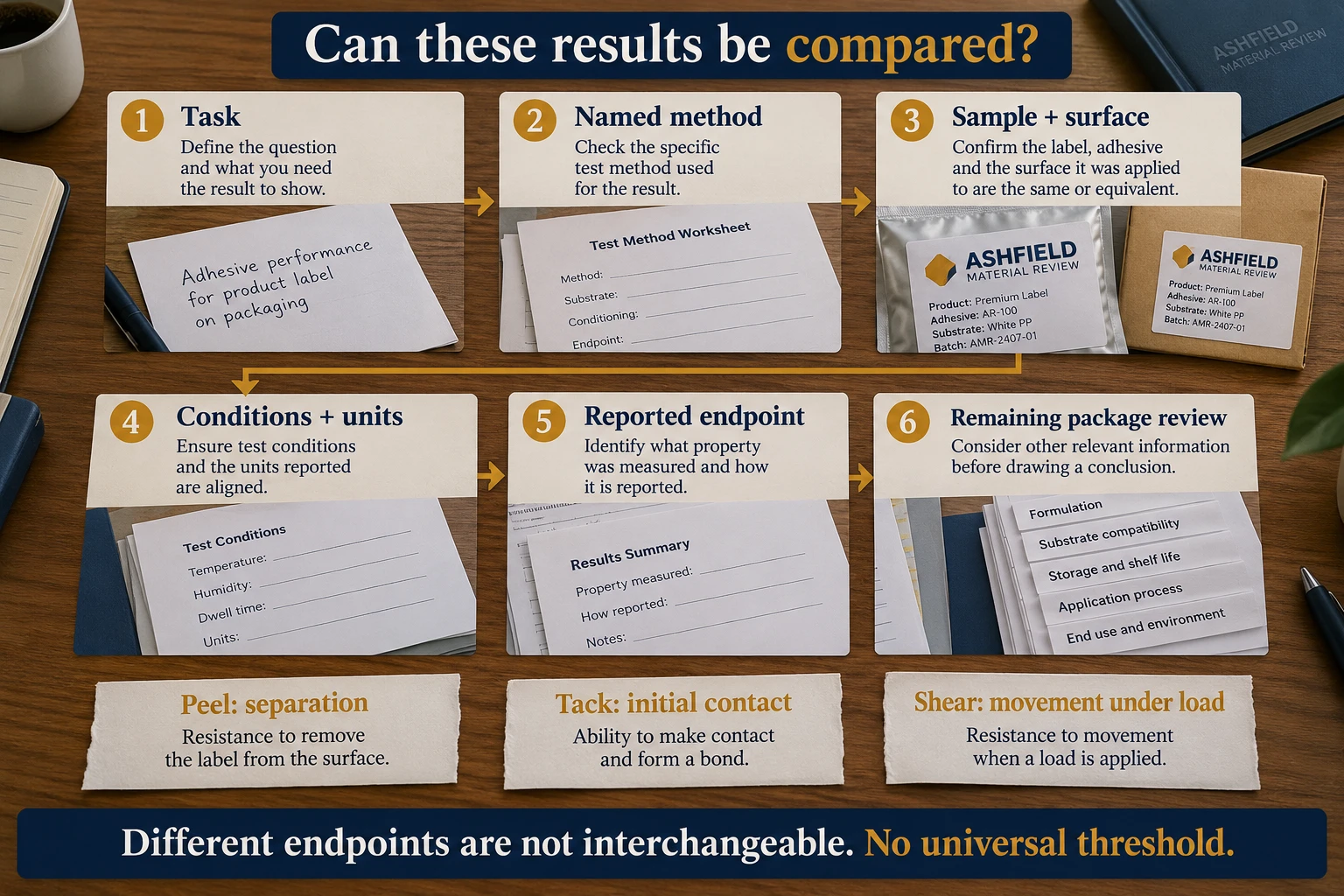
Before ranking label adhesion reports, connect each result to the intended labeling task. Peel, tack and shear describe different aspects of pressure-sensitive adhesive behavior. Even two results carrying the same test name need enough method and sample information to establish whether they can be compared.
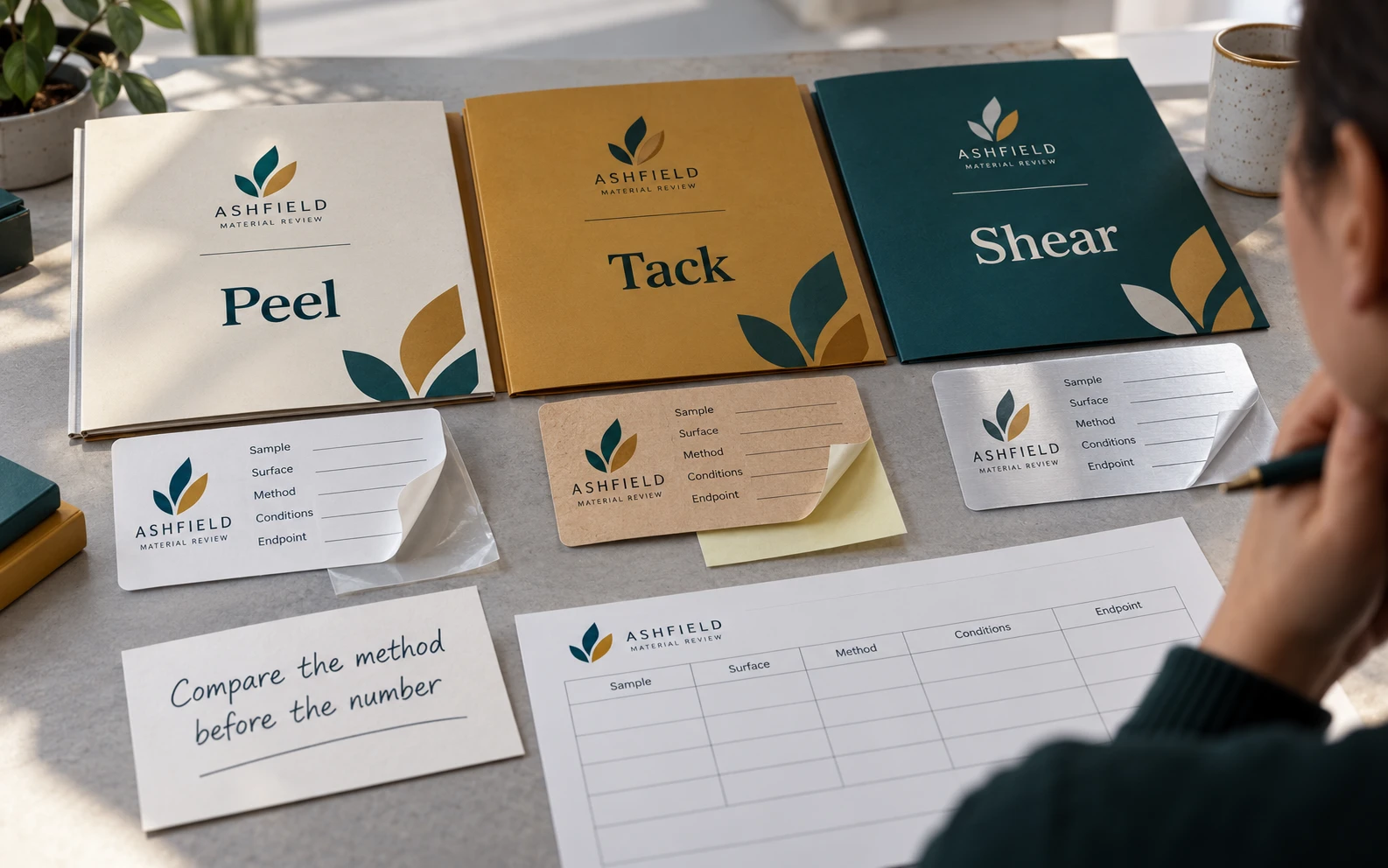
Ask what the result is intended to answer
The label may need initial contact during a particular application step, continued attachment through handling, or a specified removal end state. Identify that event first. A high value in a different task can be irrelevant or even conflict with the project, particularly when removal is intended.
The surface specification guide helps identify the actual contact. Keep the surface, application state, required use and end state together. Calling a label permanent does not establish a report's relevance to that complete sequence.
CCT's pressure-sensitive adhesive test overview distinguishes peel, tack and shear as different performance measures. NIST's research on pressure-sensitive adhesive peel measurement also identifies different test families and demonstrates temperature-dependent peel behavior within its research setup. Neither document supplies a universal acceptance limit for packaging labels.
Keep the three endpoints distinct
Peel considers separation from a surface in a defined geometry and method. Tack considers an initial-contact behavior under its specified method. Shear considers resistance to movement under a load applied in a different direction. A label's general stickiness cannot replace those definitions.
Ask for the actual named method and version when a formal method is relevant. If a supplier uses an internal comparison instead, identify it honestly and request enough detail to understand its scope. Do not upgrade a finger-peel impression into a standardized result.
| Report family | Buyer question | Important boundary |
|---|---|---|
| Peel | What separation result was measured on the stated surface? | Geometry, rate, dwell and construction matter |
| Tack | What initial-contact behavior did this method assess? | Not interchangeable with later attachment or removal |
| Shear | What movement or holding endpoint was assessed under the stated load? | Different loading and endpoint from peel |
| Informal observation | What happened to this identified sample in this task? | Not a formal grade or universal material property |
The comparison above is a reading aid, not an instruction for constructing a test rig. The responsible technical reviewer should select and perform an appropriate method. Avoid creating a home-made weight or angle requirement merely to fill a blank in the purchasing form.
Normalize the report scope before the value
Record the full tested construction, including relevant face, adhesive and backing state. Identify the test surface and preparation. A result on a named standard panel can be useful as a controlled comparison while still leaving a textured production package unreviewed.
Then retain the conditioning, application, dwell, environment, method settings, units and endpoint supplied in the report. Not every method uses the same fields, so ask the reviewer which are applicable. Missing information stays missing; do not reconstruct it from a typical value found in another product's brochure.
Put two proposals side by side with a scope column before their result columns. Where the method or conditions differ, mark the values not directly comparable and request the appropriate next evidence. Unit conversion can align arithmetic without aligning the underlying experiment.
Read the failure description, not only the total
A retained report may describe separation at an interface, material tearing or adhesive remaining on a surface. Keep the reported observation and the sample identity together. Different physical outcomes can matter to the intended job even when a summary value looks favorable.
For a removable label, the buyer may need a defined surface condition after removal as well as enough holding during use. The removable versus permanent guide owns that end-state decision. A high peel number cannot silently approve clean removal.
If the physical observation appears inconsistent with the report, preserve the discrepancy for the technical owner. Avoid diagnosing the chemistry from one image. The defect evidence guide explains how to retain a useful observation without naming an unsupported root cause.
Bridge controlled evidence to the actual package
A comparable laboratory result may help choose what to investigate, but the final label still meets a specific package and application sequence. Ask which representative review connects the proposed construction to that sequence and which exposure requirements remain open.
An illustrative buyer could receive two peel reports made under different dwell conditions. It would be premature to conclude that the higher result identifies the better adhesive for its actual short application interval. The next action is a scope clarification or agreed comparable review, not an invented conversion factor. This is a decision example, not a customer test.
The same caution applies to using a prior material report after a substitution. Ask what changed and whether the report still represents the delivered construction. A familiar adhesive family name is not complete identification of a finished label.
Buy the evidence needed for the decision
A more extensive testing program can add cost and time, while an undefined report can add paperwork without resolving the choice. Agree the decision, owner and deliverable first. A known compatible construction with retained relevant evidence may not need every possible test repeated; a changed critical condition may need targeted new evidence.
For a label material enquiry, send ZC Labels the actual surface and application description, current/proposed construction references, relevant reports with methods and units, intended removal or service state, artwork/dimensions, quantities and destination. Use the custom label page to discuss the supply scope and confirm which sample or testing services are available. The useful outcome is a comparison the buyer can explain, with the unresolved evidence named before a material is released.