
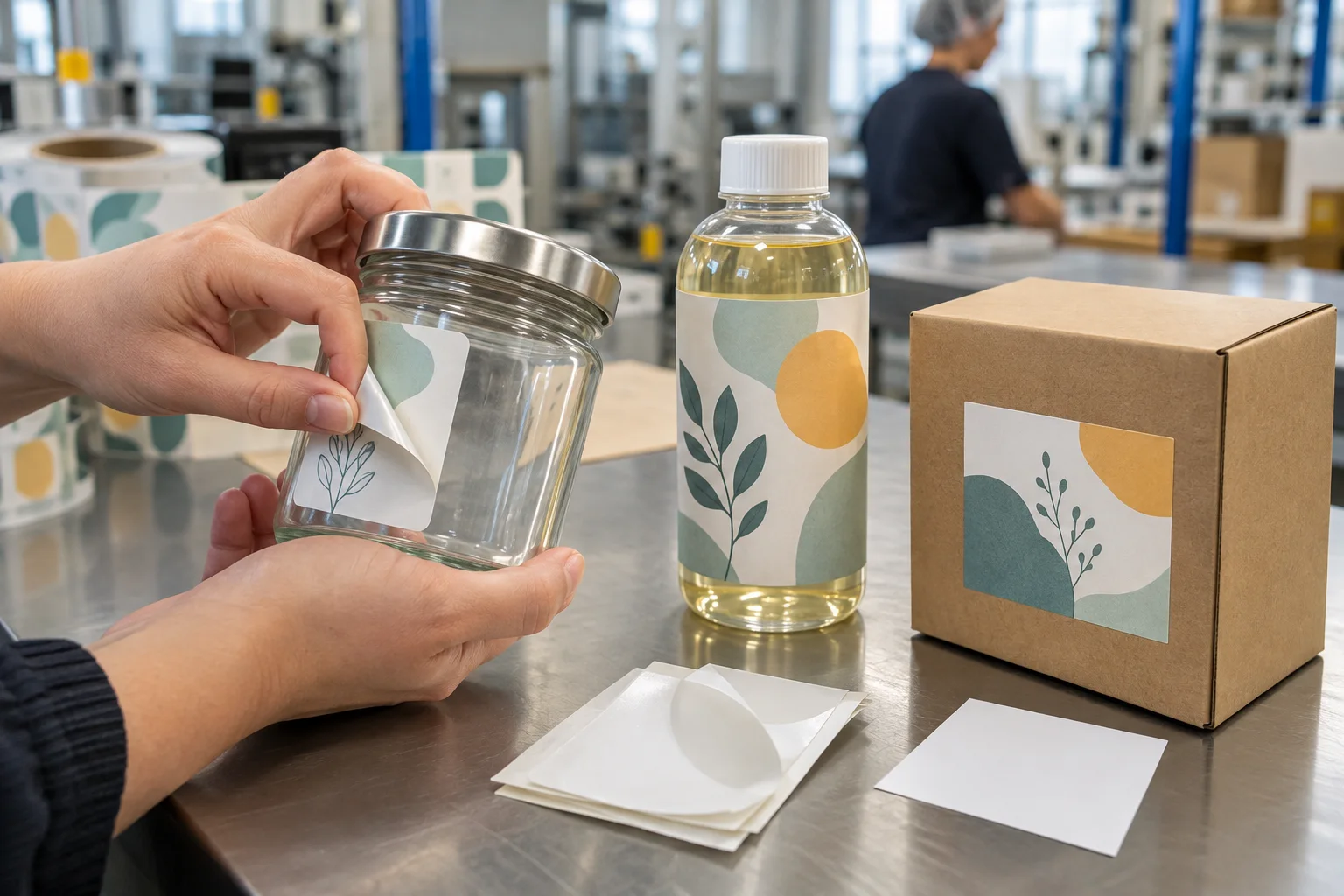
The phrase "removable sticker" sounds reassuring. It suggests a label that holds when needed and disappears without residue when the job is over. Sometimes that is exactly the result. Sometimes the same label peels from one surface and clings stubbornly to another.
From a factory review perspective, removable and permanent are directions, not magic guarantees. We need to know what the sticker must survive and what should happen at the end of its use.
Start With the End of the Sticker's Life
A promotional sticker on a reusable glass jar may need clean removal after two weeks. A product label on a bottle may need to stay through transport, refrigeration and handling. A price label may need to peel without tearing a paper box. Those are three different definitions of success.
| Need | Likely direction | Main risk to test |
|---|---|---|
| Temporary event or window graphic | Removable adhesive direction | Edge lift during use and residue after removal |
| Reusable container identification | Removable or wash-off discussion | Heat, water and dwell time |
| Retail product label | Permanent adhesive direction | Transport, moisture and curved surfaces |
| Security or tamper indication | Application-specific construction | Visible evidence and substrate compatibility |
The Surface Can Overrule the Product Name
Smooth glass, textured plastic, coated paper, raw kraft board and low-energy plastic do not accept adhesive in the same way. Even two plastic containers that look similar may have different surface treatments. Dust, release agents, oil and cleaning chemicals add another variable.
We have learned to be cautious when a buyer sends only a product photo and asks for "easy peel." A photo can show shape and label area, but it cannot confirm the coating or surface energy. A physical sample, supplier material information or a real application test gives the discussion a firmer base.
Dwell Time Changes Removal
Adhesive behavior immediately after application may not match behavior after days or months. Pressure, heat and time can increase contact with the surface. Sunlight and cleaning products may also change the label face, adhesive or underlying item.
That means a five-minute peel test is useful but incomplete. If the planned campaign lasts three months, test removal after a representative dwell period. Include the warmest, coldest or wettest expected condition rather than testing only on a clean desk.
Permanent Does Not Mean Indestructible
Permanent adhesive is selected when reliable long-term attachment matters more than clean removal. It does not mean the label can never be peeled or that it will survive every chemical, texture or outdoor exposure. Face material, laminate, ink system and application quality still affect the finished result.
The trade-off is straightforward: a specification optimized for easy removal may give up some holding power, while a stronger bond may leave residue or damage a delicate surface. The right choice protects the buyer's actual priority, not every priority at once.
Adhesive Review Checklist
- Exact surface material and coating
- Clean, dusty, oily, wet or cold application condition
- Flat, curved, textured or flexible label area
- Required service time
- Indoor, refrigerated, wet or outdoor exposure
- Whether removal must be clean
- Whether the container will be reused or recycled
- Risk of surface damage or staining
- Real-item testing requirement
Our Honest Recommendation
Ask for a removal result, not just a removable material. Write the requirement in plain language: "hold on this coated box for 30 days, then peel without tearing the print," or "stay on this bottle through refrigeration and hand contact." That sentence gives the factory more useful information than an adhesive label copied from another quotation.