
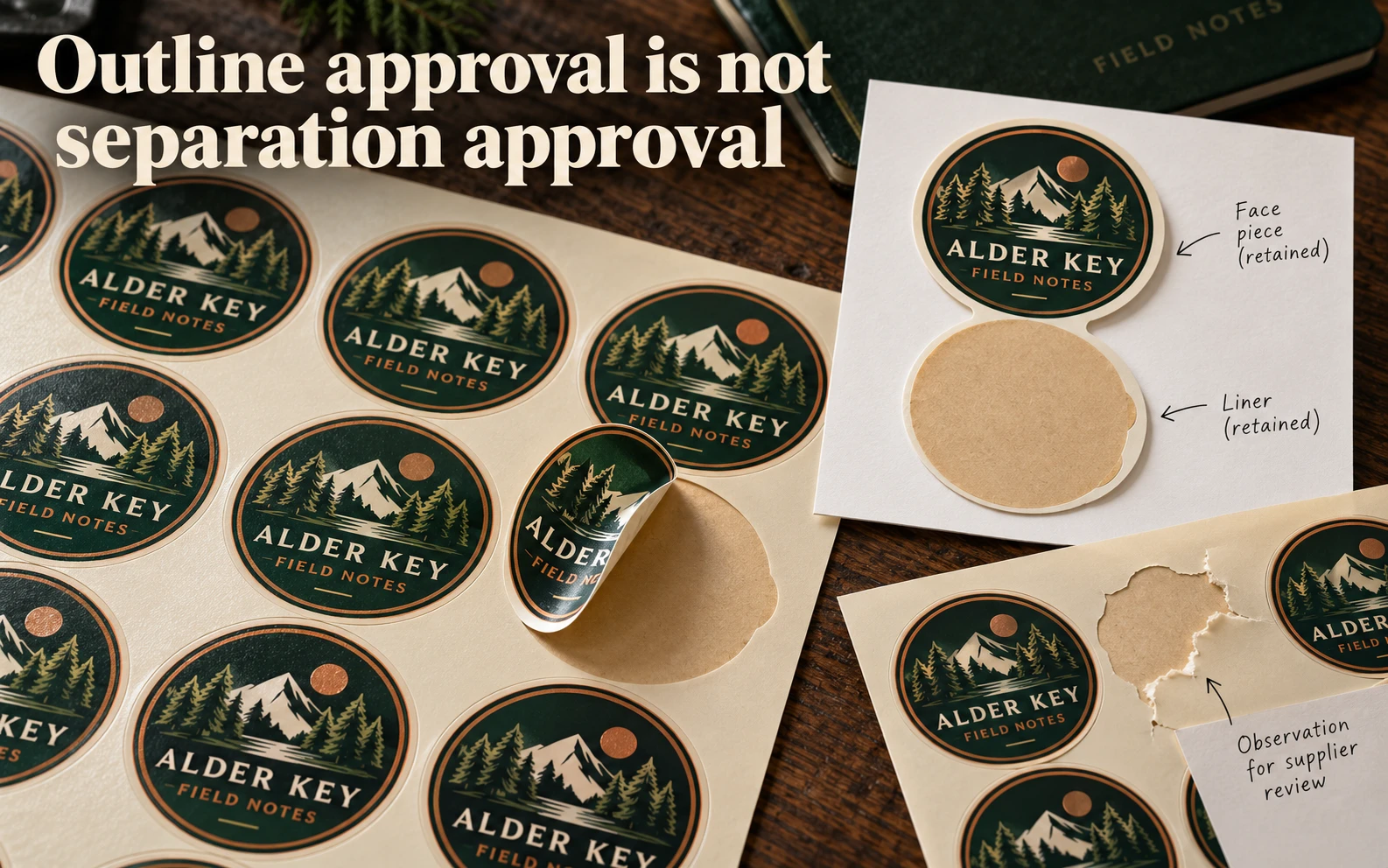
The proof shows the right outline. On the supplied sheet, one label lifts with a neighboring piece; elsewhere, the backing tears as the packer tries to peel it away. The artwork may be correct while the converted material needs investigation. Changing the cutline drawing immediately can hide the distinction.
For kiss-cut label depth, separate three approval questions: is the contour correct, does the intended face separate, and does the retained backing remain suitable for handling? A drawn line answers the first. The other two need evidence from the actual converted construction and intended use.
Name what should separate and what should remain
Define the supplied format before discussing depth. An individual through-cut sticker, a kiss-cut item with extended backing and a multi-label sheet do not retain the same surrounding material. The proposed construction should identify the face, adhesive and release liner, with any relevant upper finish included.
Then show which outline is the finished face and which is the backing. If an additional slit or perforation is deliberate, identify it separately. A planned opening feature should not be confused with an unintended liner injury, and an ordinary backing mark should not automatically be diagnosed as a functional defect.
The cutline artwork guide controls the physical outline and file handoff. Keep that approval. The present review asks whether the converted layers perform the separation the agreed format needs.
Do not prescribe a machine correction from one photograph
The supplier needs the exact construction, converted sample and observation. A label that does not release cleanly could present several questions about cutting, release, material or handling. Procurement should describe the event before assigning a cause or demanding additional cutting force.
Avery Dennison's Global MDO technical overview connects tooling to its named face and liner construction and asks users to obtain technical support for its die-strike check. It illustrates why a tool or check appropriate for one material cannot simply be carried over to another. This article gives no blade pressure, die clearance or operator procedure.
Likewise, a liner name alone does not establish the required behavior. 3M's 5051 liner description identifies a specific liner construction and intended cutting uses. That is product-specific evidence, not a recommendation to substitute it into an unreviewed label order.
Observe the intended peel sequence
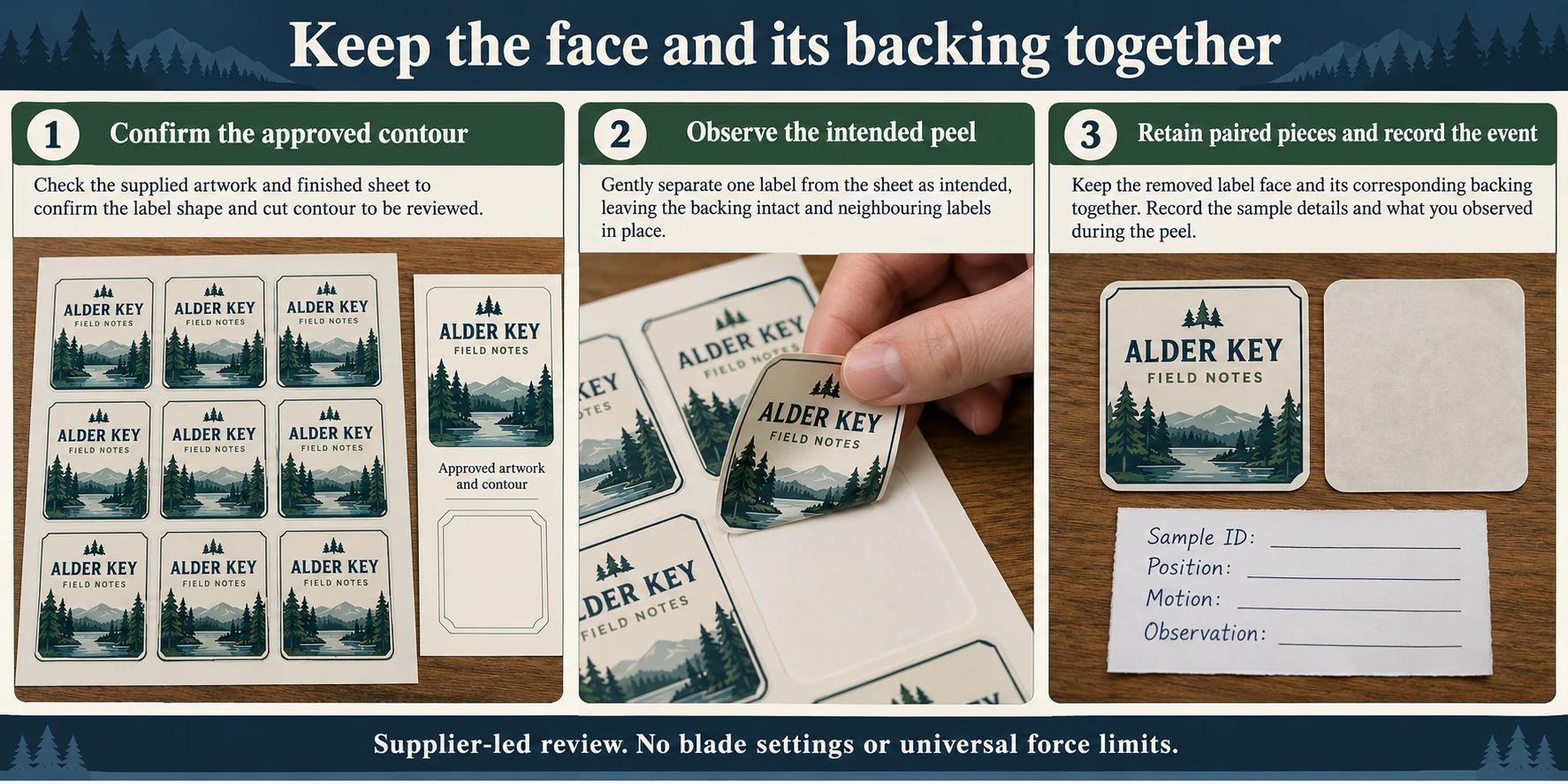
Use an identified supplied sample and the actual pick, flex and peel motion. Record whether the face separates at its outline, whether a neighboring piece moves, whether adhesive or face bridges remain, and what happens to the backing. Keep the removed piece and its corresponding liner together where practical.
A flat desk demonstration may not represent a packer wearing gloves or a dispensing route that bends the liner around a peel point. Include the relevant conditions with the responsible owner. Do not invent a universal force or sampling frequency for an informal buyer check.
| Observation record | Why it matters |
|---|---|
| Sample/order and construction identity | Connects the behavior with the proposed supply |
| Position on sheet or web | Helps bound what was observed |
| Intended separation and actual motion | Distinguishes a wrong method from an unresolved construction question |
| Face, neighboring pieces and retained backing | Preserves the physical relationship |
| Photo plus paired physical pieces | Supports a supplier investigation beyond appearance alone |
| Owner disposition and next evidence | Keeps uncertain material out of an assumed approval |
The easy-peel guide addresses access to a grasp point. A bigger grip margin can help handling without correcting an incomplete face cut or unsuitable retained liner. Keep these decisions separate so a convenience feature does not become a substitute for investigating the observation.
Include the downstream web requirement
For a roll, ask whether the retained liner can continue through the intended application path. A label may peel acceptably by hand while the complete web still needs a machine review. Refer to the actual equipment requirements and keep machine operation with trained personnel.
For sheets, inspect the supplied unit the buyer will actually distribute or feed. A small sample clipped from a full sheet may not represent the complete backing, its edges or the way neighboring labels are supported. Retain an unaltered reference where those conditions matter.
Where the project proposes another liner, finish or face material, ask the converter which prior evidence still applies. The liner choice guide covers that construction discussion. Do not keep an old cutting acceptance merely because the visible artwork has not changed.
Give a revised sample a defined purpose
If the supplier proposes a correction, record what changed and request an identified revised sample for the unresolved event. Compare it using the same relevant handling state where possible. A clean-looking new photograph does not tell the buyer whether separation and retained backing were actually checked.
Keep the accepted contour distinct from the accepted conversion reference. A correction that changes the finished edge may need artwork or package-fit approval again. A process adjustment that preserves the edge still needs the appropriate physical evidence; procurement should not guess which internal setting produced it.
There is a cost and schedule tradeoff. Revising the outline may be sensible for a genuinely difficult shape, but it can change branding, usable space or the supplied format. Retaining the outline while reviewing conversion may preserve those decisions. Ask what is feasible before treating either route as the automatic remedy.
Request a sample review with the pieces still identifiable
Send ZC Labels the approved cutline and backing drawing, actual-size artwork, material references if known, photographs showing the observation, corresponding label/liner samples where available, hand or machine use, quantities and destination through the kiss-cut project enquiry. Use the custom kiss-cut sticker page to confirm the intended supplied format.
State which question remains open: outline, separation, retained backing or downstream handling. That gives the next sample a concrete job. It also prevents a correct visual proof from carrying a physical approval it never demonstrated.