
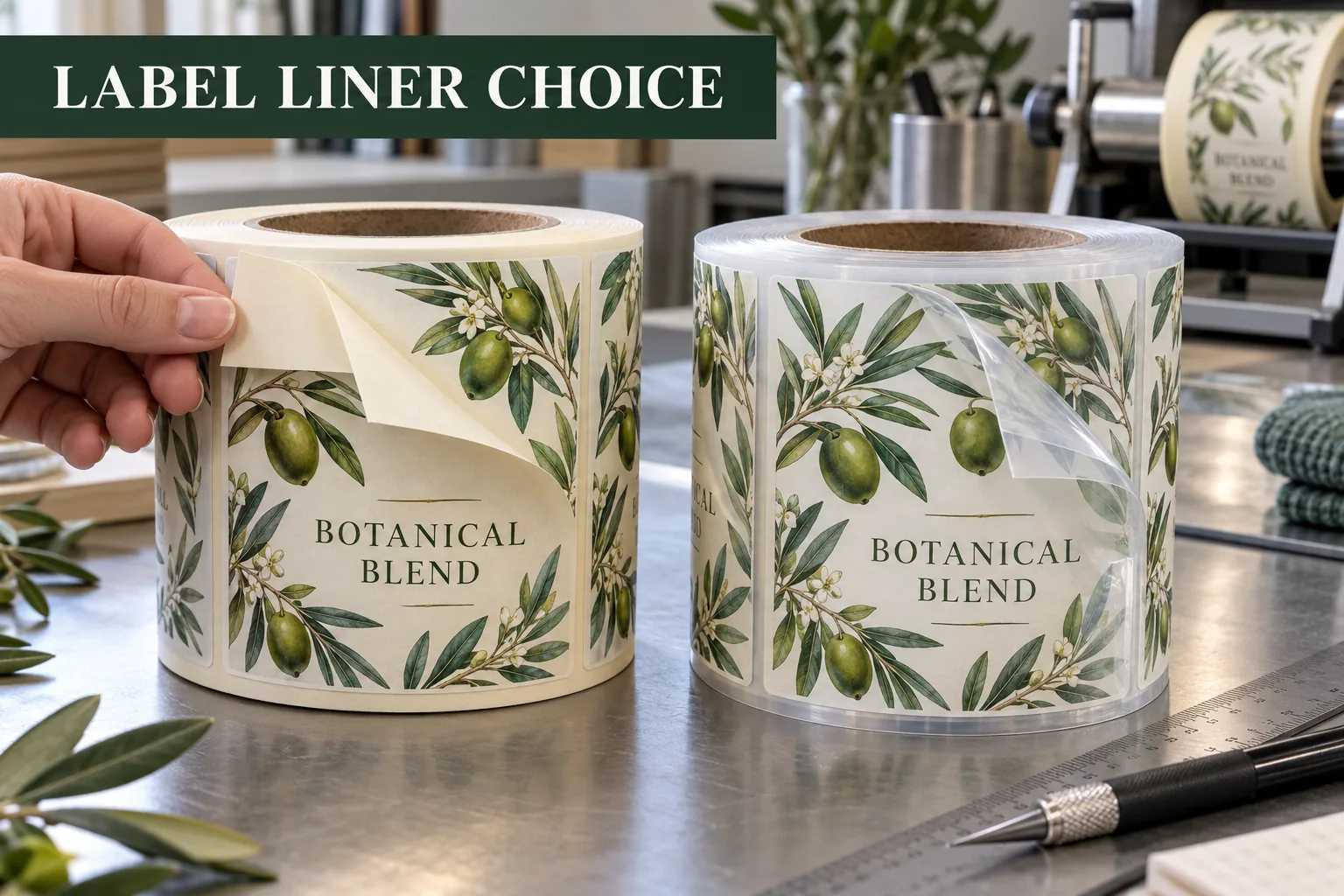
A buyer can spend an hour comparing matte and gloss, then write 鈥渁ny backing鈥?in the order notes. The backing is thrown away, so it feels unimportant. At an applicator, however, the liner carries every label past a sensor, around a peel plate and into the waste roll. I would ask where the label is applied before settling the liner.
Paper liners, including glassine-type options, and film liners can differ in thickness, tear behavior, transparency, moisture response and release. None of those properties makes one material universally superior. The useful question is whether the proposed full construction works with your label geometry and application method.
Start With the Applicator, Not a Material Name
| Application | What the liner must do | Trial to request |
|---|---|---|
| Hand peel from sheet | Release without tearing or curling | Peel after normal storage |
| Hand dispense from roll | Wind and unwind cleanly | Short run with real dispenser |
| Automatic labeling | Track, sense and strip consistently | Trial on the named machine |
| Small complex die-cut | Support cuts without liner damage | Inspect waste removal and edge quality |
Ask the line operator for the machine model, sensor type, dispensing direction, roll dimensions and current failure mode. A transparent film liner may behave differently with optical sensors; a paper liner may respond differently to humidity or bending. These are reasons to test, not grounds for a blanket promise.
Check the Cut and the Waste
Very small labels or pointed shapes leave little room for error. If the die cuts too deep, the liner may split; too shallow and labels can remain connected to the waste matrix. Inspect a physical sample after die-cutting, not just the digital cutline. If operators must strip the waste, watch whether small shapes lift accidentally.
Also ask where spent liner goes. It may be collected at the applicator, mixed with general waste or sent to a specialist program. Avoid describing either paper or film as recyclable without a real collection route and material confirmation. The buyer's waste process is part of the specification.
Approve the Whole Construction
Send the exact label face, adhesive, size and application surface together with the liner request. A trial roll should match the intended quantity per roll, core, winding and storage conditions as closely as possible. Run it long enough to observe tracking and dispensing, then check the applied label. A smooth unwind is not success if the label lands crooked or lifts later.
- Document manual or machine application
- Provide applicator and sensor information
- Confirm label dimensions and cut complexity
- Inspect die-cut depth and matrix stripping
- Trial the proposed liner after normal storage
- Verify the actual local waste route before making claims
Read the roll direction and core guide for machine setup, and the roll versus sheet guide for format selection. Send machine details and a sample of your current label through the specification planner. The backing deserves attention precisely because the customer will never see it.
Questions Before You Order
Is a film liner always better for automatic application?
No. Machine compatibility depends on the applicator, sensors, label size and release characteristics. Trial the exact construction on the intended line.
Can paper and film liners be recycled in the same stream?
Do not assume so. Collection options depend on local facilities and the liner construction. Ask the waste handler before making a recyclability claim.
Does liner choice change the label face material?
They are separate layers, but the combination affects dispensing and die-cutting. Approve the complete construction rather than choosing each layer in isolation.