
A page tab needs to remain identifiable after the book closes and when the reader approaches it from the other side. A flat sheet proof shows neither view reliably. For custom index tab stickers, approve the intended page-edge position and visible faces before freezing the cutting file.
Begin with the actual book, notebook or folder and the task the tab should support. A label on an existing divider, a sticker projecting from a page and a fold-over design are different products. Do not ask the supplier to infer which one is intended from a rounded rectangle called a tab.

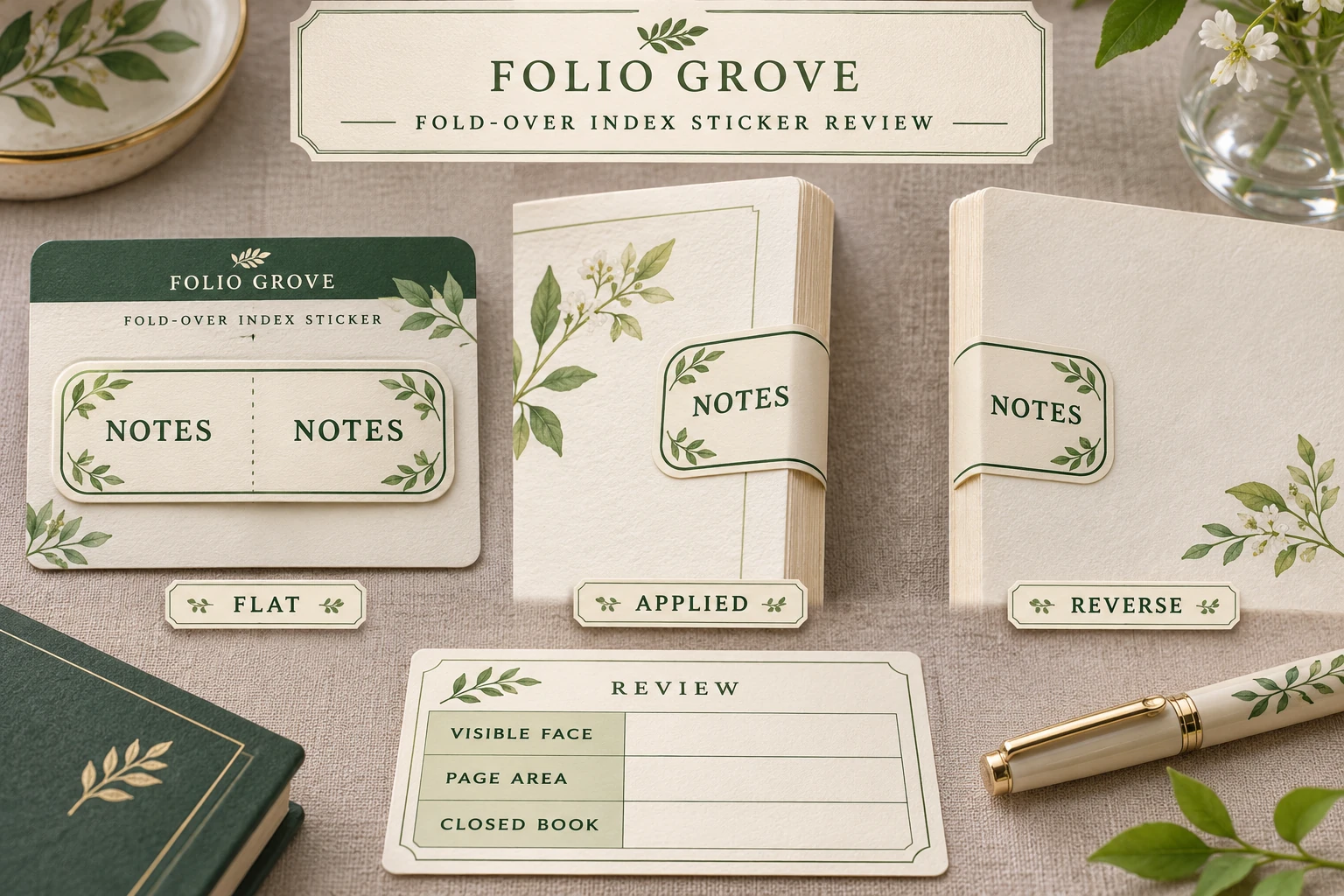
Show the applied result as well as the flat shape
The ZC Labels stationery range includes page-tab directions. Prepare a marked example of the particular result you want reviewed. Show the page attachment area, the part intended to remain visible beyond the edge and any proposed fold. Ask the supplier to confirm a feasible construction and supply format for that drawing.
Do not assume every index product is an adhesive fold-over sticker. Avery's printable-tab overview distinguishes divider inserts from page-attaching index tabs. That distinction helps name the product; Avery's own dimensions, repositioning features and printing options do not specify this custom order.
For a proposed fold-over item, identify both printed panels and the intended center relationship. A fold guide is not automatically a cutting instruction, perforation or scored feature. Separate those requests explicitly. Keep a print-only view and an annotated review view tied to the same revision so a helpful guide cannot accidentally become an unwanted visible line or physical slit.
Review each reading direction on the page
Make a final-size paper mockup to explain placement and orientation. It can reveal that a name becomes upside down on the reverse or disappears when adjacent tabs overlap. It cannot establish the adhesive's performance, the converted tab's durability or the eventual cutting accuracy.
Show the book from the front, from the reverse and closed at its edge. Ask the product owner which directions must be readable and how the user normally selects a section. A repeated label on both flat panels does not guarantee that both applied views are correct. A diagram should make the intended orientation explicit, especially where the fold changes what faces the reader.
Use the longest real section name in the smallest proposed tab. If wording does not fit, compare an owner-approved abbreviation, a wider tab or fewer positions along the page. Each changes something: abbreviations can become ambiguous, width can crowd neighboring tabs, and fewer positions can change the indexing scheme. Shrinking all the type may preserve the sheet layout while losing the navigation task.
| Reference to provide | What the owner should decide | What needs physical confirmation |
|---|---|---|
| Flat artwork with identified faces | Approved text, order and reading direction | Whether the proposed converted item represents that arrangement |
| Marked page-edge position | Attachment area and intended visible projection | Fit on the actual page and clearance from nearby content |
| Complete tab-position map | Which section occupies each position | Visibility with neighboring tabs and the book closed |
| Named paper, cover and use conditions | Retention or removal expectation and acceptable page condition | The actual construction on the representative bound item |
Map the whole index before filling the sticker sheet
Assign each tab to a section and a position along the relevant page edge. Include repeated positions if the index deliberately cycles. Do not assume that every section can remain visible at once simply because every sticker fits on a sheet. Compare the closed arrangement, not a fan of pages spread out for a photograph.
Keep navigation order separate from print-sheet order. A sheet can group colors efficiently while the book needs a different sequence. If the customer applies the tabs, decide what instructions identify the section and intended position without relying only on color. The publisher supplies that mapping; the printer should not infer chapter order from decorative artwork.
Count the supplied tab set against that map. If one section needs a different language or a longer name, keep its file and quantity identifiable. Treat spare or alternate-wording tabs as stated contents rather than letting them silently replace a required section. The sticker-pack contents guide covers the related task of defining a complete sellable assortment.
Include the page, cover and normal handling in the sample scope
Identify the actual paper or divider, coating where known, edge position and attachment sequence. Ask what representative sample is needed for the decision. A thick divider and a thin printed page are different contact items even when the tab artwork is identical.
Review opening and closing, selecting the intended section, contact with adjacent tabs and the cover or sleeve used for the product. Note whether the tab catches, hides essential print or interferes with the intended carrying arrangement. Agree the relevant observation and acceptance owner without inventing a universal projection, folding allowance or lifetime.
If removal or repositioning is required, state when and on which page it matters. Do not infer that a page tab can be moved repeatedly from its name or from another manufacturer's product. The holding and removal guide helps separate those requirements. The peel-access guide addresses a different question: lifting a sticker from its backing, rather than using the applied tab to find a page.
Keep the flat and applied approvals connected
Retain the section map, text revision, face orientation, finished dimensions, backing outline and accepted applied reference together. If a fold-over arrangement is proposed, preserve its intended center and both views. A later change to page size, cover, wording or attachment area can require a targeted review even if the decorative collection is unchanged.
If the actual page or intended applied view is unavailable, keep the relevant decision open. A conventional printed divider or a nonprojecting page label may be worth comparing when the protruding arrangement is unsuitable, but each changes the product and needs owner approval. Do not solve an unresolved geometry question by promising stronger adhesive or silently reducing the tab.
Send ZC Labels an index-tab review brief with the actual book or marked photos, page and cover dimensions, final section list and language, flat artwork showing intended faces, position map, retention/removal expectation and set quantities. Ask which construction and representative sample can be reviewed. Sample scope, availability, cost and timing require confirmation under the current sample policy.