
The purchase order says 10,000 labels. The line operator asks how many rolls will arrive and whether each roll fits the applicator. Both questions matter: the total ordered quantity does not by itself specify the number of finished rolls, the labels on each roll or the work needed to change them.
Before asking a supplier to split an order, identify the machine limits, the allocation by artwork and how the line handles a roll change. Ask what distribution the supplier can actually offer. A preferred number of labels per roll is an ordering request, not proof that the finished roll will fit the equipment.
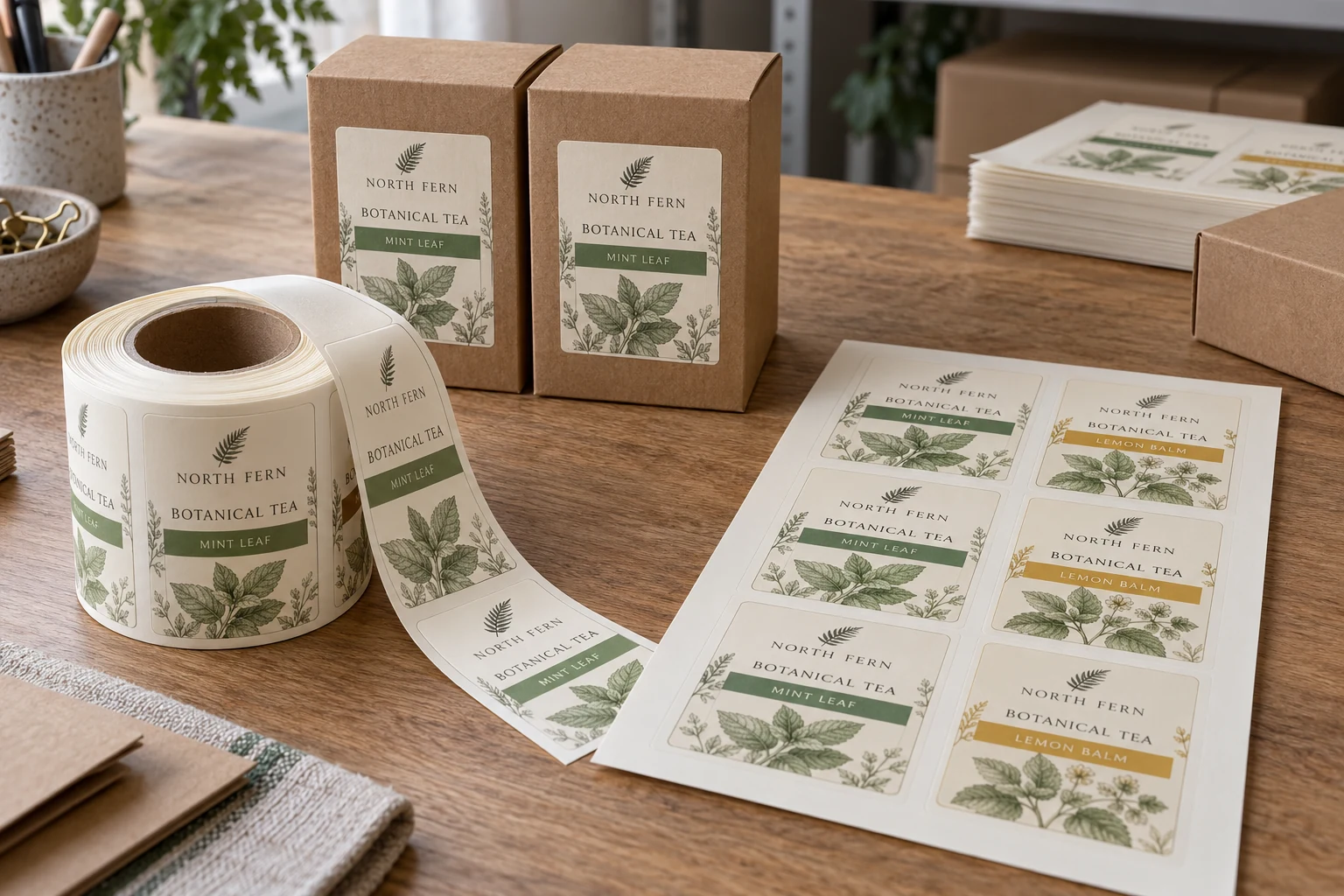
Start with the total and the real application route
List the approved label designs and quantity for each design. Then ask the person responsible for application whether each version runs on a machine, a hand dispenser or another agreed route. Two versions with the same dimensions may still need separate rolls and separate identification.
For an illustrative 10,000-label project, the buyer might explore several possible splits. The arithmetic can describe an intended distribution, but it cannot determine the finished roll diameter. Label size, gap, construction, winding and core all affect the resulting roll. The supplier and equipment owner need to confirm the actual specification. The example is not an MOQ, quote or promised production option.
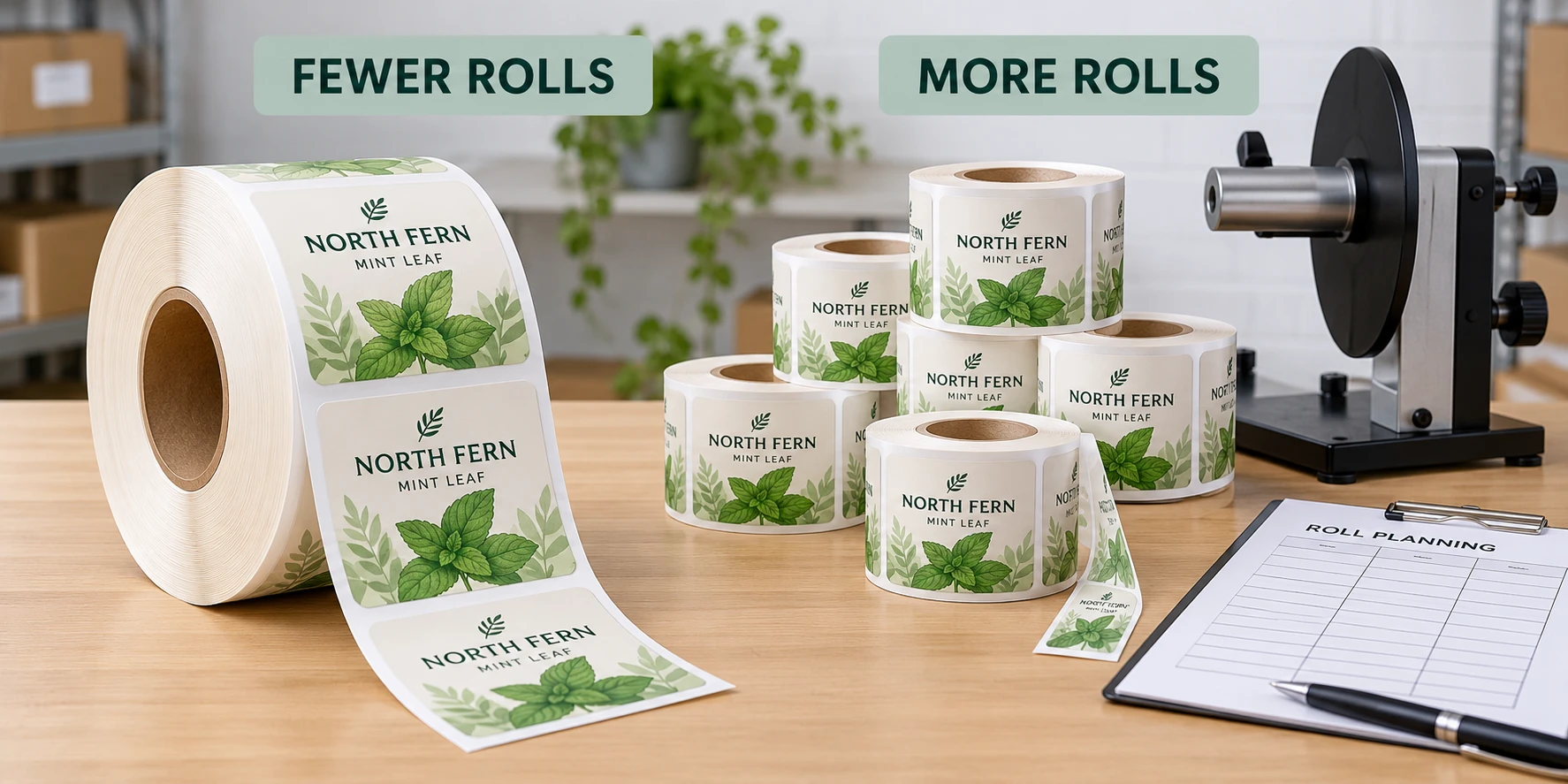
The illustration compares larger and smaller fictional roll groups. It helps frame a distribution discussion; it does not represent a counted shipment, an approved machine configuration or a performance test.
Separate the quantity request from the mounting limit
Ask the machine owner for the permitted core, maximum outside diameter and any other limits that apply to the actual applicator. Request those values from the relevant equipment documentation or responsible operator, not from a picture of a similar machine. Send the constraints to the supplier with the artwork, label dimensions and intended quantities.
| Buyer reference | Question it answers | Still to confirm |
|---|---|---|
| Total per design | How many labels are needed for each approved version? | How they will be distributed across rolls |
| Desired labels per roll | How the buyer would prefer the order divided | Whether the supplier can provide that split |
| Equipment constraints | What core and outside diameter the machine accepts | Whether the proposed finished roll fits |
| Roll presentation | Which artwork edge and face reach the applicator | Actual line setup and operation |
The Avery roll-order guidance shows that its customers can request a particular roll distribution. That is a description of Avery's service, not a promise about ZC Labels, a universal minimum or a guarantee that a given split fits another machine.
The roll unwind guide covers the separate orientation question. A roll with an acceptable outside diameter can still present the wrong leading edge for the line. Keep both instructions with the same artwork revision and equipment reference.
Compare roll changeovers with the available storage and handling
More, smaller rolls may mean more changeovers, more cores and more separate items to identify and store. Fewer, larger rolls may reduce the number of changes but can exceed a machine limit or be harder for the team to handle. The effect depends on the actual line, handling process and supplier offer. Do not assume that either option is always faster or less expensive.
Ask the operator what happens when a roll ends: how the next roll is identified, whether the line stops, and who confirms the restart. If the line uses a specialized changeover system, obtain its requirements from the equipment owner. This article does not specify a splice method or authorize changes to machinery.
Rolls that wait between shifts also need a storage plan. The finished-roll storage guide addresses protection and identification before use. It does not approve a particular machine setup or guarantee a storage life for the proposed construction.
Keep each artwork allocation visible
For a range with several approved variants, record the total for each version and the desired roll grouping. If a supplier proposes a different distribution, ask how many rolls are expected for each design and what each roll will contain. Do not assume that an attractive overall total preserves the right version allocation.
A remainder may arise when the desired quantity does not divide evenly into the preferred roll size. Identify the proposed handling of that remainder with the supplier. A short final roll, a different split or another agreed solution can have different effects on counting and changeovers. The correct choice depends on the offer and the application route; no particular production method is assumed.
Keep the final approved artwork reference, quantity allocation, equipment constraints, roll presentation and supplier-confirmed distribution together. If the label size, liner or machine changes later, ask whether the old distribution and diameter reference remain applicable. A broader reorder review can identify which previous approvals are affected.
Reconcile the proposed roll schedule by design
Put the supplier's proposed split into rows that can be added back to each design quantity. Record how many rolls carry the stated count, whether there is a shorter final roll and what the total becomes. Keep this schedule distinct from the buyer's initial preferred count and from the receiving team's later observed count.
| Illustrative design | Proposed full rolls | Proposed remainder | Total labels |
|---|---|---|---|
| A | 2 rolls of 1,000 | 1 roll of 350 | 2,350 |
| B | 1 roll of 1,000 | 1 roll of 650 | 1,650 |
This invented schedule contains five proposed rolls and 4,000 labels across two designs. It is an arithmetic example only; it is not a ZC offer, a production distribution or a statement that those rolls fit any machine. Dividing the overall 4,000 by 1,000 would miss the separate design remainders and incorrectly suggest four uniform rolls.
Ask how each actual finished roll will be identified and how its stated count relates to any agreed usable-quantity rules. If a splice or another exception affects pieces, keep the confirmed treatment attached to the relevant roll rather than adding an invented allowance. The splice requirement guide covers that separate confirmation.
If shorter rolls create inconvenient changes, ask whether another split is feasible within the actual core, diameter and handling limits. Compare the revised schedule with quantities by design again. An equalized split may change the roll count or the preferred amount on each roll; neither should be assumed available. Save the supplier-confirmed schedule with the artwork and winding requirements so receiving can compare what arrives against an identifiable agreement.
Request a distribution the supplier can answer
Use the custom roll labels page for the supply discussion. For a labels-per-roll review, send final label dimensions, artwork and quantity by design, the desired labels per roll if known, core and outside-diameter limits, application method, orientation reference and destination. Mark unknown equipment limits instead of guessing. The supplier can then confirm a feasible roll distribution and identify what still needs a line review.