
The purchase specification names the label size, core and winding direction. It says nothing about joins within a roll. Receiving later finds a marked section of web and asks whether the roll should go to the line. The answer is not available from the artwork proof.
For label roll splices, establish what the actual equipment and application owner accepts, then ask the supplier to confirm the delivered-roll requirement. Do not assume every roll is continuous, that every join is permitted, or that a colored marker establishes compatibility. A missing requirement should become a visible question before production release.

Separate a supplied join from a roll-change operation
A join already present inside a supplied roll is a different purchasing question from joining the end of one roll to the next during operation. Identify which question the team is discussing. Otherwise a description of a machine's roll-change feature can be mistaken for permission to accept an unspecified join in delivered material.
HERMA's upgrade information describes particular systems for handling reel changes, including a buffered splicing arrangement. It shows that the line configuration matters. It does not state that every applicator accepts every supplied splice, or provide a ZC Labels delivery standard.
Keep equipment operation with trained personnel and the applicable instructions. This guide defines the purchase and confirmation record; it does not teach an operator how to make, bypass or run a join through machinery.
Obtain a requirement from the actual line owner
Ask for the equipment reference and any applicable delivered-web requirements. If the line uses additional printing, sensing or inspection stages, have the responsible owner consider those stages as well. Approval by one station does not automatically cover the entire route.
The answer may prohibit a supplied splice, permit a defined construction under specified conditions, or remain unresolved until a representative review. Record the actual answer. Do not substitute a guessed maximum count, tape width, strength or clearance because another supplier publishes one.
| Item to resolve | Confirmation needed |
|---|---|
| Whether supplied joins are allowed | Requirement for the actual line and job |
| Construction and identification | What the supplier proposes and how it is recognized |
| Affected labels or data | How usable units and any exceptions are identified |
| Receiving information | What accompanies each affected roll |
| Unresolved condition | Owner and action before release |
A requirement of “no splices” also needs supplier confirmation. Ask whether it can be supplied for the identified construction, quantities and roll arrangement, and what effect it has on the quotation. A buyer's preference is not evidence that the converter has accepted it.
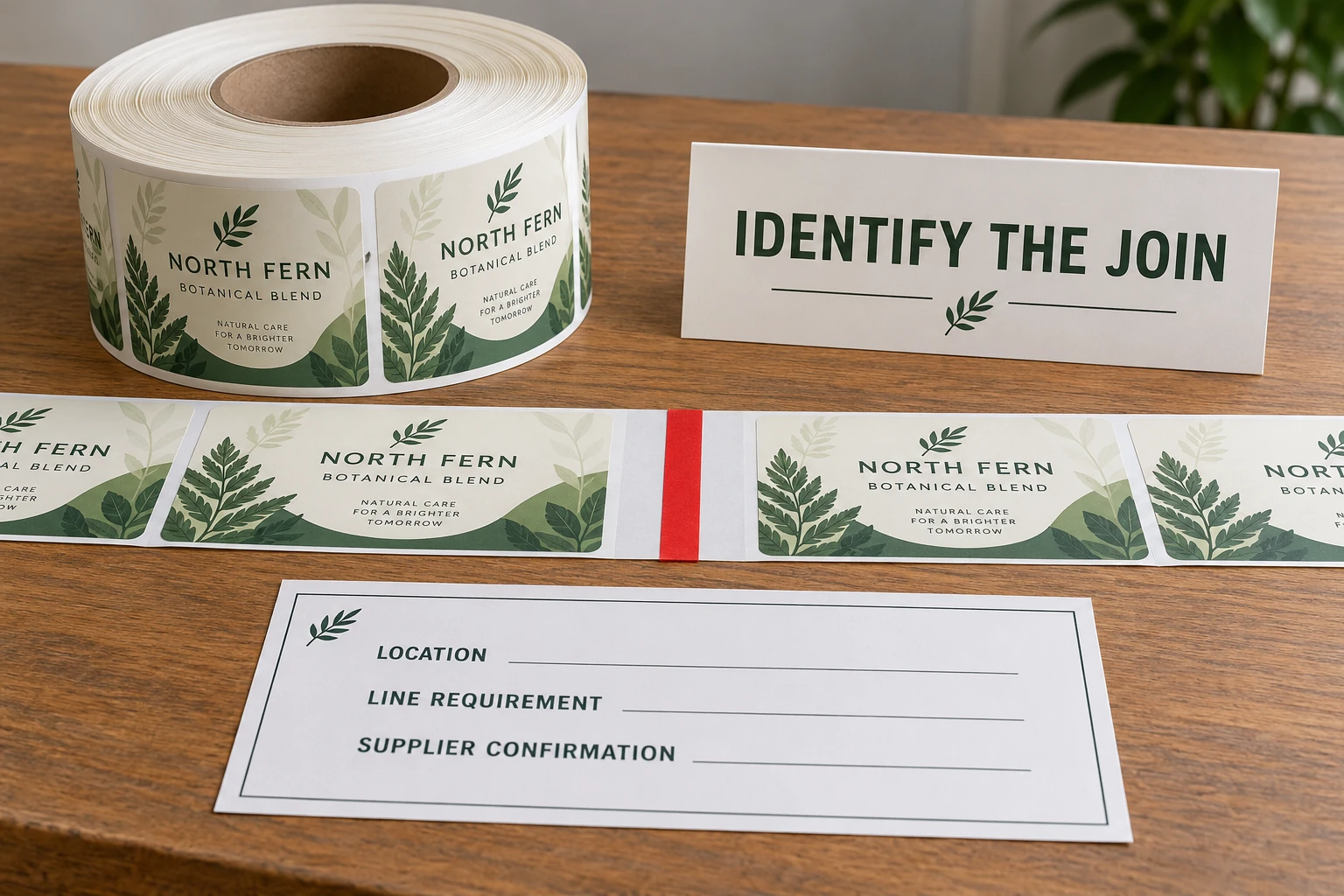
Make the exception recognizable before loading
Agree how the supplier will identify an affected roll and what information receiving should retain. The useful record connects the roll to the order, artwork and confirmed exception. Do not depend solely on a particular color being understood by every shift.
Where the buyer requires a location reference or count, define what those fields mean and ask whether the supplier can provide them. An unconfirmed tracking field should remain pending rather than becoming a fabricated inspection result. Keep any requested photograph or sample tied to the actual proposed construction.
If an unexpected join arrives, preserve the roll identification and the purchase record. Refer the discrepancy to the responsible supplier and line owner before use. Avoid cutting, rewinding or modifying stock in a way that destroys the evidence before an agreed disposition. The permitted handling remains a matter for the responsible operation.
Keep usable quantity distinct from web length
If a join affects printed pieces, ask how those pieces are treated in the agreed usable count. This is especially important when the artwork contains controlled identifiers, a fixed assortment or another sequence that cannot be inferred from a total length of material.
Do not invent a standard allowance for missing labels. The purchasing and data owners must agree the required quantity basis and exception record. If a number cannot be assigned before manufacture, agree how the actual delivered information will be reported.
For serialized or other controlled data, the variable-data release guide addresses the separate reconciliation task. A mechanically acceptable join does not by itself prove that the supplied records are complete or correctly allocated.
Compare the options against the real consequence
One project may need a confirmed uninterrupted supplied roll. Another may be able to use a specifically identified join under the line owner's accepted conditions. Neither conclusion follows from calling the labels premium or economical. It follows from the actual application route and evidence.
If the requirement cannot be met in the proposed roll arrangement, ask about feasible alternatives. A different roll split or construction may deserve review, but could change handling, sampling or quotation scope. Do not promise a cheaper option or shorter delivery without the supplier's actual response.
The roll direction and core guide covers mounting and orientation. Keep that approved drawing with the splice requirement. Correct winding does not settle a join exception, and resolving a join does not approve an oversized roll.
Put the confirmation in the release package
Save the job and artwork identity, line requirement, proposed supplied condition, receiving identification and acceptance owner together. If the construction, equipment or data sequence changes on reorder, decide whether the earlier confirmation still applies. Do not silently carry an exception into a different job.
Use the custom roll label page for the supply discussion. Send ZC Labels a roll exception review brief with the actual equipment requirements, construction if known, size and winding drawing, quantities by artwork, any controlled data needs and the exact supplied-splice question. These inputs allow a specific supplier response. They are more useful than approving the roll from an attractive front-label proof.