
The printed labels have arrived, but the packing line will not use all of them this week. An open roll is left beside a loading door while the rest are stored with unrelated supplies. Before ordering more or blaming the next application problem on the adhesive, agree where the finished rolls will be kept, how a partly used roll is protected and which version the team should take next.
Ask the supplier for storage and handling instructions applicable to the actual label construction and packaging. General guidance can help frame the question, but a different face material, adhesive, liner or finished packing method may need a different answer. Storage before application is also separate from the conditions the applied label must later withstand.
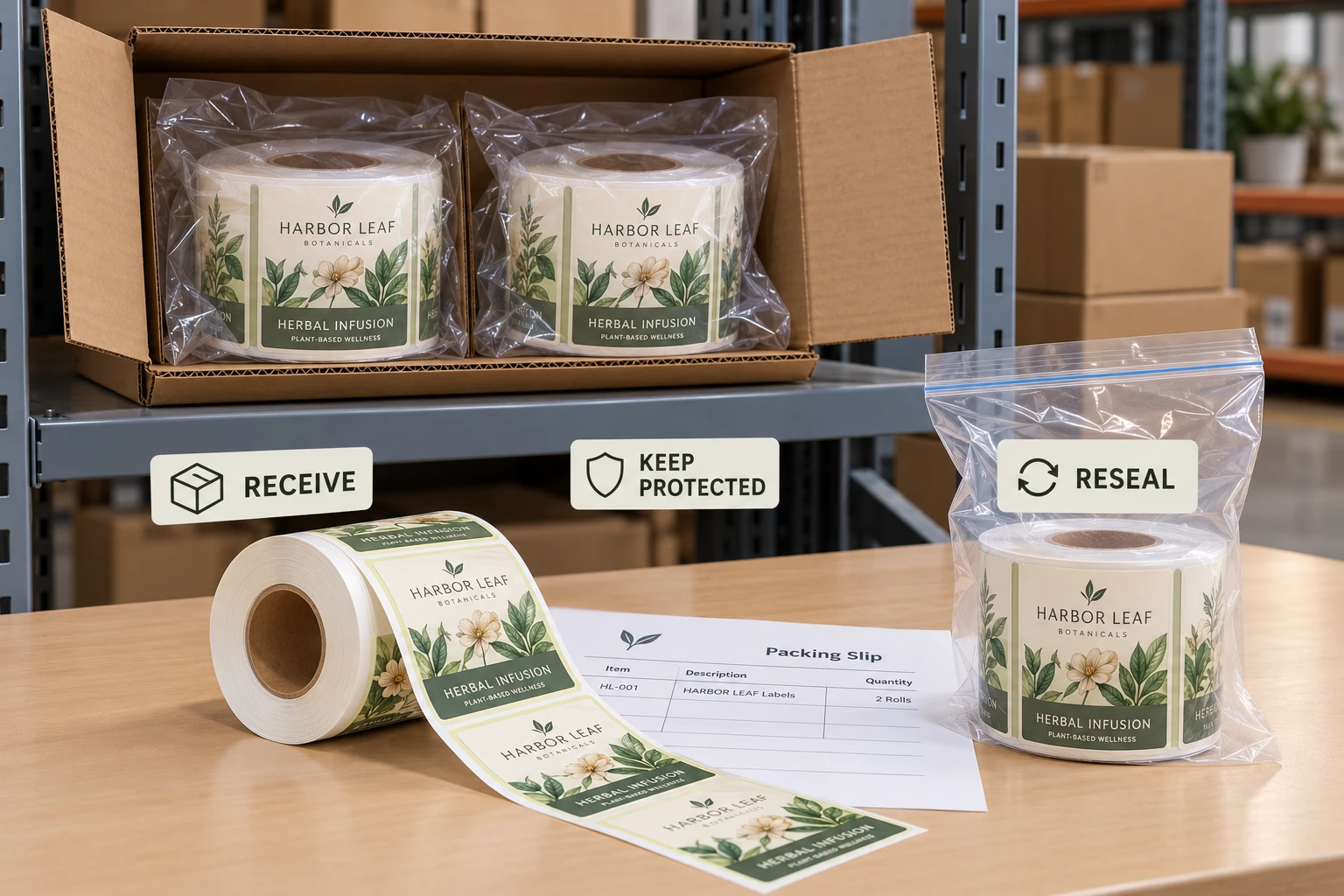
Make the receiving decision visible
Record the supplier's product or order reference, artwork version, quantity and receiving date. Keep the agreed storage instructions with that record. If several similar designs arrive together, identify each roll or its outer package so the operator does not need to open every bag to find the right version.
Check the delivery against the agreed packing and report damage or uncertainty to the supplier. A crushed carton, broken protective package or unclear identification is a reason to document the condition and ask how to proceed. A photograph can show the condition on receipt; it cannot establish how long the label will remain suitable.
The picture below is a fictional storage example. It shows finished rolls protected inside a carton and a partially used roll at a work area. It is a prompt to discuss receiving, storage and resealing, not a picture of an actual warehouse or an approved storage test.
Ask what protection the finished roll needs
The Avery Dennison storage bulletin distinguishes raw roll stock from finished labels and discusses protecting finished rolls from moisture, light and dirt. It gives recommendations for its materials and explicitly notes that many variables affect usable life. It is a useful discussion reference, not a ZC-specific warranty or a universal expiration date.
For the actual order, ask the supplier which packaging should be retained, the relevant storage environment, whether there is a stated usable period, and what to do after a roll is opened. Store and handle the rolls according to the instructions for that construction. If the buyer cannot maintain a recommended condition, describe the actual constraint and ask how it affects the proposed order and review.
| Handoff | Information to retain | Question to resolve |
|---|---|---|
| Receipt | Order, artwork and roll identification | Is the delivered item the approved version? |
| Storage | Supplier's instructions and original protective packaging | Can the stated conditions be maintained? |
| Opening | Roll identity and remaining quantity | How should the unused portion be protected? |
| Next use | Intended job and application reference | Is this still the correct released version? |
Avoid turning a general temperature or humidity value from a supplier bulletin into a blanket specification for every label. The proposed construction and the actual operating conditions control what needs confirmation. Likewise, do not turn a suggested stock-rotation habit into a promised shelf life.
Plan the partly used roll before the first shift ends
Ask who returns an opened roll, where it goes and how it is identified after use. Keep the original packaging and supplier instructions when appropriate; if the packaging is damaged or cannot be reused, ask for an acceptable alternative. Record the quantity remaining where that information is useful for planning, and retain the released design reference with the roll.
An illustrative packing team may use a single roll across several shifts. If the roll is removed from a machine between shifts, the operator also needs to preserve the application reference. A label that is well protected in storage can still be loaded incorrectly if its orientation is unclear. The roll unwind guide addresses the distinct machine setup question.
Do not infer from the image that a particular bag, carton, storage orientation or resealing method is approved for every construction. The supplier's instructions and the buyer's actual process determine the arrangement to review.
Keep old and new artwork versions from sharing a shelf label
If a product name or approved content changes, decide what happens to the remaining old labels before placing the new version alongside them. The owner may authorize use, hold the older stock or determine another disposition. Record that decision; a familiar color or logo is not proof that the copy is current.
The sticker reorder checklist covers classifying a changed artwork or packaging reference. Here the narrower task is making the correct released roll identifiable during storage and issue. If a roll cannot be identified reliably, hold it for the responsible person's decision rather than guessing from a partial visible label.
Review the tradeoff before setting order quantity
Ordering more at once may change the quoted unit economics, but it also increases the amount of finished stock that needs suitable space, identification and version control. Smaller releases may reduce stored stock while creating additional ordering and handling work. Ask the supplier for the actual options and compare them against your expected use; do not assume a particular minimum, price or lead time.
If the storage history is uncertain or the product has passed a supplier-stated review date, consult the supplier and the responsible buyer before use. Inspecting appearance may be useful, but it does not by itself validate adhesive performance. Agree what further review is appropriate for the actual product and application.
Bound an uncertain storage event before issuing the roll
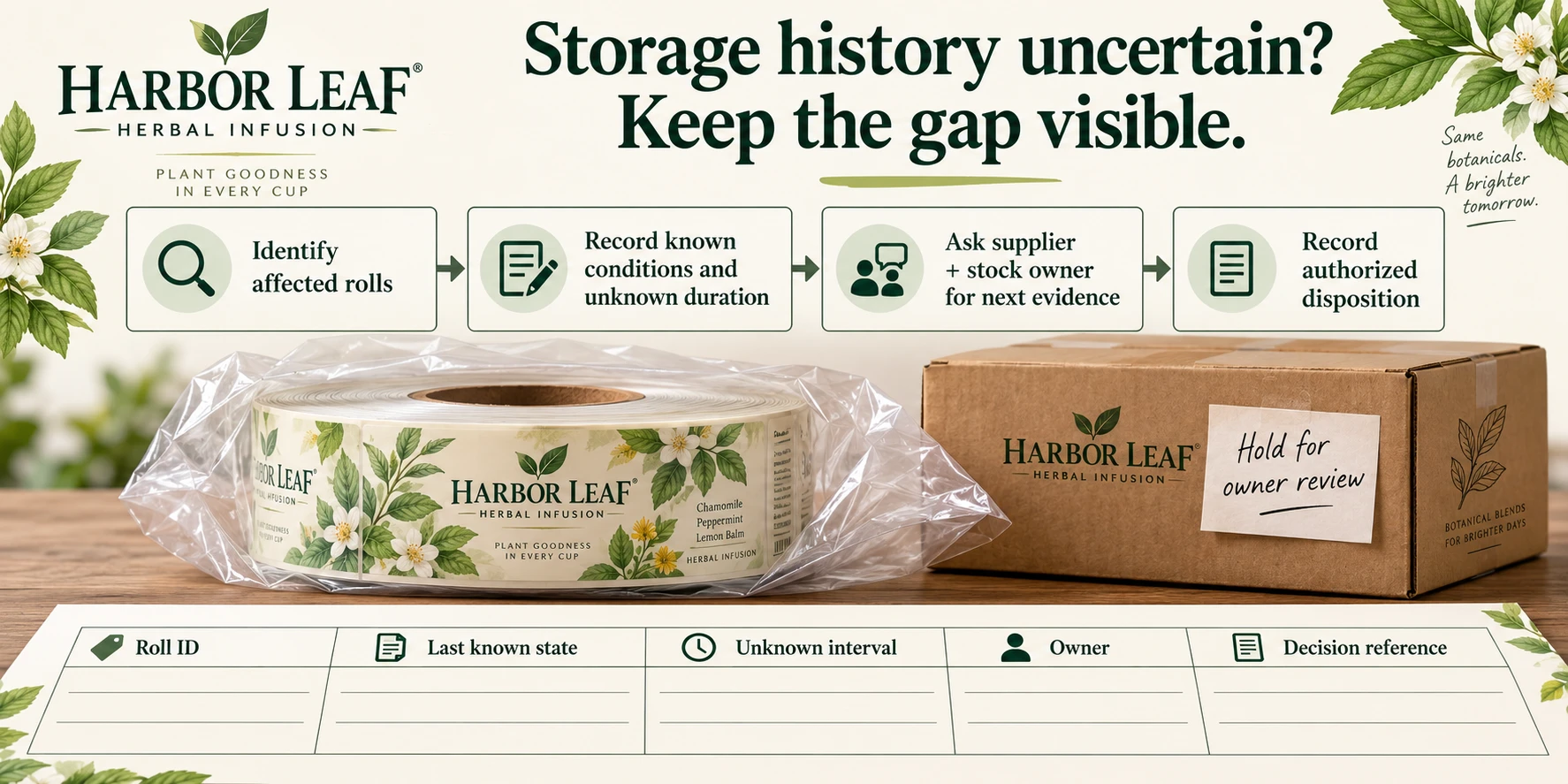
If a roll has moved through an unknown environment, preserve that uncertainty rather than assigning a convenient start time. Identify which rolls were actually present and which are merely stored nearby. Keep their order, construction and artwork references connected to the event; a general note saying the warehouse was hot cannot identify the affected stock.
Record the last known protected state, the next known observation and any information available between them. If the duration, environment or whether the bag was open is unknown, say so. A photograph taken afterward can show condition at that moment, but cannot reconstruct the entire interval or establish that unseen adhesive behavior is unchanged.
| Excursion field | Record to retain |
|---|---|
| Affected stock | Identified rolls and their construction/artwork references |
| Known conditions | Actual observations, location and relevant records |
| Unknown interval | Missing duration or conditions, kept explicit |
| Current disposition | Hold or other owner-authorized status |
| Next evidence | Supplier advice or agreed representative review |
| Final authorization | Responsible owner, scope and decision reference |
Ask the supplier and the buyer's stock owner which further evidence is appropriate for the actual construction and application. A visual inspection may be one input. It is not a substitute for a required physical review, nor a reason to discard every roll automatically. Keep the affected stock identifiable while that decision is pending, using the buyer's own approved handling procedure.
Avery's storage guidance for its 5667 label sheets discusses original packaging and sensitivity of layflat to environmental changes. Its product scope is limited: it does not establish an excursion limit or usable-life decision for these rolls. Obtain instructions for the proposed roll itself.
An illustrative operation could know that a bag was closed before a weekend and find it open afterward without knowing when it opened. Record that bounded gap. Do not replace it with a claim of a measured two-day exposure. Once the relevant reviewers authorize a disposition, retain what that decision covers and any conditions left open. If the stock cannot be identified, resolve that identity gap before using an attractive appearance as evidence of suitability.
For a roll label storage and order review, send the artwork and label construction if known, intended application method, expected rate of use, storage environment, packing needs, quantities by version and destination. Use the custom roll labels page to discuss the supply format. These details help the supplier explain the applicable packing and storage conditions before stock arrives.