
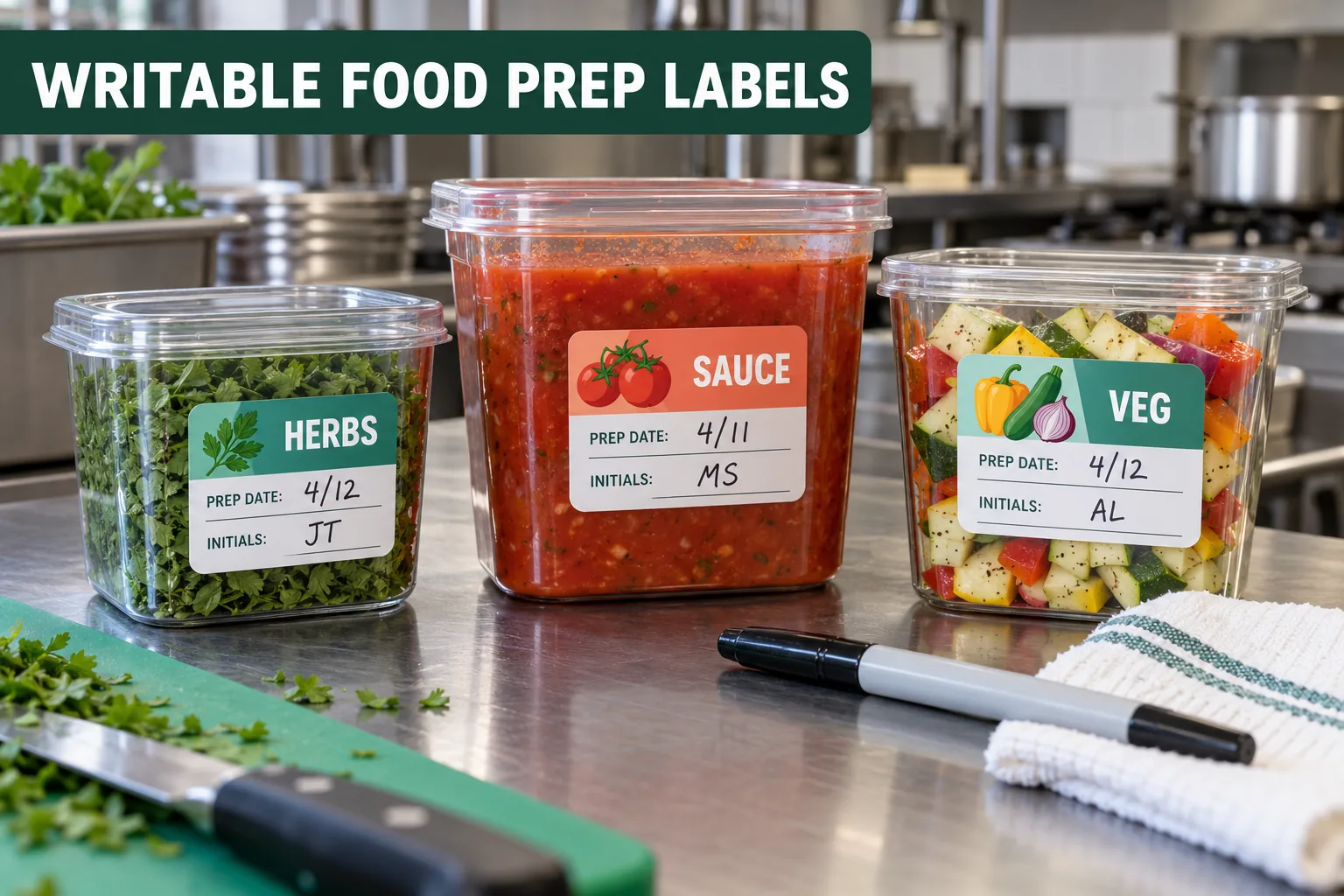
A clear tub moves from prep bench to walk-in cooler, then into the hands of another shift. If the label says only 鈥渟auce鈥?in damp handwriting, the next worker has to ask what was made and when. I would design the writable food prep label around that hand-off, not around a pretty empty rectangle.
Decide which information is always printed and which is added each day. A simple original herb icon can help staff identify a family of contents, but the product name, date fields and initials need most of the space. The kitchen must approve its own date-control rules; a label supplier cannot decide how long prepared food remains usable.
Start With the Container and the Writing Tool
| Question | What to test | Why it matters |
|---|---|---|
| Where is the label applied? | Real dry or chilled container | Surface and temperature affect hold |
| What writes the data? | Actual pen, marker or printer | Ink may smear on the coating |
| Who reads it next? | Container on a crowded shelf | Text must be visible at working distance |
| How is it removed? | Normal wash or disposal routine | Residue can slow reuse |
Try the longest realistic product name and the messiest plausible handwriting on a full-size proof. Small fields encourage abbreviations that different shifts may not understand. Leave enough contrast for a black pen without making the printed artwork so dark that fresh writing disappears.
Trial the Full Kitchen Cycle
Apply sample labels after the same surface preparation staff normally use. Write on them, place them in the cooler, handle them with damp hands and wipe the container as usual. Then remove the label using the actual cleaning method. A sample that looks excellent on a dry desk proves very little about a reusable kitchen tub.
Paper, film and removable adhesive are options to review, not universal answers. The container may be polypropylene, glass or stainless steel. A label can hold well on one and fail on another. If the kitchen uses thermal-transfer or direct-thermal printing for variable data, confirm that printer, ribbon or printhead and label construction together.
Make Version Control a Shift Habit
Keep the date format and field order consistent across batches. If the business changes its prep procedure, retire old rolls rather than leaving two label versions beside the printer. The human cost of inconsistent fields is the pause before someone trusts the container.
- Send a photo of the actual filled container
- List fixed text and changing fields separately
- Test the intended pen or printer at final size
- Check legibility after cold and damp handling
- Trial removal with the real wash routine
- Approve date wording through the food business
Use the removable adhesive guide to frame cleaning questions and the overprint guide if data is added by printer. Send container photos and approved field names through the label specification planner. The best prep label makes the next shift's decision easier.
Questions Before You Order
Can any marker write on a food prep label?
No. Coating, ink and moisture affect drying and smearing. Test the actual pen or printer on the proposed label after the normal storage interval.
Should the label be removable after washing?
That depends on the container reuse process. Trial adhesion during use and removal with the real cleaning method before specifying a construction.
Who decides the date wording?
The food business owns its date-control procedure and market-specific requirements. The print supplier should reproduce approved fields, not assign shelf life.