
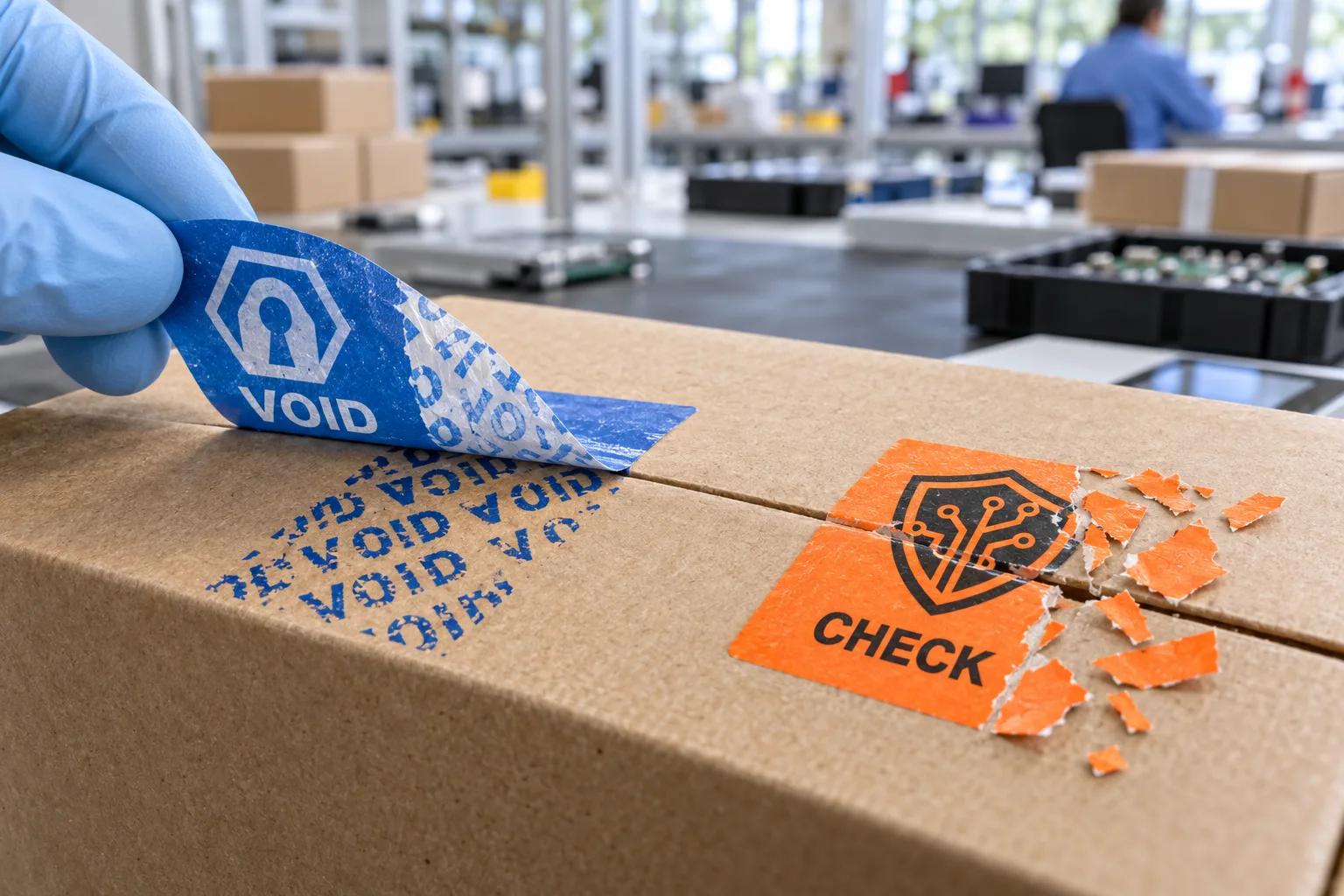
The word "security" sounds reassuring on a quote sheet. It tells me very little about what the receiver will actually see. Imagine a small electronics carton: the closing flap lifts, and the warehouse needs to decide whether the carton has been opened. A label that looks impressive while intact but peels away without a useful trace has missed its job.
I would start by asking what evidence the buyer expects after an attempted lift. A VOID-style construction aims to leave a visible transfer message or pattern. A destructible construction aims to fragment rather than come away in one neat piece. Neither description is a guarantee on every box. The face stock, adhesive, surface coating, time after application and opening motion work together.
Test the Seal on the Real Closure
Use the production carton or container, not only a supplier's demonstration sheet. Apply samples across the exact flap or cap position. Try an ordinary opening, a slow corner lift and handling after the pack has spent time in its expected storage environment. Photograph the intact seal and the attempted opening. Decide whether the residue or fragment is obvious to a person checking many packs quickly.
A heavily coated carton, textured paper or dusty plastic may behave differently from smooth test film. If a seal bridges two moving panels, check whether normal shipping flex makes it fail before the customer opens the pack. That is a false alarm, and repeated false alarms make any evidence system less useful.
Design for Inspection, Not Decoration Alone
Print a complete original mark, a clear inspection cue and, where useful, an approved batch or serial field. Do not rely on tiny security wording that disappears at the final size. Keep the artwork away from the engineered evidence area unless the label supplier confirms the effect remains visible. A box may need a separate product label and a smaller security seal instead of forcing both jobs into one crowded sticker.
The product owner should define the inspection rule: what counts as opened, who photographs the result and what happens to an exception. A tamper-evident label cannot establish chain of custody by itself, and it should not be marketed as tamper-proof.
- Send the actual packed carton and closure location
- Describe the evidence the receiver must notice
- Trial both constructions on the real surface
- Check shipping flex and intended storage
- Approve visible artwork at actual size
- Document the inspection decision
Our tamper-evident label overview covers the wider buying decision. For closure geometry, compare the jar seal and shrink-band guide. Send the package, a photo of the closed flap and the desired evidence result through the quote form.
Questions Before You Order
Are VOID and destructible labels interchangeable?
No. A VOID design is intended to reveal a transfer pattern when lifted under suitable conditions, while a destructible construction is intended to break apart. Results depend on the complete label and the application surface.
Will either seal prove that nobody opened a package?
No. A seal is one part of a packaging and inspection process. Test the proposed construction on the actual carton, closure and handling route.
Can a security label be applied across a fold?
It may be possible, but corners, coatings and opening forces can change the result. Test the final placement on packed samples before approval.