
The buyer wants separate letters on a glass door with no visible rectangle around them. The quotation says clear sticker. A clear printed panel may communicate the design well, but it still leaves a continuous film between the letters. The intended finished result has not been specified.
Before ordering transfer tape decals, identify what remains after installation. Individually cut graphic elements can be held in position by a temporary application carrier. A printed sticker normally carries its artwork on a retained face film or paper. Both can be appropriate; the decision concerns the installed construction and the user's application task.
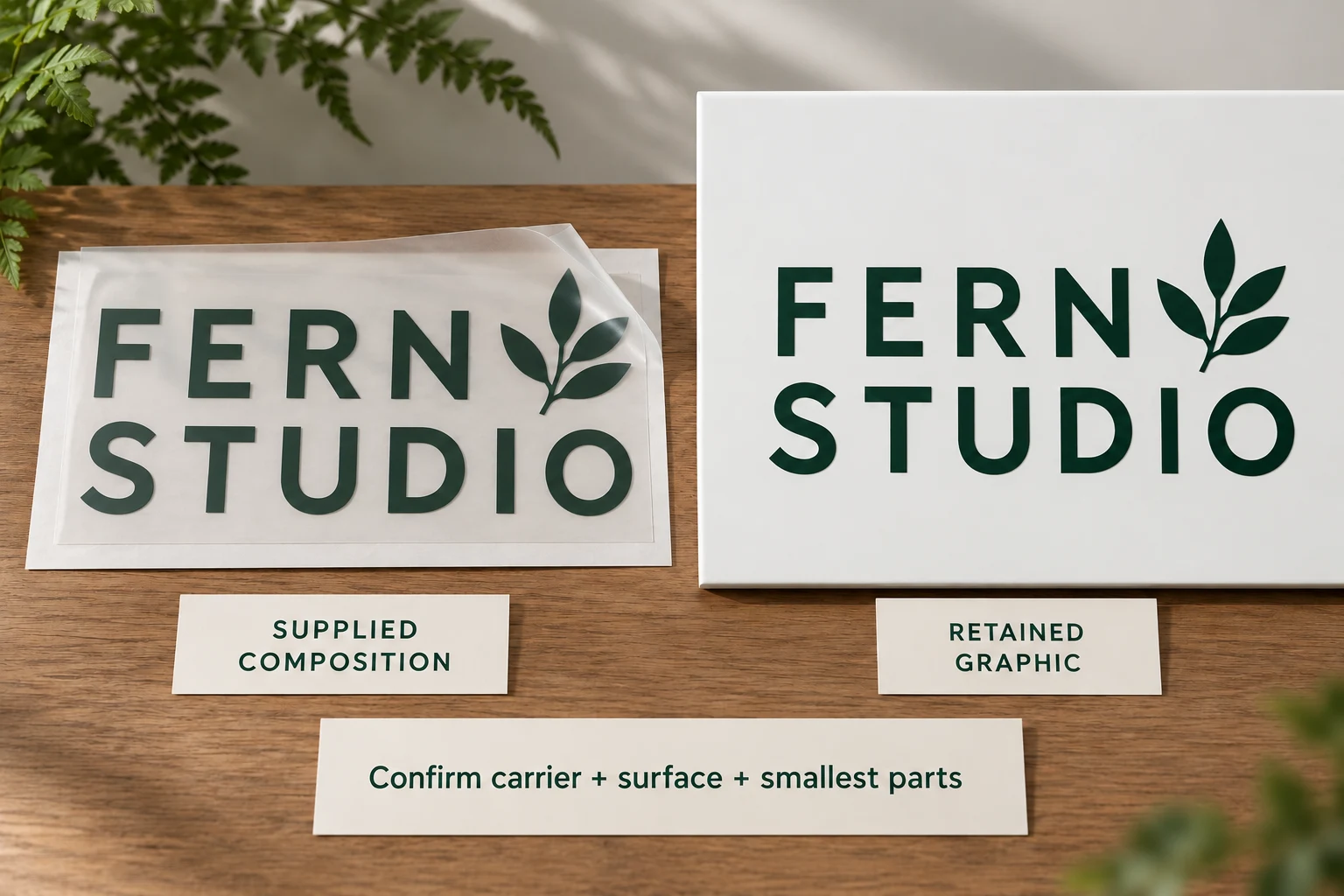
Draw the installed result first
Mark the parts intended to remain on the surface and the open spaces between them. If the buyer wants disconnected letters, a small dot and a botanical symbol placed as one composition, show their relative positions. State whether a continuous clear face film is acceptable or whether the gaps must remain physically open.
A visual mockup cannot settle that distinction by hiding the edge of transparent film. Keep the retained elements and any temporary carrier identifiable on the enquiry. The delivered product may have several layers even when the final appearance looks like separate marks directly on glass.
Avoid using the phrase transfer sticker without a description. It can be confused with heat-transfer products, dry transfers or other systems. This guide concerns pressure-sensitive graphic elements applied with a temporary carrier. If another process is intended, name it and request the relevant supplier instructions.
Separate backing, graphic and temporary carrier
Ask the supplier to explain the actual supplied arrangement. For a proposed cut-graphic route, identify the release backing, the graphic elements and the application tape or other temporary carrier used to preserve their layout. The carrier is not automatically part of the final graphic.
3M's application-tape bulletin describes tapes used to support graphics and aid registration of cut parts, with recommendations tied to particular film constructions. It does not establish that every tape works with every printed or cut film, or that ZC Labels supplies the named materials.
Keep the complete supplied sample when discussing feasibility. A loose letter can show color and shape while leaving the transfer sequence unreviewed. An attractive finished photograph can hide an unsuitable pickup or carrier-removal step.
Review the smallest element through the whole sequence
Choose the narrowest stroke, smallest dot and closest spacing that matter to the design. They can behave differently from a large solid word. Ask the converter to review the actual artwork and proposed material before turning one supplier's minimum dimension into a universal rule.
The relevant sequence includes removal of unwanted surrounding material, pickup from the backing, positioning on the real surface and removal of the temporary carrier. Identify which parts the supplier completes before delivery and which parts the installer performs. Do not silently move a difficult finishing step to the buyer's staff.
| Design feature | Procurement question |
|---|---|
| Narrow strokes | Can the proposed construction be converted and transferred as intended? |
| Separate dots or symbols | Does the supplied arrangement preserve their positions? |
| Tight internal spaces | What is removed, retained or simplified? |
| Long composition | Can the installer align and handle the complete piece? |
| Printed or protected face | Is the temporary carrier appropriate for that finished surface? |
If a detail cannot be supported, compare a visible change before approval. A slightly heavier stroke, connected design, separate installation section or printed-panel route changes the product differently. The buyer should choose with those consequences visible, rather than discover a missing dot after installation.
Compare a printed panel fairly
A continuous printed sticker can preserve intricate multicolor artwork without separating every component. It also leaves a physical background film, which may be clear or opaque. The buyer needs to decide whether that perimeter and the material between letters are acceptable in the final setting.
Cut elements can create physically open gaps but may introduce extra conversion and installation work. Multiple colors may require another arrangement that the supplier must confirm. Do not assume the process is automatically cheaper or more durable because less visible film remains.
The clear-versus-white comparison addresses background appearance. The cutline guide addresses the physical boundary. Neither replaces the decision here about which layers and disconnected elements arrive together and remain after installation.
Give the installer the actual surface and reference
Send the contact finish, dimensions, viewing side, placement and relevant environmental conditions. Have the surface owner approve compatibility where needed. A door, painted panel and coated display can present different requirements even when all appear smooth in a photograph.
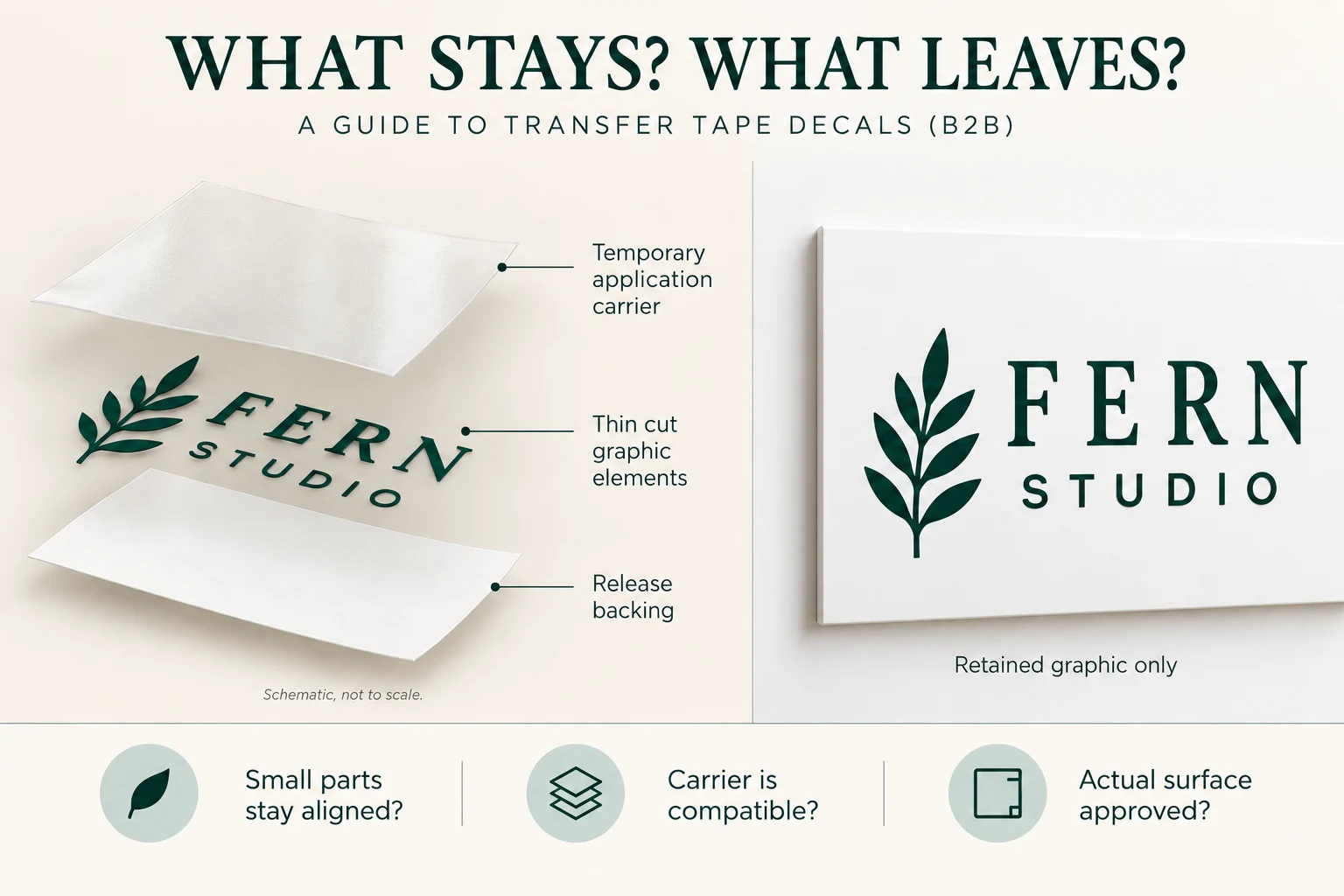
Ask which application and carrier-removal instructions apply to the identified construction. This article does not prescribe a universal angle, dwell, fluid or temperature. Instructions for one film and tape combination should not be transferred to another without confirmation.
Review a representative complete sample with the intended installer when the handling decision matters. Observe pickup, layout and the retained elements under agreed conditions. Record any missing or lifted part as an observation for the supplier, not immediate proof of one material fault. Keep unsuccessful examples identifiable as well as the neat final piece.
Approve both the supplied and installed states
Save the final-size artwork, retained-element map, material and carrier references, placement drawing and accepted review scope. Include whether the buyer receives a finished prespaced composition or another supplied state. A photograph of the peeled graphic is insufficient when the purchase also includes a handling carrier.
If the design, finish or smallest features change on reorder, identify which conversion or application checks need repeating. Where separate letters are not essential, a printed panel remains a legitimate alternative. Where physically open gaps define the design, keep that requirement explicit through quotation and proof approval.
For the custom graphic supply discussion, send the original artwork, final dimensions, smallest important features marked, intended open gaps, surface photographs, installation arrangement, quantities and destination through the graphic project enquiry. Ask whether the proposed transfer construction and supplied state are available for the job. Those inputs let the supplier assess a concrete installation task instead of guessing what the buyer means by a clear or transfer sticker.