
The shop wants to move a promotion between windows and use it again later. The artwork brief says removable window sticker. That still leaves the main purchasing decision open: should the graphic use a pressure-sensitive adhesive, or an adhesive-free cling construction intended for the actual pane?
Start with the installation, removal and storage sequence. A static-cling direction may be worth reviewing for a suitable temporary window application. An adhesive direction may fit another retention requirement. Neither can be approved from the word reusable or from a photograph of a clean window.
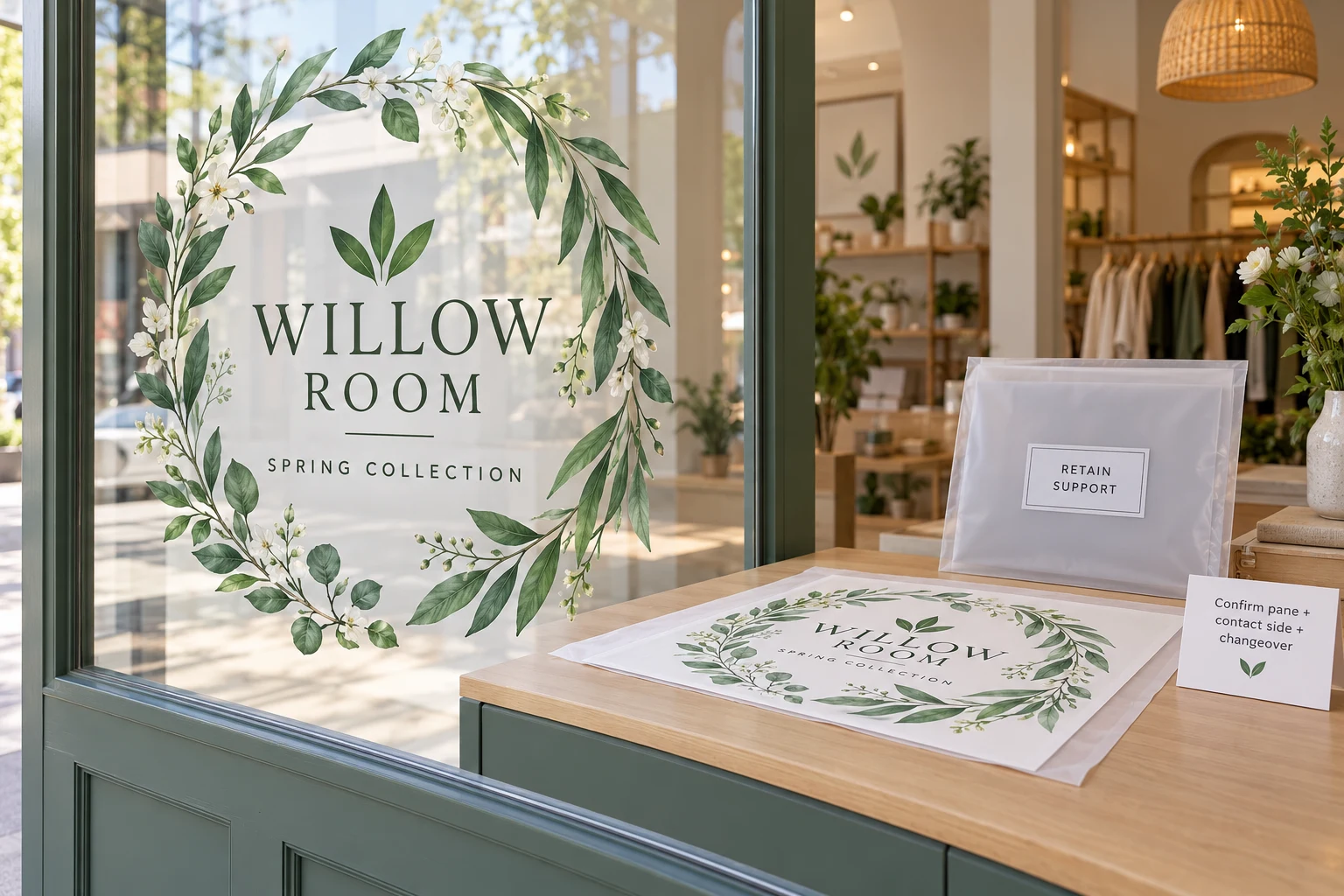
Define what the next campaign asks the material to do
Write the full route: receive the graphic, apply it, keep it in place through the campaign, remove it, store it and possibly apply it again. Name who does each step. A graphic removed and discarded at the end of an event has a different requirement from one that returns to a store cupboard between displays.
Ask how many changes are genuinely expected, without turning the planning number into a promised reuse rating. The buyer needs the supplier to evaluate an intended route. It does not need an invented guarantee that the same piece works indefinitely.
If the campaign remains in one place, do not select reuse capability simply because it sounds better. Compare the relevant retention, appearance, labor and removal requirements. If repeated moving is essential, a one-time removal observation is an incomplete approval even when the pane looks clean.
Identify the contact surface and the supported construction
Obtain the actual pane information from its owner: glass type and any coating, treatment, texture or applied film relevant to the proposed graphic. Include photographs from the viewing and application sides, plus the proposed graphic footprint. A neighboring shop's window is not a representative specification.
Nekoosa's Hi-Stat overview describes a particular flexible cling film that attaches to suitable clean, polished surfaces without adhesive. It also warns against placing that product's printed side against glass because ink may transfer. This illustrates why contact side and print route need confirmation for the identified product. It is not a claim about a ZC Labels material or every cling construction.
For an adhesive proposal, identify the full film, adhesive, print and protection arrangement. Removable adhesive remains an adhesive system whose result depends on the surface and conditions reviewed. Adhesive-free and removable-adhesive are useful distinctions in a quotation; they are not synonyms.
Keep the outside view separate from the contact side
An inside-mounted graphic read from outside needs a controlled viewing reference. Identify which side touches the pane, where the printing sits and how the message should read from the intended audience position. Do not flip the only artwork file and assume that solves every construction question.
The reverse-window printing guide covers viewing direction and white support in detail. Settle the attachment and changeover route here, then connect it to that print plan. A graphic can have the correct outward-facing message while using a construction that has not been reviewed for its contact side.
If both sides must carry different readable messages, tell the supplier. That introduces another construction and opacity question. A single-side sample does not approve the unseen side, nor establish that one message will not interfere visually with the other.
Ask for a representative removal and return-to-use review
Agree what the sample is intended to demonstrate and what conditions it will represent. Keep its material identity, printed side, pane and application method recorded. Follow the material and glazing instructions supplied for that combination; this article provides no universal cleaning fluid or wet-application recipe.
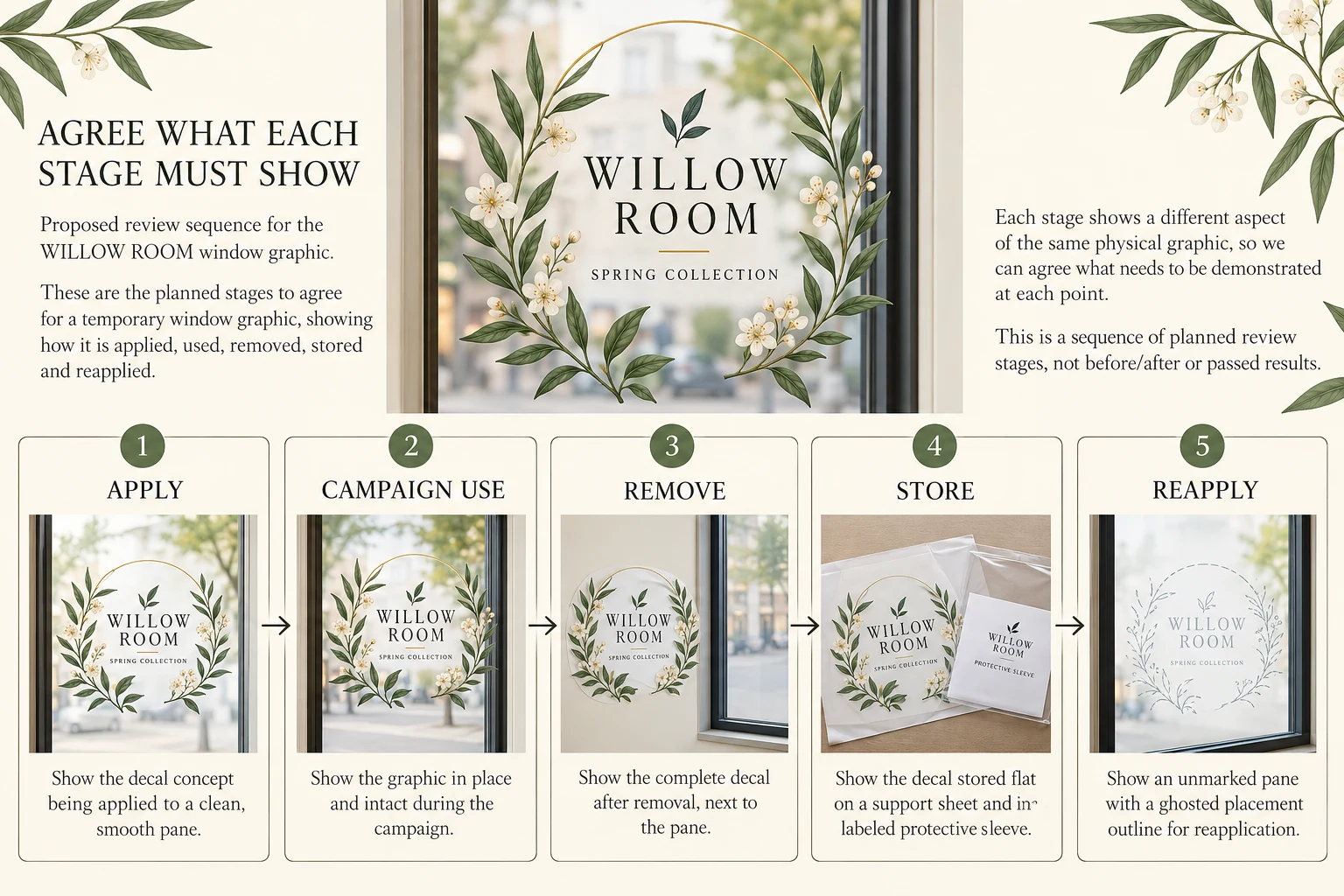
| Review stage | Question for the buyer and supplier |
|---|---|
| Initial application | Is this the identified pane, contact side and supported method? |
| Campaign use | What relevant duration and conditions were observed? |
| Removal | Is the agreed surface and graphic condition acceptable? |
| Storage | What support, protection and handling does the material require? |
| Return to use | Does the identified piece remain suitable for the next agreed application? |
If storage is part of the task, request the supplier's instructions for the actual product. Ask what liner or support should be retained and what contamination or damage would require review. Do not write a general instruction to wash, fold or roll every cling graphic. Those actions can change the reference and may be unsuitable for a proposed construction.
Compare the work as well as the material price
One proposal may make removal straightforward but require more deliberate storage. Another may be intended for a single campaign with a confirmed removal method. A different size or mounting approach may be easier for staff to handle. Compare those consequences using actual quotations and the people doing the work.
If employees must relocate a large graphic alone, describe that constraint early. A sample held flat by two people at a meeting may not represent the normal changeover. Conversely, a professional installer may have a different suitable process. The aim is a supported arrangement for the real user, not a universal ranking of adhesive-free film over adhesive film.
Where neither proposal suits the pane or intended movement, discuss an approved alternative display route. An insert in a separate holder can move the changing information away from direct glass contact, but introduces its own mounting, viewing and component questions. It remains an alternative to evaluate rather than a service promised here.
Release the campaign and material reference together
Retain the accepted construction, outside-readable artwork, pane identity, placement and observed changeover route. Record unresolved limits. If the graphic size, glazing, printing or storage routine changes, ask which observations need repeating before reusing the old approval.
The retention and removal guide helps specify the required surface after removal. Keep that result separate from whether the graphic itself is fit for another application. A clean pane does not prove a reusable graphic, and a reusable-looking piece does not establish acceptable treatment of the pane.
Use the custom decorative-label project route to explain the intended graphic. Send pane and application-side photos, glass-owner information, artwork dimensions, viewing direction, campaign duration, relocation and storage plan, quantities and destination through the window-graphic enquiry. Identify whether you want cling, removable adhesive or a comparison, and ask which routes are available for the project. These details allow a feasibility discussion before the artwork is committed to an attachment method that cannot perform the intended changeover.