
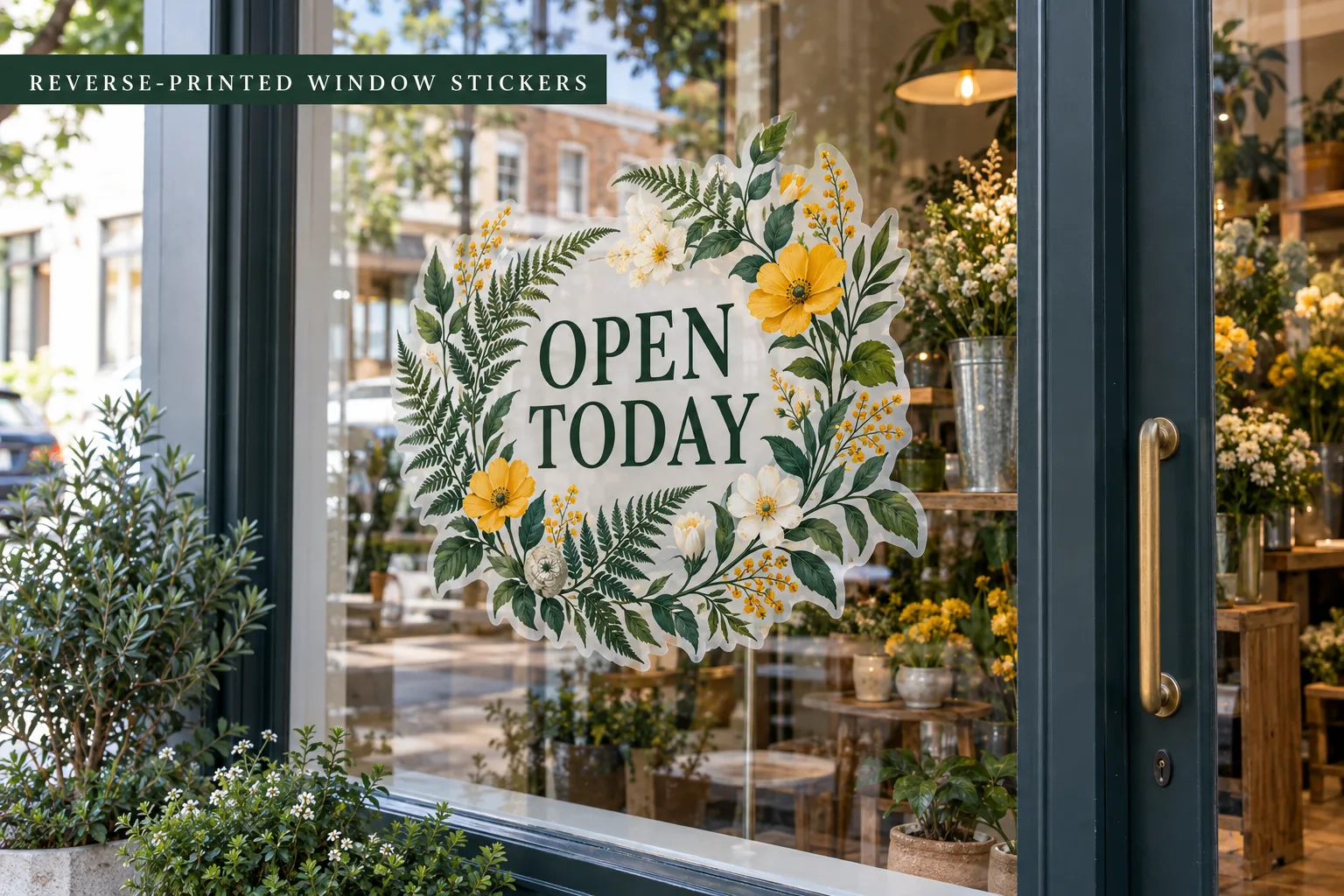
A shop owner may love a window graphic on a white PDF and wonder why it disappears on the street. Behind the glass are shelves, reflections and a bright afternoon sky. The message needs to survive all three. I would start with a photograph taken from the pavement, at the distance where a passerby first sees the window.
An inside-glass sticker is usually printed in reverse so the adhesive faces the glass and the artwork reads normally from outside. That sounds simple until the proof is mirrored the wrong way, the white backing covers an area meant to remain clear, or a door handle hides the opening hours. Mark the street side and application side directly on the proof.
Map the Actual Viewing Conditions
| Question | What to send | What to proof |
|---|---|---|
| Where will it sit? | Photo of the exact pane with dimensions | Handle, frame and eye-level position |
| Who reads it? | Street-side viewing photograph | Legibility at normal walking distance |
| What sits behind it? | Day and evening background photos | Color and white-ink contrast |
| How long will it stay? | Campaign dates and removal plan | Suitable sample and cleaning method |
Keep the first message short. An original leaf illustration and clear OPEN TODAY lettering might work for a small cafe; a dense menu will not become easier to read because it is printed sharply. Use the smallest realistic size, not a magnified screen view, to check thin strokes and letter spacing.
Decide Where White Ink Belongs
On clear film, some colored areas remain translucent. A white underprint can give important words and illustrations a solid base while leaving other areas transparent. Ask for a proof that marks the white layer separately. The same artwork can look different against a dark shop interior, a pale display or backlighting after sunset.
Do not describe every window as suitable for the same construction. Tinted, coated, textured or treated glass can change the result, and a film may not be appropriate for some glazing. The installer or glass owner should confirm compatibility. Test the proposed construction on a representative pane before committing to the full run.
Make Installation and Removal Part of the Order
Measure the clean, usable glass rather than the full frame opening. Decide whether staff will hand-apply a few pieces or an installer will place a larger graphic. Ask for an application method that matches the material. If the campaign is temporary, agree on who removes it and how the pane will be cleaned afterward.
- Mark inside and outside on every proof
- Send exact pane dimensions and street-side photos
- Identify handles, frames and any sightline obstruction
- Proof white ink and small text at final size
- Trial adhesion and removal on the real glass
- Inspect the installed sample in daylight and after dark
Compare clear film with white vinyl before choosing opacity, and use the white ink guide when fine type matters. Send your window photographs and intended campaign duration through the label specification planner. A good window sticker starts with the view from the other side.
Questions Before You Order
Which side of the window receives a reverse-printed sticker?
The adhesive usually goes on the inside so the artwork reads correctly from outside. Confirm the glass construction and the intended viewing side in the proof.
Is white ink always needed on a clear window sticker?
No, but transparent colors can lose contrast against a changing background. Proof a white backing option against the actual window and lighting.
Can an inside-glass sticker be removed cleanly?
Removal depends on adhesive, glass surface, dwell time and cleaning method. Trial a sample on the real pane and agree on the removal process.