
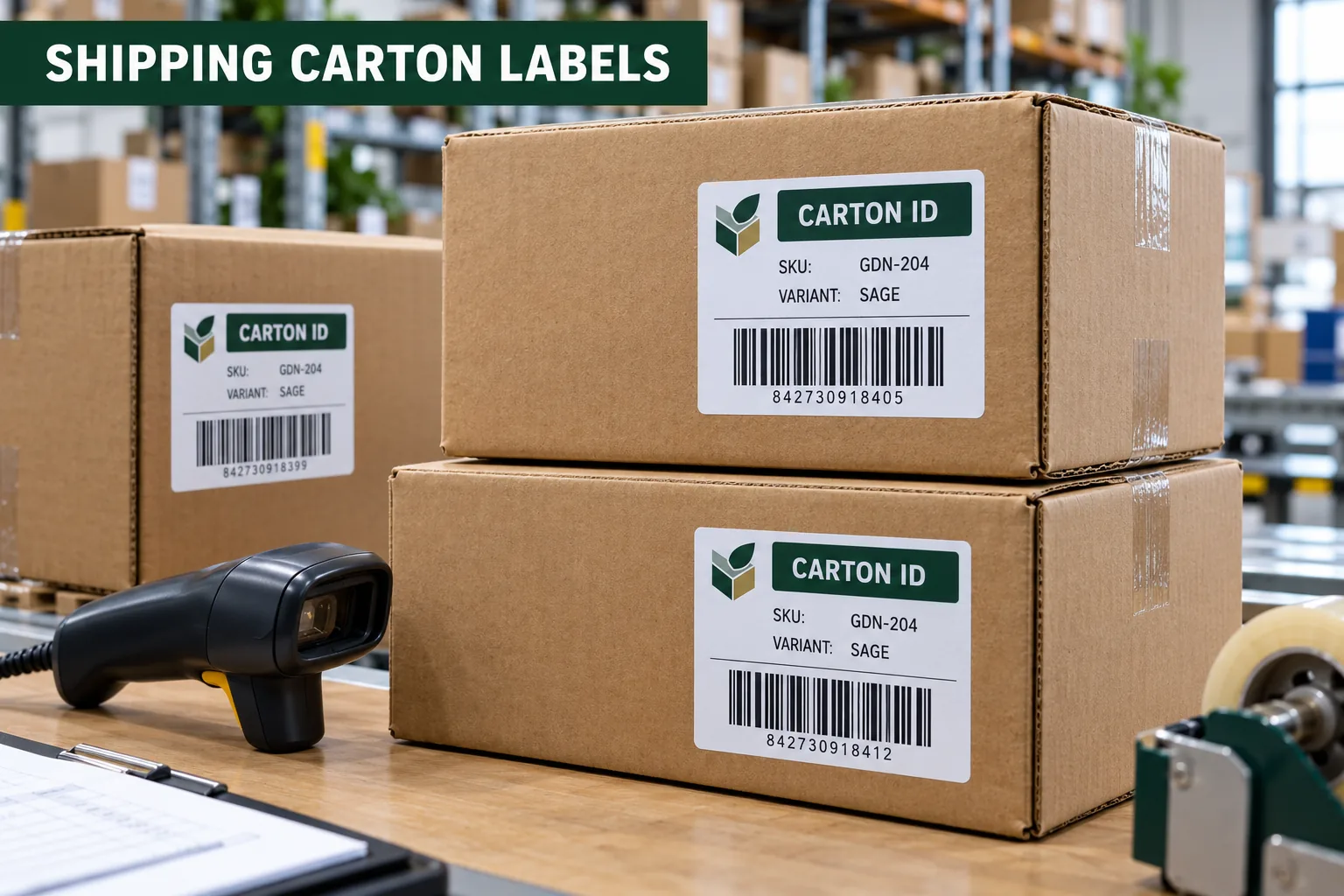
A warehouse carton is rarely viewed straight-on under perfect light. It is stacked, turned, taped and sometimes checked in a hurry at the dock. A useful shipping carton ID label gives the next person a predictable place to find the right SKU and shipment reference. I would stand where the receiver stands before deciding which box face gets the sticker.
Separate product identity from shipment-specific data. The brand may print a fixed original icon or product family cue, while SKU, variant, lot or destination information changes. The shipping or product owner must define those identifiers and any barcode format. A label printer should never invent a code that merely looks scannable.
Choose a Face That Survives Packing
| Carton feature | Risk | Check |
|---|---|---|
| Tape seam | Opening damages the code | Place away from tape edges |
| Box corner | Label wraps or creases | Use a stable flat panel |
| Stack orientation | ID disappears inside a pallet | View the real stack |
| Corrugated surface | Dust or roughness affects hold | Trial after packing |
Decide whether one face is enough or whether the warehouse needs two identical IDs on adjacent sides. More labels increase cost and application work, so make that choice from the actual storage and receiving process. Keep human-readable text near a code so a worker has a fallback when a scanner is unavailable.
Proof the Variable Data, Not Only the Frame
Test the longest expected SKU, a realistic variant name and several sample data records. Leave the quiet area around a barcode clear of borders, illustrations and box printing. Print the sample using the actual variable-data process, then scan it after the sticker is applied to the carton. Check the scan result against the visible text and the warehouse record.
The carton may pass through humid loading areas or rub against other boxes. Test the proposed material and adhesive on the production corrugate after normal taping and stacking. Do not claim universal warehouse durability from a desk sample. If labels are applied manually, the packing team needs a placement reference simple enough to repeat.
Control the Last Box in the Run
- Send the assembled carton and pallet photos
- Mark tape seams and preferred scan face
- Provide owner-approved SKU and barcode data rules
- Proof longest fields at actual label size
- Scan applied samples from normal working angles
- Define damaged-label reprint and mismatch handling
The variable ID guide covers data discipline, and the scan-testing guide covers code verification. Send a carton photo and approved data template through the specification planner. The carton label's real audience is the person who has to move the right box next.
Questions Before You Order
Can the carton label go across a tape seam?
Avoid assuming it can. Opening, tape edges and box movement can damage the label or code; test a stable panel on the assembled carton.
Can the printer create carton barcodes from a product name?
The shipment or product owner must supply the identifier rules and approved data. The label supplier should not invent codes or logistics standards.
Is a readable barcode on a screen enough?
No. Scan the final printed code on a real packed carton under the receiving workflow, including stacks and typical handling.