
One person asks for a smart label so warehouse staff can identify stock. Another expects a customer to tap the packaging for instructions. The artwork team adds a QR code. All three may be sensible requests, but they describe different interactions and can lead to different equipment, data and approval work.
Before comparing RFID, NFC or QR labels, describe the event the label must support: who captures what identity, with which device, at which stage, and what the receiving system must do next. Choosing a carrier before answering those questions can create an attractive label with no accepted operating route.
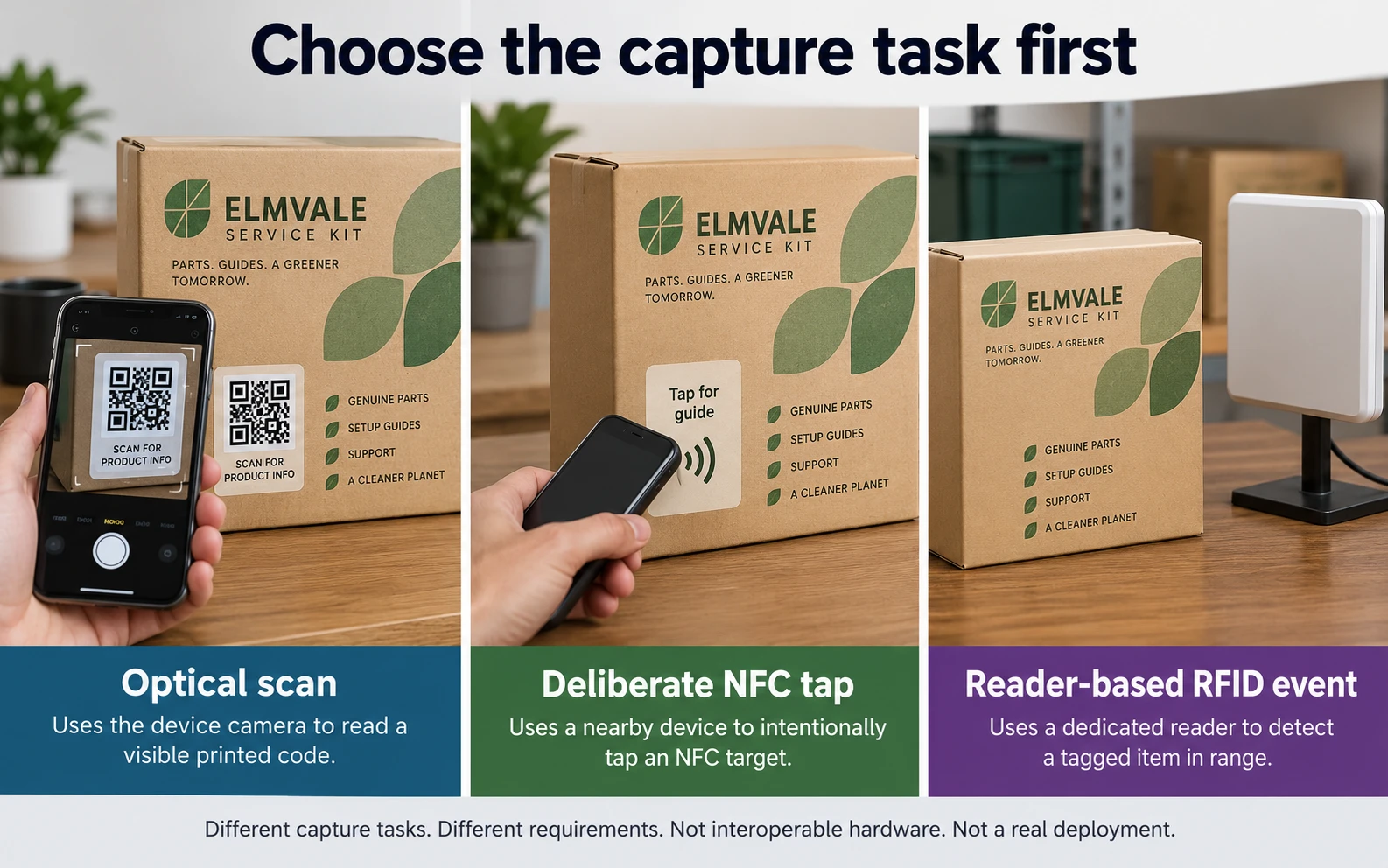
Write the capture event in one sentence
An operator deliberately presenting one item to a scanner is different from a customer opening a web page on a phone. Reading several tagged items through an established RFID process is another task. Name the required action rather than asking the technology name to select it.
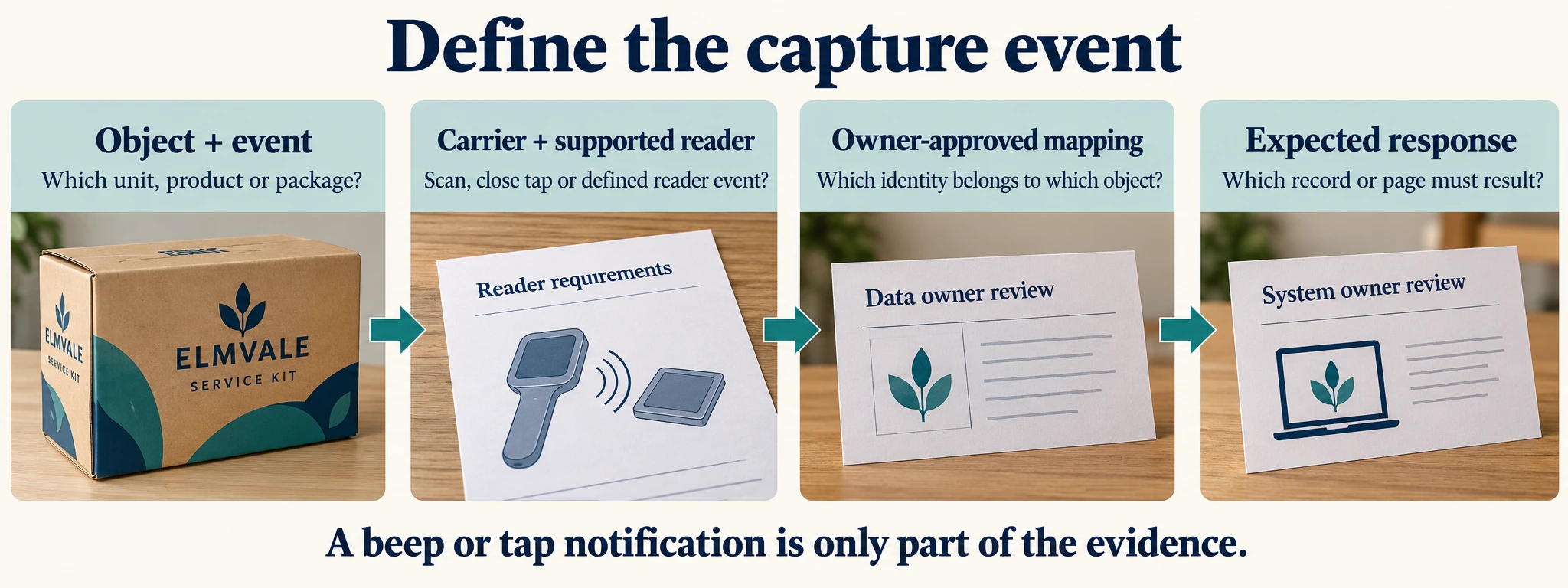
For each event, identify the object: individual unit, shared product type, carton, location or another controlled reference. Then identify the accepted output. A displayed number, an opened instruction page and a recorded inventory event are not equivalent results.
If two events are required, retain both in the brief. They may use more than one carrier, or share an identity under a deliberately designed system. Do not assume that one visible code must perform every job simply to reduce the number of graphics on the package.
Compare interactions before comparing label prices
Printed QR symbols are optically read and need an appropriate visible presentation. NFC uses a close, deliberate tap interaction with compatible hardware. A general RFID request needs further definition of the tag, reader and application; NFC belongs within the broader radio-identification landscape and should not be treated as an unrelated magic alternative.
The NFC Forum's technical overview describes its tap-centered operation and reader/writer interactions. GS1 Switzerland's EPC/RFID explanation describes a system containing a transponder and reader/writer, and separates the carrier from the identity it stores. These mechanisms explain why a printed artwork approval cannot approve the complete electronic system.
| Intended event | Evidence to obtain before label release |
|---|---|
| Deliberate optical scan | Supported reader, symbol/data requirements and final-package presentation |
| Customer or operator tap | Compatible device/task, target data and actual package interaction |
| RFID capture process | Identified tag/reader configuration, event rules and system acceptance |
| Several events on one object | Owner-approved relationship between every displayed or encoded identity |
Obtain actual equipment, integration and consumable costs from the relevant providers. A price for an ordinary printed sticker does not include an electronic inlay, encoding or data-system work unless those items are explicitly confirmed.
Keep identity separate from the carrier
Decide who assigns the product or individual identifier and who may change it. A carrier can contain a correct-looking value that refers to the wrong object. Copying the visible text into another technology does not establish that its encoding, namespace and receiving-system relationship are correct.
Use an owner-approved mapping that connects object identity, printed human-readable text, each encoded value and the intended system response. A URL may lead to information about a product family without uniquely identifying one unit. A serial may identify a unit without being an instruction-page address. Record which relationship the project actually needs.
The serial label control guide explains allocation and reprint ownership. Keep that discipline if the chosen carrier changes. Technology selection should not quietly create another uncontrolled source of identifiers.
Review the actual object and reading situation
Give the system provider representative package photographs, surface and contents information, placement constraints and the way objects are presented. Electronic tag suitability and reading behavior need confirmation on the actual configuration; this article supplies no universal range or material solution.
For an optical code, assess the final printed size, contrast and accessible view. For a tap, check whether a person can find the intended point and perform the required action with the supported device. For another RFID workflow, have its owner define the intended capture boundary and how unwanted or missed events will be investigated.
An illustrative returnable container might need a permanent identity for operational records and a visible instruction link for a user. The two tasks can coexist, but a successful visit to the instructions page would not prove that an inventory event was recorded. This is a planning example, not a deployed customer system.
Make acceptance include the receiving system
Agree what constitutes a successful event before a trial. Record the physical sample, device/configuration, decoded value, expected object and actual response in the intended system. A beep, a successful tap notification or a visible web page may cover only part of the requirement.
Include a relevant exception with the responsible owner: an unreadable print, wrong mapping, replacement label or unavailable destination. Observe what the process can identify and what remains uncertain. Do not invent a recovery method or claim data uniqueness from a small demonstration.
For a selected QR route, the QR print-and-destination guide covers that narrower review. Formal receiver verification or other compliance requirements remain separate scoped tasks; choosing a technology does not meet them automatically.
Leave a legitimate printed alternative in the comparison
If the task is simply to let a person open stable instructions, a well-planned printed route may satisfy it without a new electronic system. If the operational requirement calls for a supported electronic capture process, a visually similar printed sticker cannot substitute for the missing functionality. Choose against the event and evidence, rather than a preference for the word smart.
For a label project enquiry, send ZC Labels the capture-event sentence, package and placement photos, dimensions, owner-approved data example, reader/provider requirements, quantities and destination. Use the custom label page for the printed supply discussion. Ask separately which specialist electronic, encoding or integration scope is available; none is assumed here. That keeps the artwork discussion connected to a real operating task without promising a system that has not been specified.