
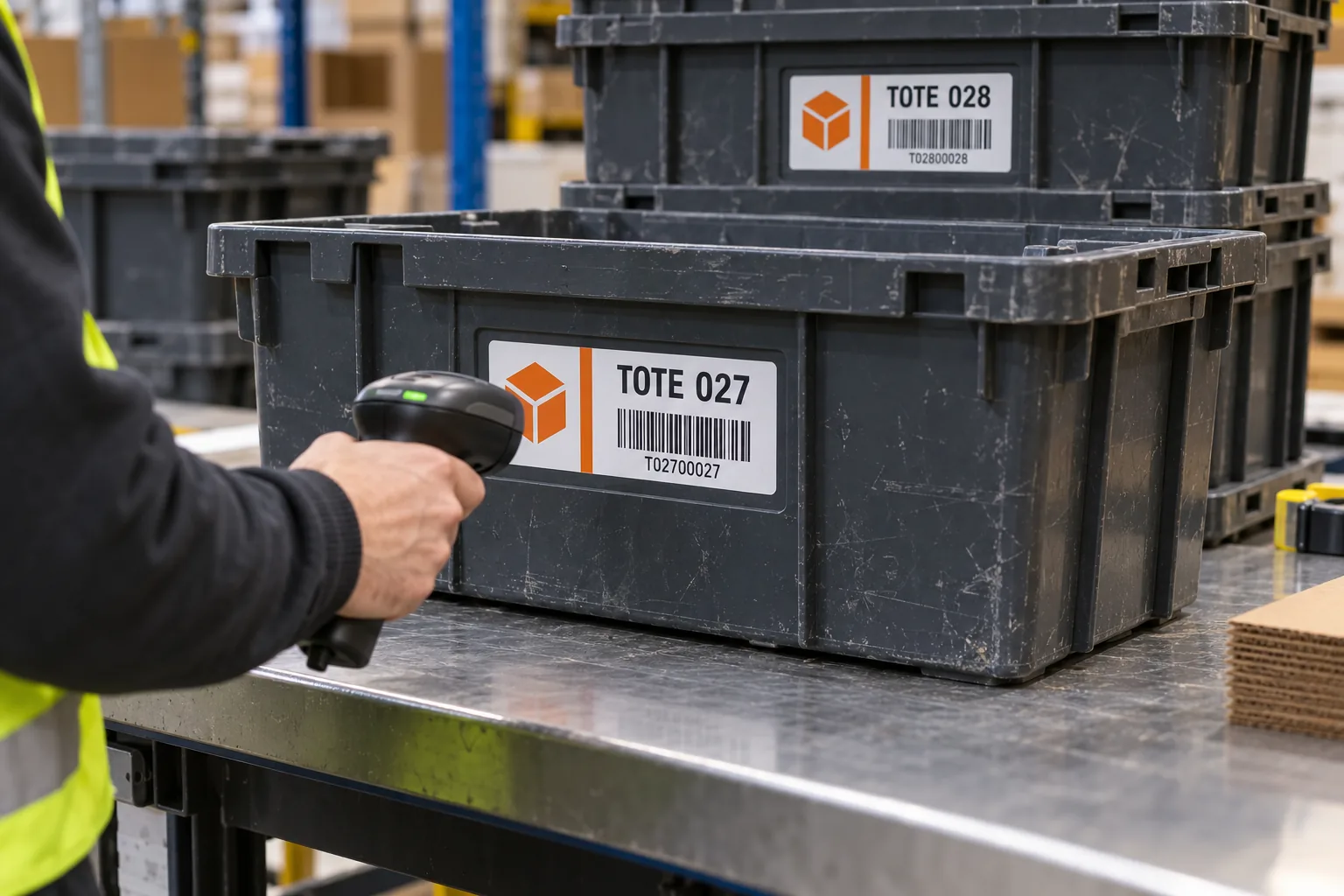
A returnable tote comes back with history: scratches, dust, wash marks and perhaps a corner of an old label. A new identification sticker has to survive that reality. I would inspect the oldest tote in circulation before specifying a label for the newest one.
Separate the permanent tote identity from shipment-specific information. If the operation reuses one tote ID, the label must remain legible through the planned handling cycle. If contents change each trip, use a controlled removable or replaceable field rather than stacking new codes on old ones. The warehouse owner defines IDs and data rules.
Find a Reliable Place on the Tote
| Surface feature | Risk | Trial question |
|---|---|---|
| Molded texture | Reduced adhesive contact | Is there a smooth label panel? |
| Handle recess | Rubbing and hand contact | Does the label stay readable? |
| Stacking rib | Repeated abrasion | What touches it in a stack? |
| Wash area | Water and cleaning exposure | What is the actual routine? |
Position the ID so a picker can scan it without rotating a full tote. An original geometric color cue may help distinguish tote families, but the number and code need enough quiet space. Trial the final printed label on a scarred, cleaned tote as well as a new one.
Plan Replacement Before the First Loss
Run the label through the owner's normal stacking, transport and cleaning process. Test the scan at the actual workstation and on representative worn labels. Define when a damaged sticker is retired, who prints a replacement and how the old code is removed or disabled. Two readable barcodes on one tote invite the wrong record into the system.
A material or laminate choice cannot be made honestly from the word "durable" alone. Document the expected temperature, cleaners, wash frequency and working life, then approve a physical trial. Do not claim a number of cycles unless the specific construction has been tested under those conditions.
Give the Warehouse One Clear ID
- Send new and worn tote samples or photos
- Mark the scan position and stacking contact points
- Provide owner-approved ID and barcode data
- Trial application after normal cleaning
- Scan after transport and wash cycles
- Write a damaged-label replacement rule
The carton ID guide explains scan-face planning, while the scan-testing guide covers physical verification. Send tote photos and the owner-approved data template through the specification planner. Reuse works better when every trip begins with one unambiguous label.
Questions Before You Order
Can a carton label be used on a returnable tote?
Not automatically. Plastic surface, molded texture, washing and repeated handling create a different use case. Trial the proposed label on the actual tote.
Should old IDs be covered by new labels?
The tote owner needs one authoritative ID and a controlled replacement method. Avoid leaving old scannable labels in view.
Who supplies barcode data?
The logistics or inventory owner supplies the identifier structure and approved records. The label supplier should not invent production codes.