
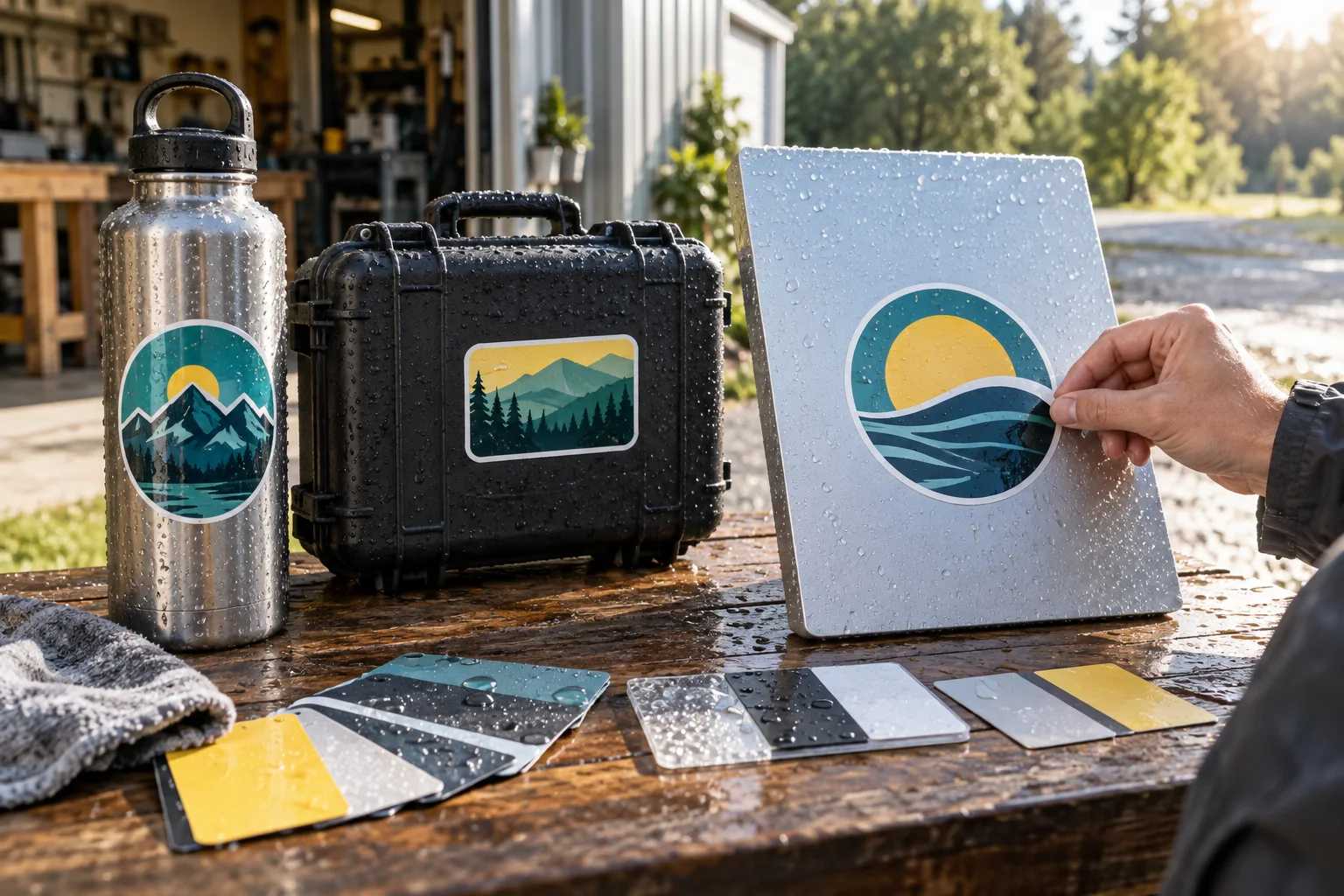
"How many years will this sticker last outdoors?" is a fair buying question and a dangerous question to answer too quickly. A north-facing sign in a mild climate, a bottle washed every day and an equipment case left in direct sun are all outdoor applications. They do not impose the same stress.
We do not think a lifespan number is useful until the exposure is described. The honest work starts with the environment, not the warranty-sounding phrase.
Outdoor Exposure Is a Stack of Problems
Rain is only one part. Ultraviolet light can fade color and affect materials. Heat and cold change stiffness and adhesive behavior. Abrasion attacks printed surfaces and edges. Cleaning fluids, salt, dust and repeated handling may matter more than occasional water.
| Exposure | Possible effect | Question to answer |
|---|---|---|
| Direct sunlight | Color change and material aging | Hours of sun and geographic climate |
| Rain and standing water | Edge stress and print exposure | Vertical, horizontal or immersed use |
| Abrasion | Scuffing and surface wear | Hands, tools, transport or cleaning frequency |
| Temperature cycling | Expansion, contraction and bond stress | Expected high and low temperatures |
| Chemicals | Ink, laminate or adhesive attack | Cleaner, oil, fuel or sanitizer contact |
The Surface Is Part of the Sticker System
A smooth painted panel, powder-coated case, stainless bottle and textured plastic box all create different bonding conditions. Fresh paint, wax, silicone, oil and dust can weaken adhesion. Tight curves and edges add lifting stress.
Surface preparation should follow the actual item and its manufacturer's guidance. A stronger adhesive cannot repair a contaminated surface, and a thick laminated label may not conform well to a small compound curve. Send the object or a representative sample when failure would be costly.
Protect the Print, but Do Not Ignore the Edges
A laminate or suitable protective layer may improve resistance to handling, moisture and abrasion. The exact benefit depends on the print system and construction. Protection on the face does not automatically prevent edge lift or water from reaching an exposed boundary.
Rounded corners often reduce sharp lifting points. Adequate pressure during application helps contact. Allowing the bond to develop before severe exposure may also matter. These ordinary process details are less exciting than a material name and often more useful.
Define Success Before Asking for a Lifespan
Does success mean the sticker remains attached, the barcode stays readable, the logo color stays within a brand tolerance, or the surface stays presentable? A label can remain bonded after its print has faded, or keep its color while an edge lifts.
Write the acceptance criteria and expected service period. For a short event, appearance for several days may be enough. For equipment identification, readability and adhesion may matter for a much longer period. These are different specifications and should not be priced as if they were interchangeable.
Use Testing to Reduce the Unknowns
A field test on the real surface provides the most relevant evidence. Accelerated tests can compare constructions under controlled conditions, but they should be interpreted against the actual application rather than treated as a universal calendar conversion.
Inspect color, gloss, cracking, shrinkage, edge lift, bubbling and residue. Include the harshest orientation and cleaning method expected. Keep an unexposed control sample so changes are easier to judge.
Outdoor Sticker RFQ Checklist
- Exact object and surface material
- Flat, curved, textured or flexible application area
- Indoor-outdoor mix and expected service period
- Direct sun, shade and geographic climate
- Rain, immersion or condensation exposure
- Temperature range and cycling
- Abrasion and cleaning process
- Critical color, barcode or safety information
- Finish or protective-layer requirement
- Representative field-test plan
Our Honest Recommendation
Be suspicious of an outdoor-life promise that arrives before the surface and environment questions. A credible specification names the conditions, chooses the full label construction and states what performance means. When the application matters, test the real object and keep the result as evidence for the next order.