
The purchase request asks for two labels across the roll. One person means two identical copies in each row; another expects the next two records from a data file. The dimensions could be correct while the output represents a different job. Before ordering multi-across label rolls, agree the physical web, the intended content in each position and how the receiving workflow will use it.
A wide roll is not automatically suitable for an ordinary single-label applicator or the buyer's printer. Have the equipment and data owners confirm the actual route. The useful specification shows what the receiver gets and which label occupies each position, with unsupported assumptions left open.
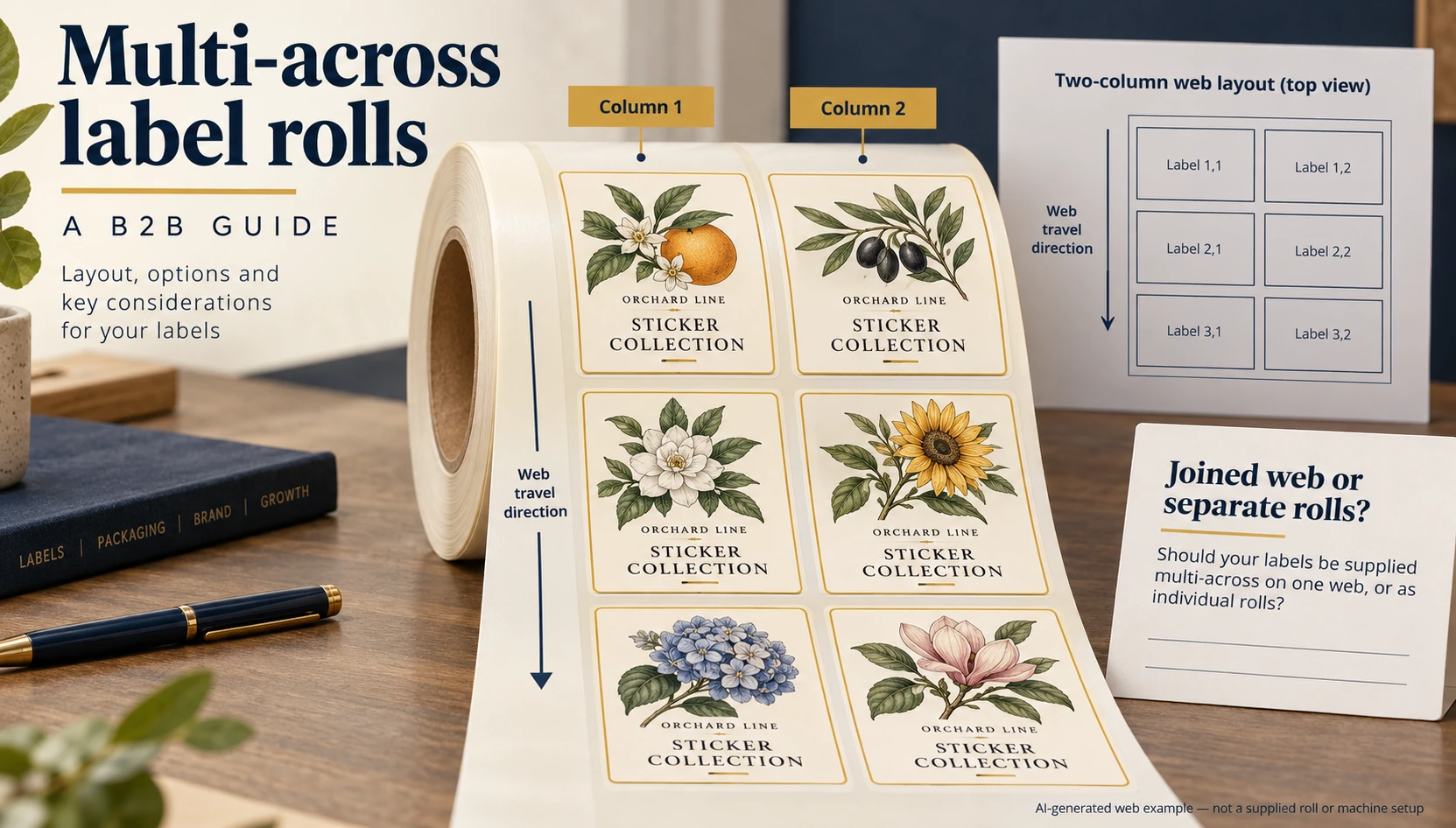
Draw the whole web before counting the labels
Show the overall backing width, each finished label width and height, the spaces between columns and rows, and the web travel direction. Name the two directions on the drawing. A phrase such as label gap is ambiguous when one team means the space along travel and another means the space between adjacent columns.
Keep dimensions and units identified, with proposed values clearly distinguished from equipment requirements. Ask the supplier which drawing and tolerances it can confirm for the intended construction. Do not borrow a spacing rule or maximum width from another machine's example.
Mark what remains together when supplied. The buyer may want a complete multi-column web for printing, or separate finished rolls after a converting operation. Those are different delivered products. A printer's production layout with several lanes does not establish that the customer will receive those lanes joined together.
The roll-direction guide covers winding, the leading artwork edge, core and mounting limits. Include those references with the multi-across drawing. An accurate column layout cannot compensate for an incompatible roll envelope or an unconfirmed sensing route.
Decide what every position is supposed to contain
Use a small, clearly labeled illustrative map before transferring live data. Give positions stable references such as row and column. State whether a row repeats the same content, contains sequential records or represents a deliberately paired set. These possibilities can look similar in a preview while requiring different input and quantity interpretation.
| Example position | Content instruction to resolve |
|---|---|
| Row 1, column 1 | Which approved record or repeated design belongs here? |
| Row 1, column 2 | Same record, next record or another named version? |
| Next row | How does the sequence continue? |
| Partial final row | What is permitted in the remaining position? |
The example references are coordinates, not verified identifiers. Do not use a realistic barcode illustration as proof that the data or symbol has been approved. If codes are involved, the responsible parties need the actual print and reader review for their application.
NiceLabel's printing procedure distinguishes label quantity, identical copies and repeated label sets. That is documentation for its software, not a universal rule for every driver or printer. It supports asking the receiving operator exactly what their quantity controls do instead of assuming that a number entered as two produces the intended pair.
Connect the data file to the rendered position map
Have the data owner supply the controlling source and field meanings. Ask the operator to show how representative records reach the actual output positions through the intended software and device. A spreadsheet sorted down a column does not by itself tell the buyer how a print layout traverses a multi-column web.
Include an awkward but legitimate example: a repeated record, the longest wording or an incomplete last row if the job can contain one. Keep these examples clearly separated from the released production set. They help expose mapping assumptions; they are not a statistical inspection plan or confirmation that every record is correct.
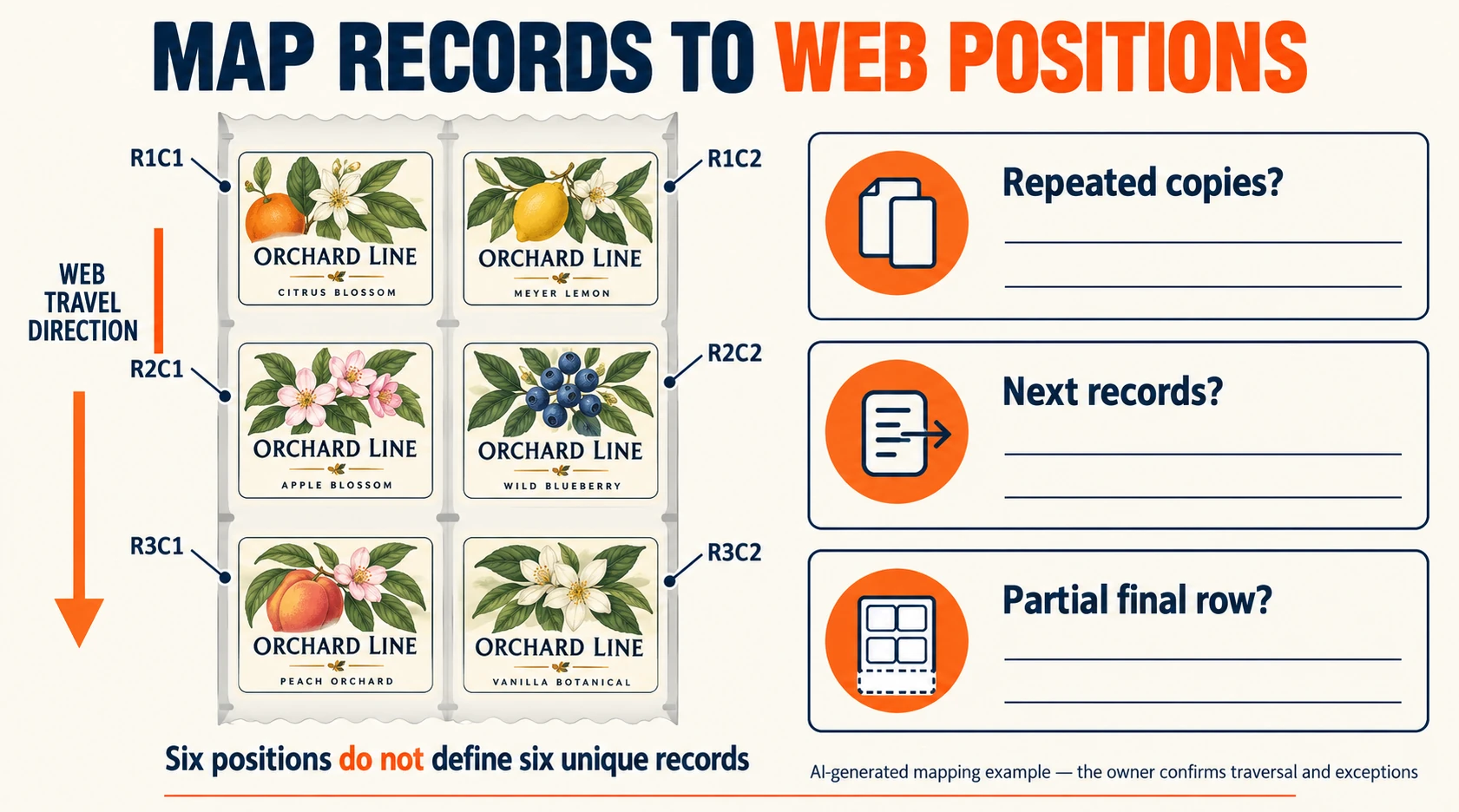
If a position is intentionally unused, ask how that state is represented and handled. Do not let an empty field silently mean repeat the previous record. Likewise, an operator should not fill a spare position with another SKU merely to use every label. The released map and the actual workflow must agree on the exception.
The variable-data guide addresses field definitions and release of the data set. Here the additional question is where those records land across the physical web and what remains after printing or separation.
Keep rows, pieces and finished rolls as different quantities
For an illustrative complete layout, three rows with two occupied label positions contain six physical labels. That arithmetic does not mean six unique records: each position could repeat one design, or the positions could carry six different records. Nor does it determine how many usable labels a supplier will deliver under the actual agreed terms.
Record the requested pieces by design or record, the intended arrangement and the proposed finished roll distribution separately. Identify how a partial row, an interrupted print or a rejected position is handled by the owner's process. A whole-row reprint can repeat a position that was already acceptable; it should not be counted as a new unique identifier without the data owner's decision.
Ask whether the receiver can keep the joined web, separate lanes or apply pieces through the intended route. A narrower single-column roll can be a sensible alternative where the equipment or reconciliation method does not support the joined arrangement. Several narrower rolls add handling and allocation work, but the wider layout may add mapping and exception work. Compare the actual feasible workflows rather than assuming more columns always reduce cost.
Release one drawing and one mapping reference together
Retain the confirmed physical drawing, construction, winding and equipment references with the accepted data-to-position map. A change in columns, label size, software template or record traversal can reopen mapping even when the individual sticker artwork looks identical. Recheck the changed relationship and preserve unaffected approvals within their scope.
For a supply discussion, use the custom roll-label page and identify whether the request is for a joined web or separate finished rolls. Availability and any specialist setup need confirmation; this guide does not promise a particular multi-across converting or printing service.
Send the complete web drawing, equipment requirements, a non-sensitive representative data file, the intended position map, dimensions, quantities by design or record and destination in a multi-across roll enquiry. State how partial rows and repeated copies should be handled. Those inputs make the next decision about a defined physical and data arrangement, instead of two incompatible meanings hidden inside two across.