
The warehouse wants identifiers that move when the layout changes. The buyer asks for magnetic stickers because the rack looks metallic. The purchasing team has not checked the actual panel's response, whether the proposed piece can sit fully against it or how it will be stored between moves. Removable has become a format preference before the contact route is known.
Compare magnetic attachment and adhesive attachment as different systems. Confirm the actual receptive surface and geometry before selecting a magnetic piece. For an adhesive option, define its holding and removal requirements. Neither route becomes suitable merely because the identifier needs to change position later.
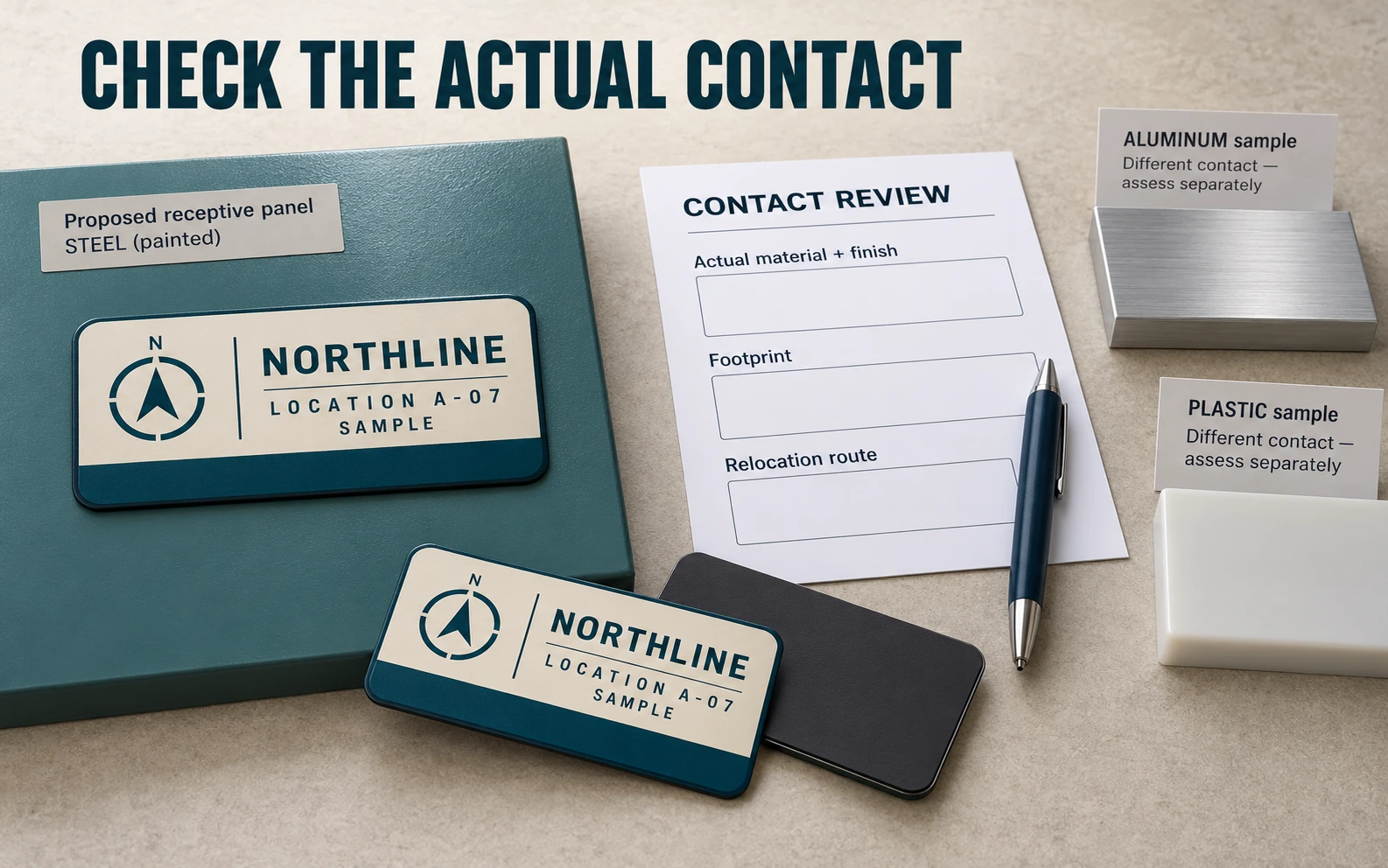
Check what the piece will attach to
Identify the exact panel and finish, not just the object below it. A painted rack, stainless enclosure, aluminum panel and plastic bin can look similar in a photograph while presenting different attachment questions. Obtain the known material reference from its owner and review the actual contact area.
Magnum Magnetics' care guidance explicitly distinguishes receptive surfaces, noting that its product does not attach to aluminum or plastic and that stainless response varies. Those qualifications support checking the actual panel. They do not establish compatibility, holding performance or finish safety for every magnetic product.
Do not infer suitability from another nearby panel or a different rack model. If a representative contact review is needed, identify the proposed magnetic construction and have the responsible owner define the appropriate observations. An informal observation can be useful within its scope without becoming a rated holding specification.
Separate magnetic attachment from an adhesive-backed magnet
A magnetic piece may carry a printed face. Another construction may use adhesive to attach a magnet to an object. Those are different interfaces. Ask the supplier which face is magnetic, where any adhesive is used and what remains attached when the identifier moves.
Draw the supplied and installed states. If a separate receptive strip or holder is proposed, include that component and its own attachment requirements. Adding a receptive surface can create another installation decision rather than making the original panel's identity irrelevant.
This guide does not confirm that ZC Labels supplies a magnetic format or a particular holder. Use the comparison to describe the task and ask what is available. A conventional adhesive label, a separate holder or another approved identification route may be a practical alternative.
Review full contact and the operating position
Mark the intended footprint on the actual panel. Include seams, recesses, protrusions and curves. Ask the material provider which contact geometry and conditions its identified product supports. A flat demonstration piece cannot approve a gap created by a rib or another installed label.
| Review field | Magnetic route | Adhesive route |
|---|---|---|
| Contact identity | Actual receptive panel and finish | Actual contact material and finish |
| Geometry | Supported contact over the complete piece | Relevant shape and edge contact |
| Use | Required retention and handling | Required retention and handling |
| Changeover | Removal, relocation and storage | Removal or replacement and surface condition |
| Extra components | Any receptive layer or holder | Any approved carrier or mounting arrangement |
Magnum's guidance requires full contact for its flexible products and addresses storage and cleaning. Apply the instructions relevant to the product actually proposed, with the site owner's agreement. Do not copy another product's temperature or care limits into an unspecified ZC quotation.
Follow the identifier through a complete move
Review the starting position, removal, temporary storage and next application. Include the normal handling and the next intended surface. If the piece can be moved only between certain panels, identify that boundary rather than calling it reusable everywhere.
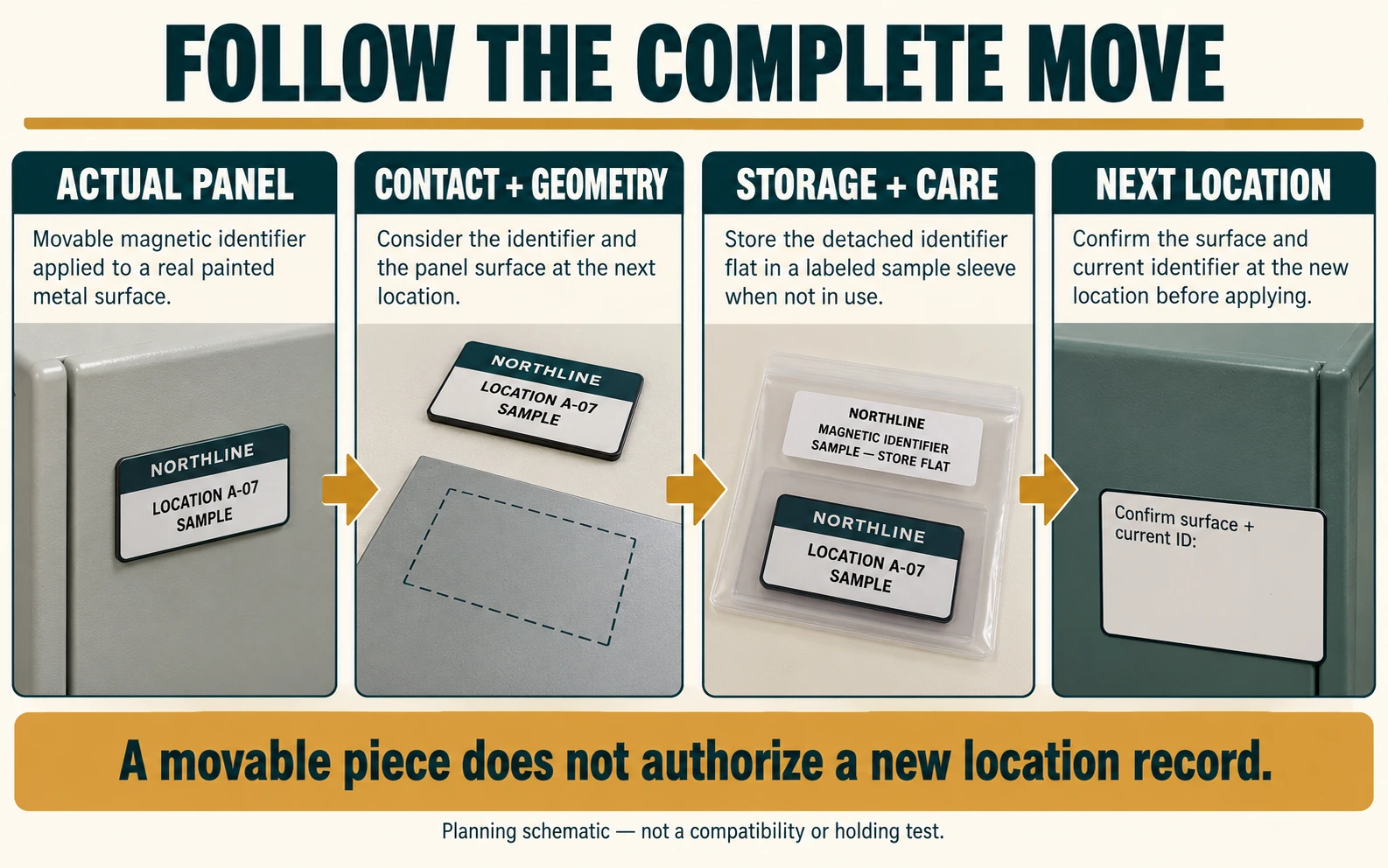
Ask how pieces are kept clean and flat through the intended route, following the identified product guidance. A movable format still creates care and inventory work. Do not assume that the absence of a label-removal step eliminates maintenance or prevents every finish mark.
For the adhesive alternative, the holding and removal guide keeps the two outcomes separate. Compare a representative changeover against that defined requirement rather than treating all removable adhesives as equivalent to a magnet.
Keep the location record aligned with the physical move
Decide what the printed identifier represents. A fixed storage location should not silently travel with a movable bin unless the warehouse owner intends that relationship. The attachment method makes a piece movable; it does not authorize changing the system record it identifies.
The warehouse location guide covers the connection between approved IDs and installed positions. Apply the same control to either attachment route. Retire or hold obsolete pieces according to the owner's process so a convenient reusable carrier does not return an old location to active use.
Keep readable wording beside any code, using the final size and actual viewing position. A magnetic format cannot correct an unreadable layout or a code associated with the wrong shelf. Confirm the identity and physical route as separate parts of the release.
Compare the real changeover work
Ask for quantities, supply scope and quotations for the alternatives actually available. Consider any holder installation, receptive component, storage, cleaning and replacement work. Do not declare one route cheaper from the price per printed face alone.
If the panel is unsuitable or the contact cannot be maintained, compare another approved mounting position or carrier rather than insisting on a magnetic solution. If relocation is infrequent, a controlled adhesive replacement may remain sensible. If frequent moves matter, a supported reusable route can be worth evaluating without promising unlimited cycles.
For a movable-identifier enquiry, send actual panel photographs and known material/finish, footprint and geometry, intended positions, handling and relocation sequence, artwork, quantity by design and destination. Use the custom identification graphic route to ask what format is available. The next decision can then address a real contact and changeover task instead of assuming that every metal-looking surface accepts every movable label.