
The operation wants less spent backing at the packing station. Someone suggests ordering linerless labels in the same width as the current roll. The printer still has its original feed path and cutter. Before the buyer compares material prices, the equipment owner needs to answer whether that system is intended to handle the proposed linerless construction.
Treat linerless as a system decision. Establish the supported printer configuration, actual material and way the label will be dispensed or cut. Then compare the operating work and waste route. Removing a backing layer from the purchasing description does not establish that an existing label process will keep working.
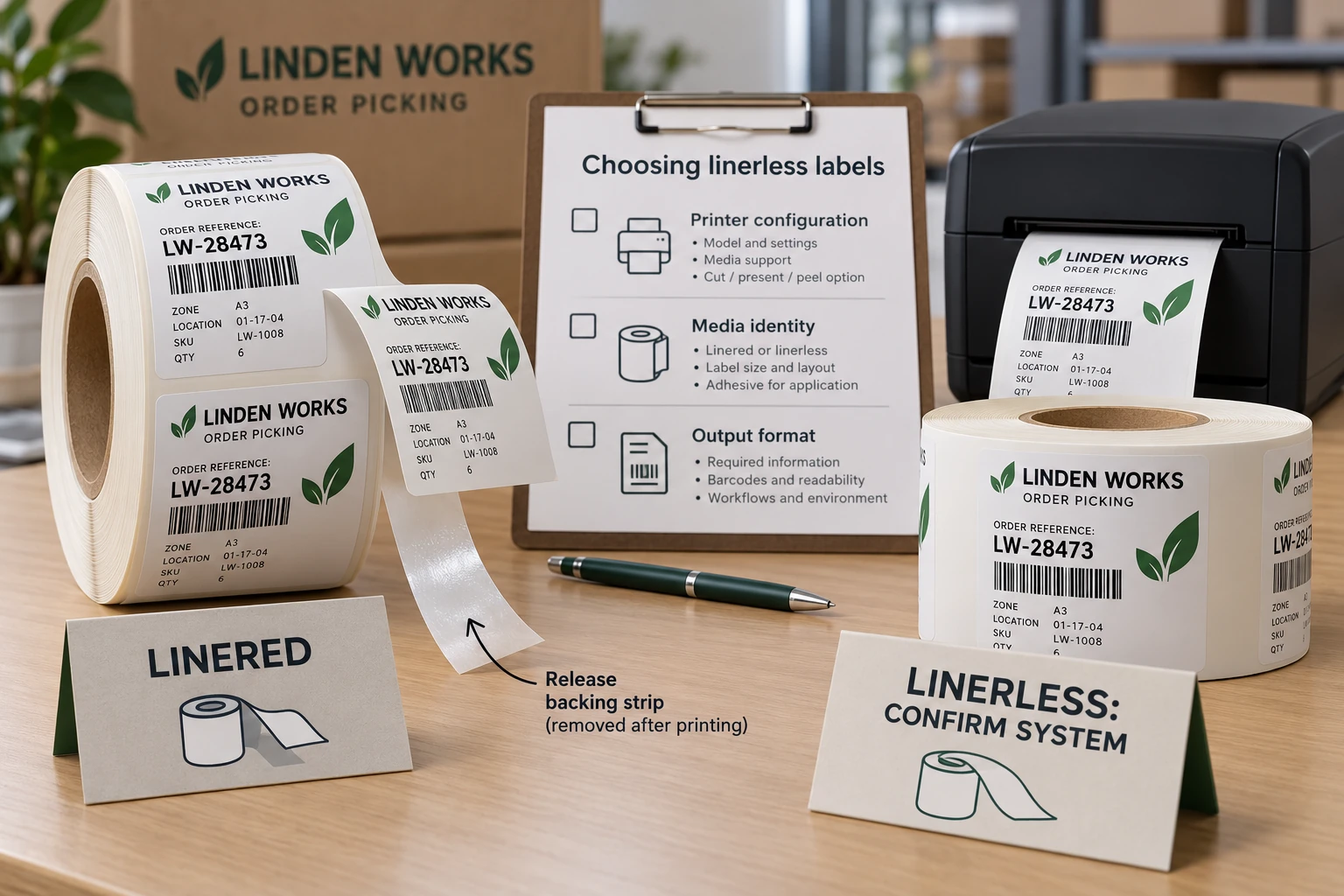
Ask what prevents the wound roll from sticking to itself
A conventional pressure-sensitive label is carried on a release liner before separation. A linerless system needs a different arrangement to wind, feed and separate its adhesive material. Ask the supplier to identify that arrangement in the actual proposed stock rather than assuming it is an ordinary label with the backing removed.
Avery Dennison's linerless explanation describes its direct-thermal continuous media with adhesive and a release-coated face. It states that the relevant printers have release surfaces and components intended for linerless use. These are useful reasons to request a complete equipment and material reference. They do not establish interchangeability between all linerless products or confirm any named construction is available from ZC Labels.
Keep the printed face and contact surface requirements visible. Eliminating a removable backing does not eliminate the need to approve image retention, attachment, removal where required or the readability of information after handling.
Obtain the exact supported configuration
Record the printer model, fitted options, feed and cutting arrangement and the applicable instructions. A similar-looking model or another site using linerless media is insufficient evidence. Ask the equipment provider or responsible technical owner which media constructions the actual configuration supports.
Do not propose modifying rollers, disabling a cutter or changing a guarded path to consume an unsuitable roll. This guide is a procurement record, not a retrofit instruction. If new equipment or a supported option is needed, keep that cost and responsibility in the comparison rather than hiding it behind the material amount.
Avery Dennison's compatibility announcement for a particular printer and material names the combination it evaluated. That specificity matters more to the buyer than a broad compatible-with-printers claim. Request similarly identifiable evidence for the combination being considered, without transferring the announcement's result to another machine.
Define the piece leaving the equipment
Does the process produce a fixed-size label, a variable-length ticket-like piece or another controlled output? Who defines the cut length, artwork and data field? Keep those questions separate from the roll's nominal width and total length.
A longer information entry can change the finished output if length is variable. The operator then needs a clear way to identify, handle and apply it. A fixed artwork layout has another constraint: the design and separation reference must stay connected. Neither task should be left to an improvised tear chosen during packing.
| System field | What the buyer should obtain |
|---|---|
| Equipment | Actual model, configuration and supported route |
| Material | Identified linerless construction and relevant limits |
| Separation | Supported cutter or dispensing arrangement |
| Output | Finished dimensions or controlled variable-length rule |
| Data | Current template and authorized information source |
| Package | Contact surface and required holding/removal outcome |
If the task uses a second print pass on predecorated material, ask whether that route is supported for the proposed stock. Do not infer it from an illustration of a printable white field. The thermal-transfer overprinting guide covers its own ribbon-and-surface review; it is not a specification for every linerless system.
Walk through the receiving-to-application route
Keep the original roll identification and supplier handling instructions with the material. Review loading, printing, separation, pickup and placement through the actual supported process. Include the point at which the next label is presented, because a convenient first sample can hide an awkward repeated task.
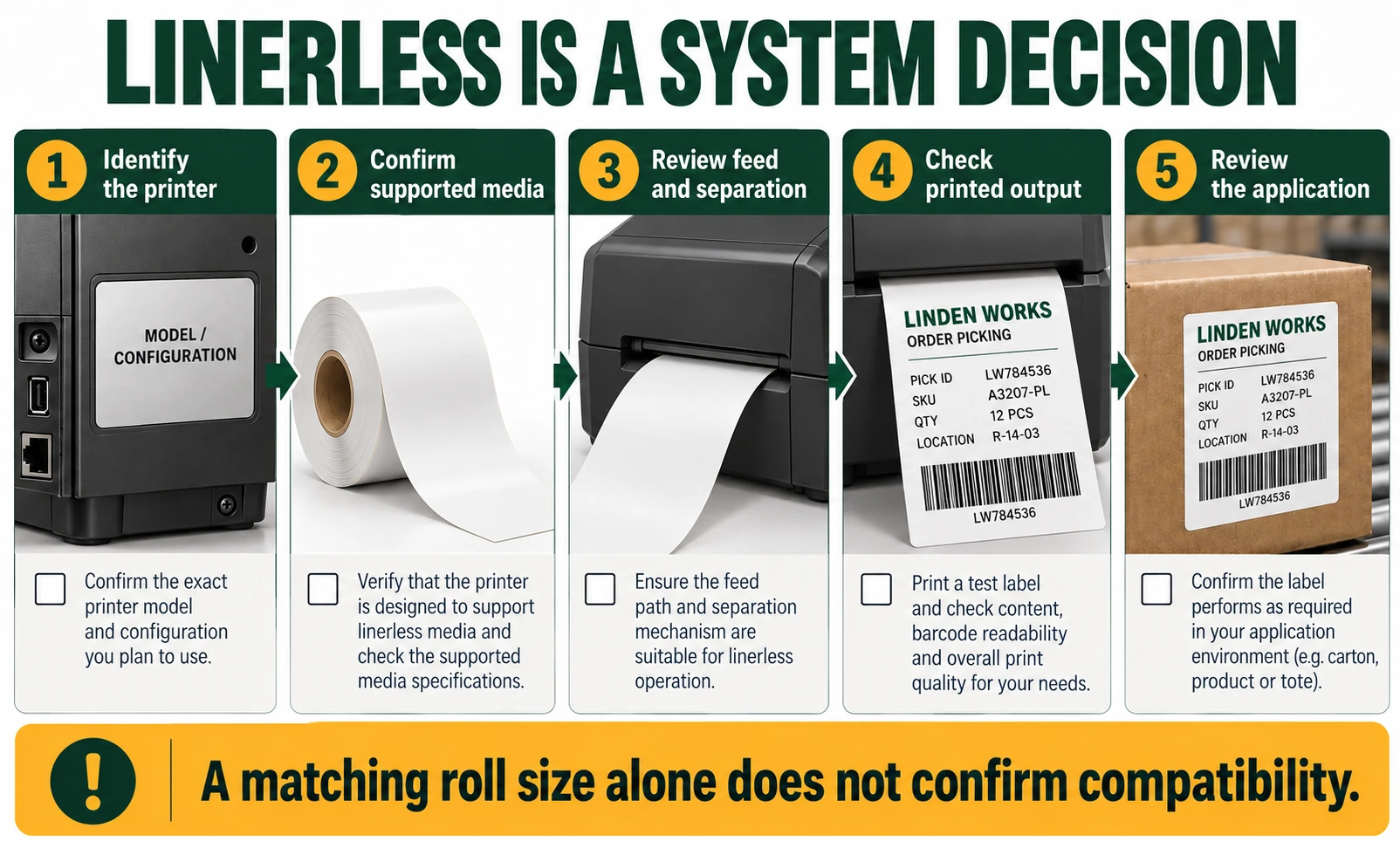
Have the equipment owner define the relevant observations and acceptance. A neat printed piece alone cannot establish cutter behavior, repeated feed or the practical application motion. Likewise, a successful feed does not establish that the intended data are correct or the adhesive suits the package.
Keep results tied to the actual combination. If the material, coating, printer configuration or output dimensions change, identify which observations remain representative. Avoid treating one supplier's general product family as approval for an unreviewed substitution.
Compare the complete operating change
Count what changes at the station: consumable handling, spent backing collection, roll changes, cutting, piece handling, maintenance requirements and any equipment work. Obtain actual material and service quotations where needed. The purpose is to compare the buyer's operation, not borrow a productivity percentage from a different site.
The absence of a spent liner can be directly described for an identified linerless process. A broader carbon, safety or total-cost claim needs an appropriate basis. Do not infer an environmental winner from one removed component while ignoring changes elsewhere. The liner collection guide provides the alternative discussion for an existing lined construction.
Keeping the current proven system and arranging its backing collection may remain a sensible option. Switching may also be worthwhile when the equipment and application route are supported and the actual consequences suit the business. Let the confirmed requirements decide; linerless is not an automatic upgrade for every roll label.
Send ZC Labels the equipment configuration and supported-media reference, intended output dimensions, artwork/data example, package photos, required use and removal conditions, quantities and destination through the roll-label project enquiry. Use the custom roll label route to explain the supply requirement and ask whether the requested construction is available. Keep equipment compatibility and any proposed change under the responsible technical owner's confirmation before treating a linerless quotation as a ready replacement.