
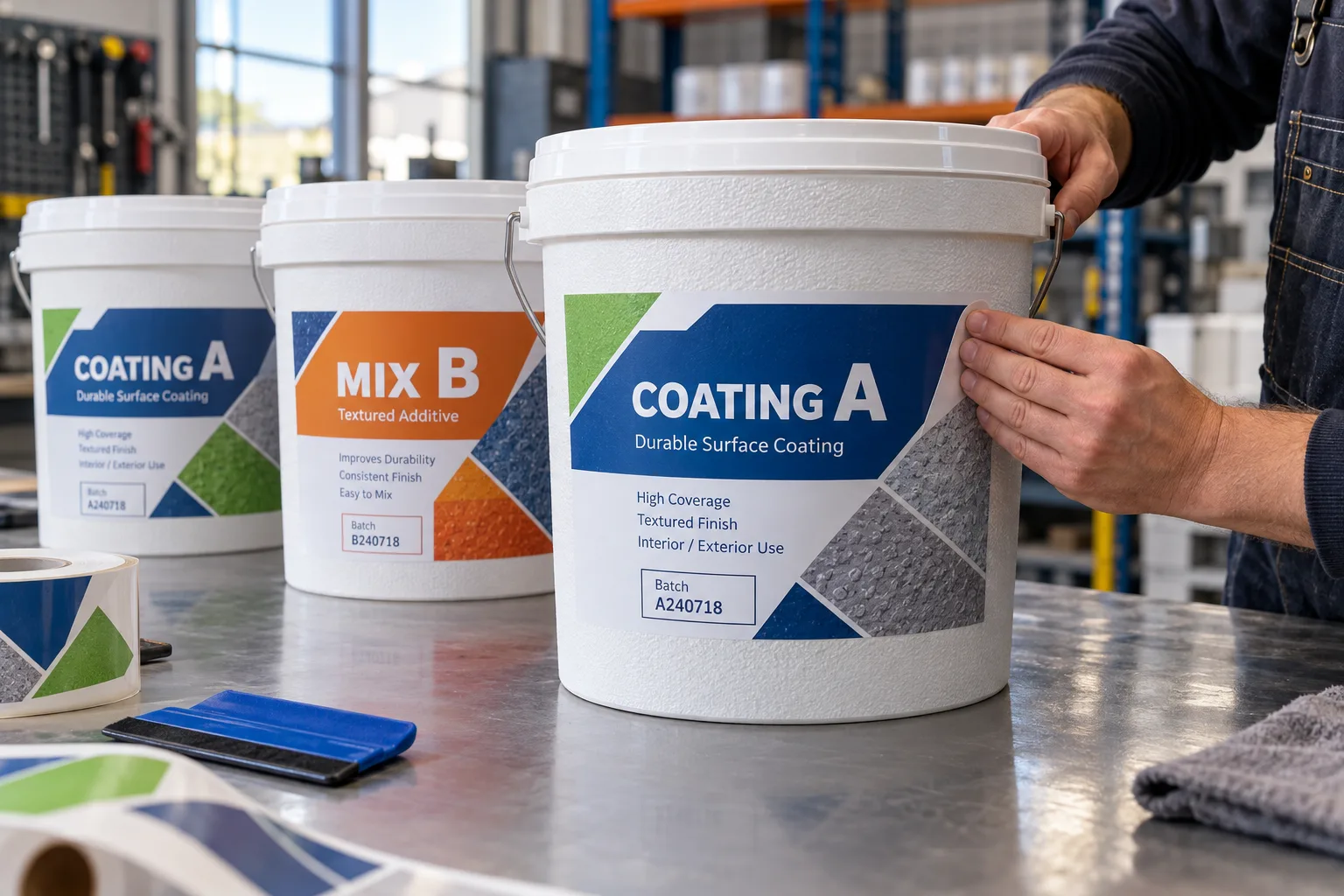
A textured plastic pail can make a label look secure for five minutes and loose by the time it reaches storage. The wall is curved, the molded surface is uneven, and someone may grab it by a handle while the label brushes against another bucket. I would ask for the actual pail before choosing a face stock or adhesive.
Find the Real Application Zone
Mark the flattest uninterrupted area on a filled container. Measure the available height below any top rim and above a lower ridge. Note molded marks, ribs and the handle swing. Ask when the pail is labeled: before filling, after filling or after the exterior has been wiped. Dust, oil or residue can change the result even when the plastic resin is unchanged.
Trial final-size labels, not tiny sample dots, on production pails. Apply them with the same pressure and method that the line will use. Check edges after the normal hold, stacking and transport routine. If the pail will be outdoors, wet or exposed to contents, define those exposures separately and test them. No generic adhesive name guarantees a result on every textured wall.
Keep Identification Legible in a Stack
An original geometric color system can help identify product families, but the owner-approved product name and batch field must remain readable from the working angle. Keep variable-data panels away from the strongest curve. If a barcode is used, scan it on the labeled pail with the intended scanner after stacking, not only on a flat proof sheet.
For regulated or hazardous contents, the product owner has to supply and approve current market-specific wording and symbols. A supplier can flag a space problem; it cannot decide classification or make a safety claim from a photograph.
- Supply the exact pail resin and finished sample
- Mark ridges, handles and application zone
- Describe cleaning and labeling sequence
- Trial final-size construction on real pails
- Inspect after stacking and handling
- Approve all product and variable fields
Read the adhesive and surface guide and the variable-data overprint guide. Send pail photos, contents and handling conditions through the specification planner.
Questions Before You Order
Will a stronger adhesive always fix a textured pail?
Not necessarily. Resin, texture, surface treatment, contamination and application pressure all matter. Trial the full label construction on the actual pail.
Can the label cover a molded ridge?
A ridge changes contact and may lift an edge. Measure a flatter application zone and test the final size before crossing it.
Who approves chemical or safety information?
The product owner must supply and approve the correct market-specific content. The printer should not invent classifications, warnings or compliance claims.