
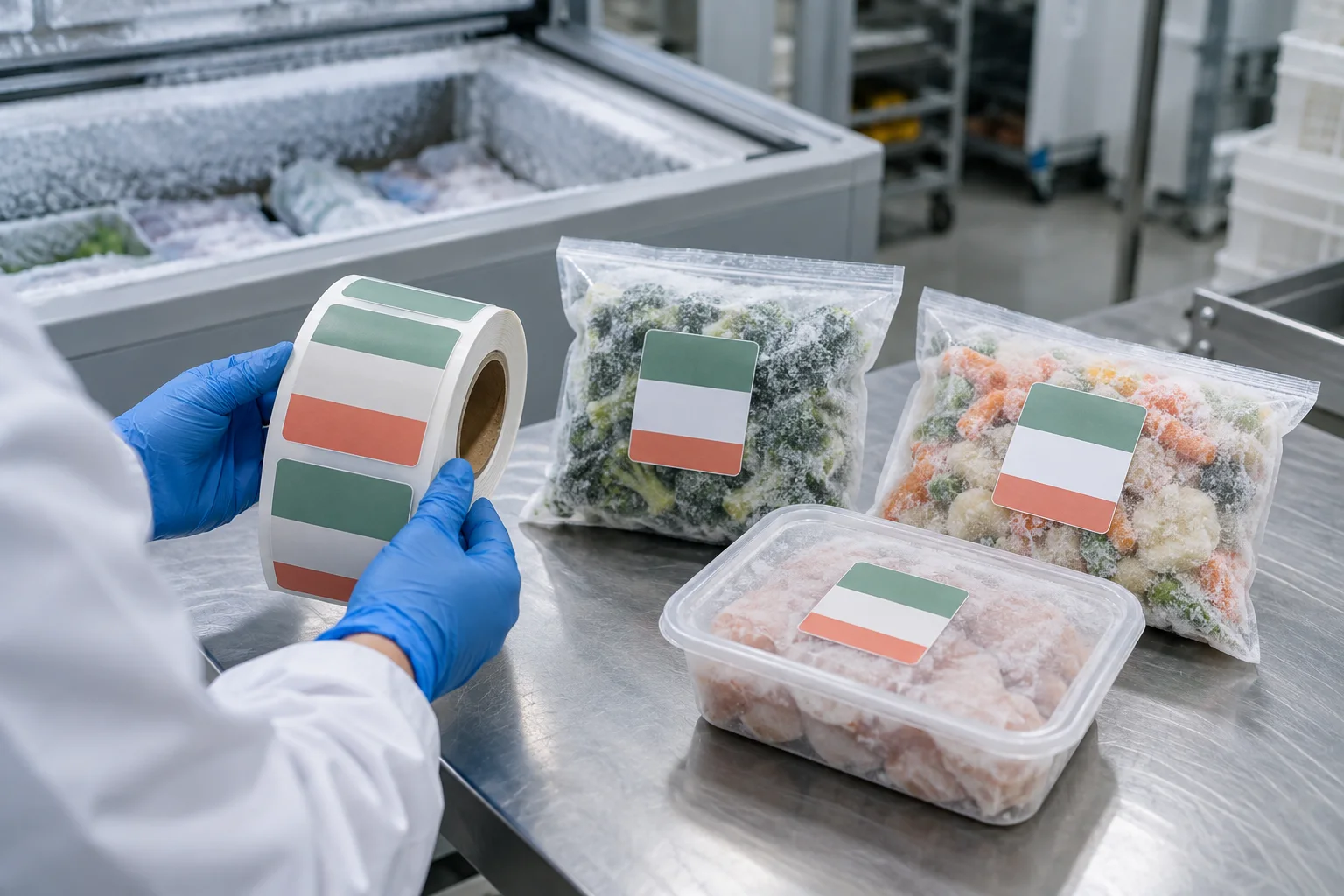
A buyer may ask for a freezer label as if it were one material. From the production side, that question is incomplete. The label might be applied to a clean pouch at room temperature and frozen hours later, or it might be pressed onto a frosted container inside a cold room. Those jobs can look identical in a product photo and behave very differently.
We would rather slow the quote down for one useful question than recommend a material from a keyword. The first question is simple: when and where is the label applied?
Application Temperature Is Not Storage Temperature
Application temperature describes the package surface when the label is first pressed down. Service temperature describes the conditions after the bond has developed. Confusing the two is one of the easiest ways to approve the wrong specification.
| Production situation | What changes | What to report |
|---|---|---|
| Label first, freeze later | The adhesive may bond under warmer, cleaner conditions | Time between labeling and freezing |
| Apply to a chilled package | Condensation may interfere with initial contact | Surface temperature and visible moisture |
| Apply to a frozen package | Frost and low temperature make initial adhesion harder | Lowest application temperature and frost level |
| Repeated freeze-thaw handling | Moisture, movement and edge stress may repeat | Number of cycles and handling process |
The Package Surface Still Decides the Job
A smooth rigid food tub gives the adhesive a different contact area from a textured pouch or a carton with a coated surface. Flexible bags also move after labeling. If the film wrinkles, expands or is handled while cold, a large rigid label can lift even when its face material looks durable.
Send an unfilled package sample or clear photos of the exact label panel. Identify whether the packaging is plastic film, rigid plastic, coated board or another material. If the pouch has seams, gussets or changing curves, mark the usable flat zone instead of quoting from the total package width.
Condensation Is a Process Problem, Not a Marketing Word
Moisture can appear before application, during transfer or after a cold package enters a warmer room. A statement such as "waterproof label" does not answer whether the adhesive can make good first contact through condensation. It also does not describe edge lifting, ink protection or abrasion from cartons rubbing during transport.
This is where buyers sometimes ask for the strongest adhesive available. We understand the instinct, but stronger is not automatically better. It may create removal or recycling problems, and it still cannot compensate for heavy frost, oil, dust or an unsuitable surface.
Build a Representative Freezer Test
A useful test follows the real sequence: clean or fill the package, apply the label using the planned pressure and temperature, allow the expected dwell time, freeze it, move it through the expected handling cycle and inspect the edges. A sample tested on a warm empty container proves much less than buyers often hope.
Check adhesion after the coldest stage and again after condensation appears. Look for edge lift, tunneling, wrinkles, label cracking, ink damage and adhesive residue. The test should include the most difficult surface in the range, not only the easiest one.
Freezer Label RFQ Checklist
- Food package material and exact label area
- Application temperature and surface condition
- Storage temperature range
- Time between labeling and freezing
- Condensation or freeze-thaw exposure
- Rigid container, flexible pouch or carton
- Label size, shape, quantity and roll or sheet format
- Direct-food-contact boundary and required documents
- Expected handling, transport and retail display
- Need for a representative package test
Our Honest Recommendation
Do not begin with "freezer grade." Begin with the labeling sequence. If the supplier understands the package, temperature, moisture and handling path, material selection becomes a production decision instead of a guess. For a critical frozen-food launch, a realistic trial on the actual package is worth more than a confident adjective in a quotation.