
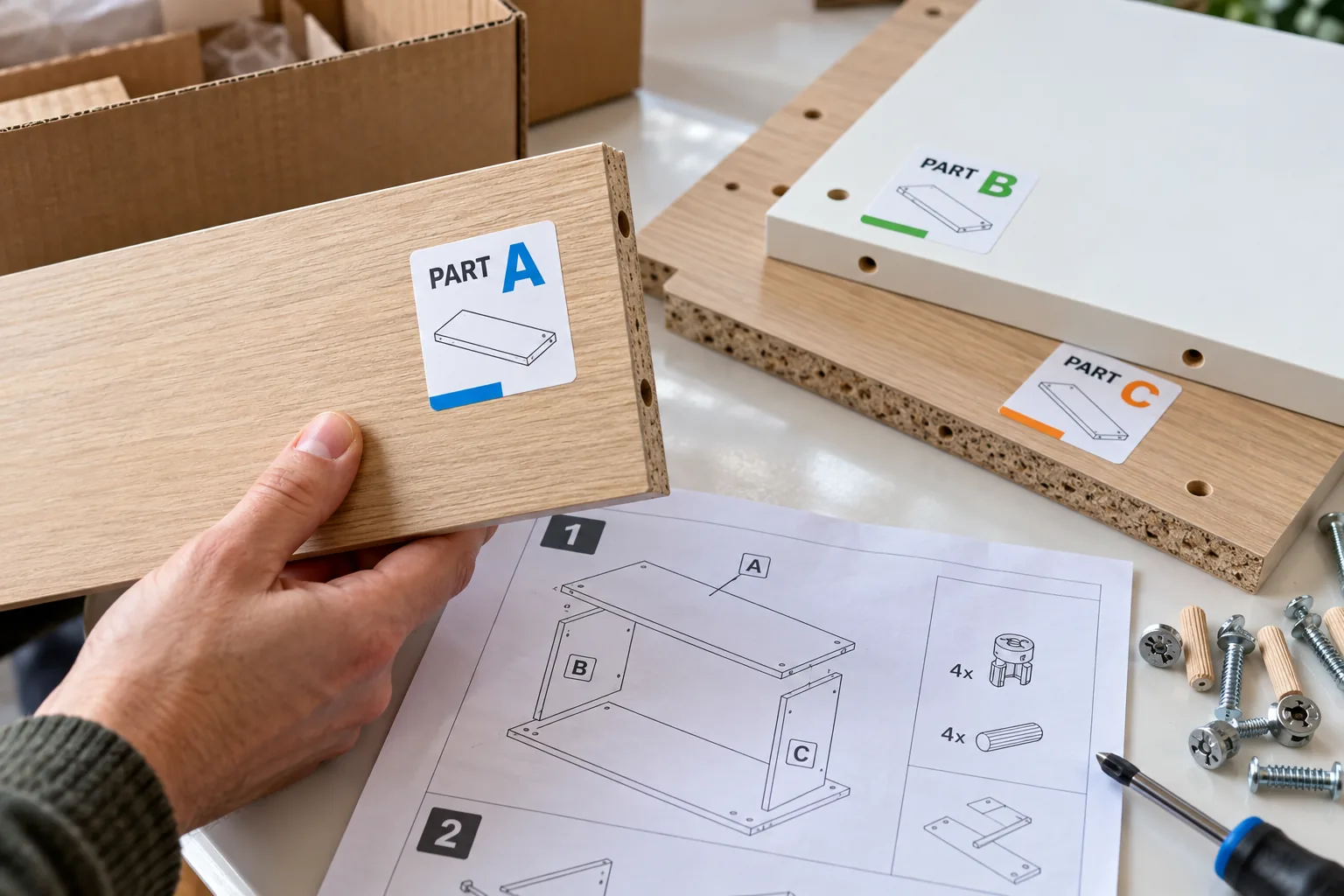
A flat-pack box opens onto several panels that look almost identical. The instruction sheet says "Part B," and the person building the shelf turns each board over to find it. I would treat the part sticker as part of the assembly experience, not as a warehouse afterthought. It has to be present when needed and gone when the furniture is finished.
The furniture maker must supply the approved part codes and match them to the bill of materials. A printer can make A, B and C clear, but it cannot resolve a mismatch in the assembly instructions. Confirm whether the sticker belongs on a panel edge, a protective wrap or a removable backing sheet.
Choose the Placement With the Box Open
| Surface | Question | Risk |
|---|---|---|
| Finished face | Can it be removed cleanly? | Visible residue |
| Raw board edge | Will it hold in transit? | Lost ID |
| Protective film | Is film removed early? | Part loses identity |
| Hardware bag | Does the code match the sheet? | Wrong fittings used |
A complete original little panel silhouette can help distinguish similar parts, but the letter and approved code should be largest. Try the artwork at the scale of the actual part. An assembler should not need a magnifier to separate B from D.
Run an Unboxing and Removal Trial
Pack representative panels in the planned order, then open the carton as a customer would. Can each part still be identified without rearranging the entire pile? Rub the labels through normal handling, assemble the trial item and remove the stickers at the intended stage. Check every finish involved: veneer, laminate, paint and raw edge can respond differently.
Do not promise residue-free removal based on one fresh sample. Dwell time, temperature and coating age matter. If direct application is risky, consider putting the ID on protective wrapping instead. The furniture owner decides acceptable placement and removal criteria.
Keep the Parts List in Sync
- Supply the approved bill of materials and part codes
- Photograph the unboxing sequence
- Mark safe label or wrap positions
- Proof lookalike letters at final size
- Trial hold during packing and removal after assembly
- Version the labels with the instruction sheet
Read the removable adhesive guide before choosing a face stock, and use the reorder checklist to keep changed parts in step with changed instructions. Send panel photos and your part list through the specification planner. The label should disappear only after it has done its job.
Questions Before You Order
Can a parts sticker go on every furniture finish?
No. Veneer, paint, laminate and unfinished wood respond differently. Trial the adhesive and removal on each representative finish.
Should the label stay on during assembly?
That depends on the workflow. It should remain visible long enough to identify the part but not be trapped under hardware or visible on the finished product.
Who supplies A and B part codes?
The furniture maker owns the bill of materials and assembly instructions. Label artwork must match those approved part references.