
A packing station wants to stop changing small rolls. A supplier proposes fanfold labels in a box behind the printer. The buyer compares the number of pieces per pack, but nobody has checked whether the printer supports that inlet or whether the stack has a clear path to it. A larger supply has been discussed before its route is known.
Choose fanfold or roll presentation against the actual supported feed path. Identify where the stock sits, how the web enters, where folds fall and what happens to the output. Fanfold describes a continuous folded supply, not a set of unrelated sheets and not a different printing technology by itself.
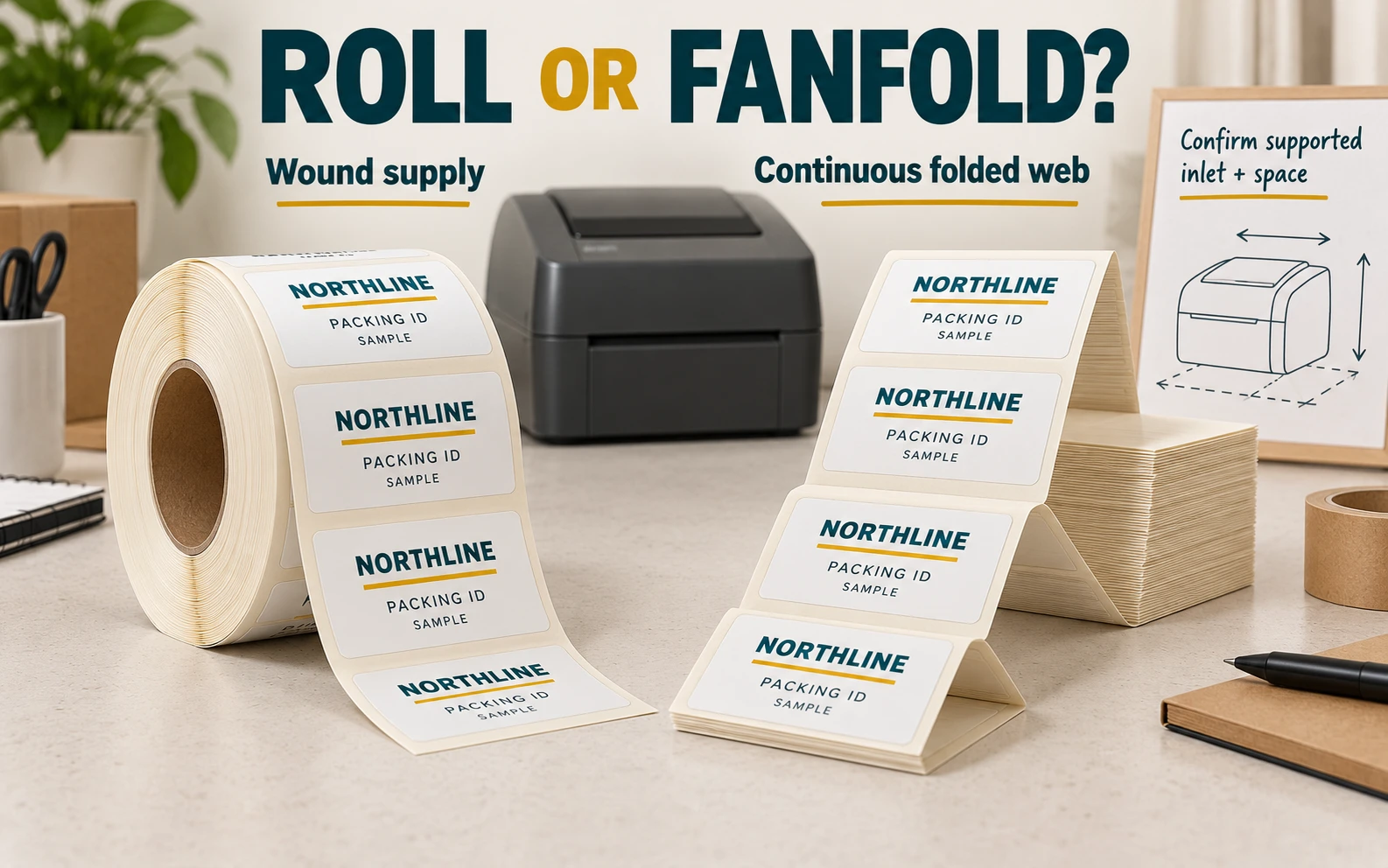
Distinguish the supply form from the imaging method
A wound roll and an accordion-folded stack can both present a continuous web. Their storage and entry arrangements differ. Direct thermal, thermal transfer and other print methods describe another part of the system. A request for fanfold should not leave the image-forming method or supported media unspecified.
Ask the equipment owner for the actual printer model, configuration and applicable instructions. Obtain confirmation that the proposed format, construction and dimensions are supported. A slot visible on a similar printer is not sufficient evidence that this machine can consume the proposed stack.
Zebra's ZD500 user guide, in its fanfold-media section, describes a rear entry and media-guide arrangement. That establishes a model-specific route worth identifying. It does not authorize using those instructions on another printer or changing its guarded path.
Include the stock position in the specification
Draw the proposed station from above and from the side. Mark the stack or roll, supported entry, operator area and output. Show the available space without treating the unprinted supply as invisible. A box behind a printer can conflict with a wall, shelf, cable or normal packing motion.
Ask the line owner to confirm the supported approach and handling. Keep the web clear of an unapproved sharp bend, obstruction or improvised support. This is a purchasing review, not an instruction to modify equipment or bypass its normal operation.
For a roll route, record core, outside diameter and winding requirements. For a fanfold route, obtain the relevant stack, web, fold and entry requirements. Do not replace all those fields with an equal overall label count. A count tells the buyer how many pieces are intended, not whether the station can feed them.
| Field | Roll proposal | Fanfold proposal |
|---|---|---|
| Supported entry | Identified roll mounting and path | Identified external inlet and path |
| Supply envelope | Core, diameter and width | Stack and box envelope with working clearance |
| Presentation | Winding and leading artwork reference | Folded-web orientation and fold reference |
| Identification | Version and quantity per roll | Version and quantity per stack or pack |
| Output handling | Agreed printed-label route | Agreed printed-label route |
The appropriate dimensions and limits come from the actual equipment and supplier offer. No default stack size or universal fanfold pitch is specified here.
Ask where the folds occur
Have the supplier identify the proposed fold position relative to labels, gaps and any perforation. A fold and a perforation are different physical features. Do not assume that every fold is intended as the operator's tear point or that a quoted label repeat establishes the folding interval.
Review whether the chosen layout, sensing reference and intended output remain compatible with that presentation. The equipment owner should define the relevant checks. A neatly stacked sample can demonstrate the supply concept while leaving repeated feeding and output unresolved.
The roll orientation guide remains useful for the wound alternative. The comparison should preserve a real supported option on each side rather than treating an incomplete fanfold sketch as equivalent to an accepted roll specification.
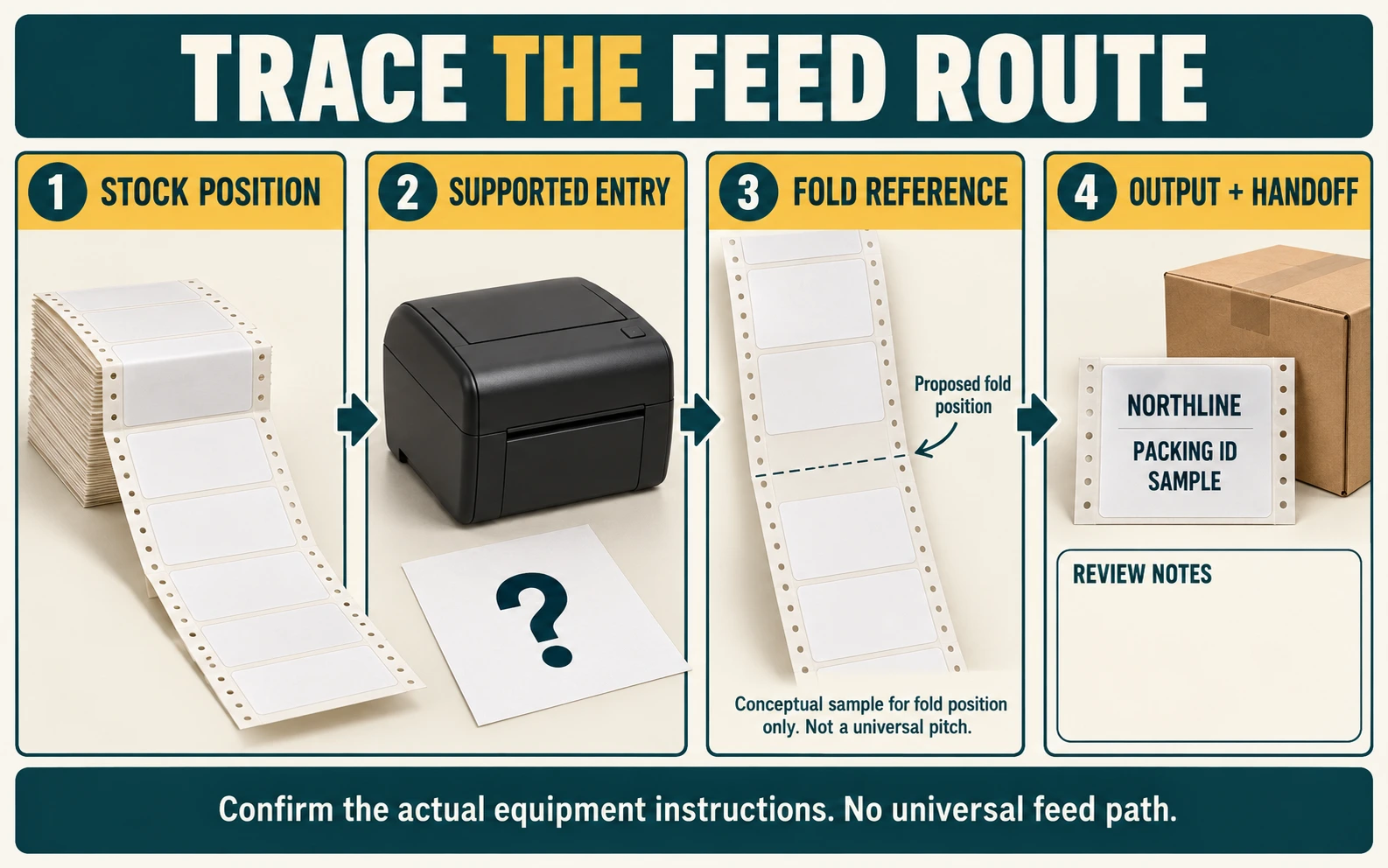
Follow the output as well as the incoming stock
State whether the printed piece is peeled, torn, cut or otherwise presented through a supported route. Identify who picks it up and where the next piece waits. Changing incoming presentation does not automatically improve the downstream motion or keep printed identities associated with the correct carton.
If the material carries changing data, keep the approved template and information source connected to the run. Supply form does not authorize the printer to create new identifiers. Check the actual returned strings and output association through the buyer's established process.
Include a representative changeover or replenishment in the review. Ask how the next stock pack is identified and how the restart is accepted. Do not invent a guaranteed reduction in stoppages from the larger supply alone.
Compare the complete station work
Consider storage protection, replenishment, clearance, unused-stock handling and the actual output task alongside the quoted material amount. Fanfold may suit a supported external-feed arrangement. A roll may fit the available station or already accepted process more simply. Neither format is universally faster or cheaper.
For quantity allocation, the labels-per-roll guide handles the roll schedule. Keep the fanfold pack schedule equally explicit by design. A shared order total does not show how many physical supply packs arrive or whether different artworks remain distinguishable.
For a feed-presentation enquiry, send the printer model and supported-media reference, station photographs and available space, final label dimensions, required print route, fold/perforation requirements if known, artwork, quantity by design and destination. Use the custom roll-label supply route to describe the current option and ask whether the proposed alternative is available. The next discussion can then compare two defined routes instead of choosing a box or roll from its headline count.