
The packaging team wants an eco-friendly sticker. A supplier sends a description of a paper face material. The brand wants to put a recycling claim on the finished package. Those three statements do not necessarily describe the same thing. Before approving the artwork, identify the exact claim, the part it refers to and the evidence that covers the proposed construction and destination.
Start with a specific buyer question. Are you asking about the label's face material, a particular component, the complete package in a named recycling stream, or wording that will appear in marketing? Keep those questions separate. A material description can be a useful starting reference without proving every conclusion the brand may want to communicate.
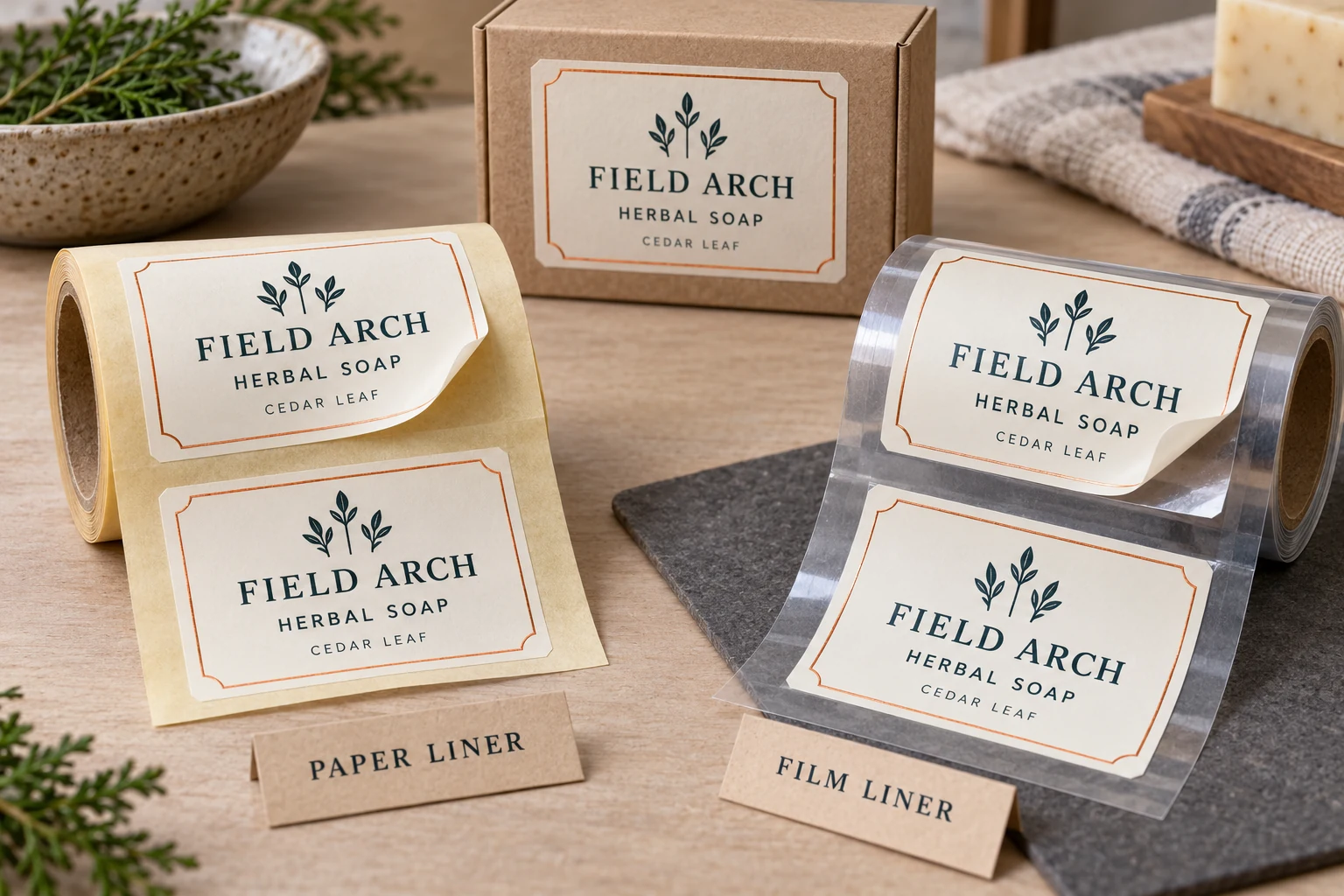
Name the component before asking for a document
Describe the package and intended label construction as accurately as the supplier can confirm. A pressure-sensitive label may include a face, adhesive, print, finish and a release liner. The package is another object with its own material, decoration and expected end-of-life route. A document about one component should be identified as such rather than described as an approval of the whole package.
The fictional example below separates a package, a printed label and a request for evidence. It does not show a certificate or prove that any part is recyclable, compostable, recycled or suitable for a particular collection system.
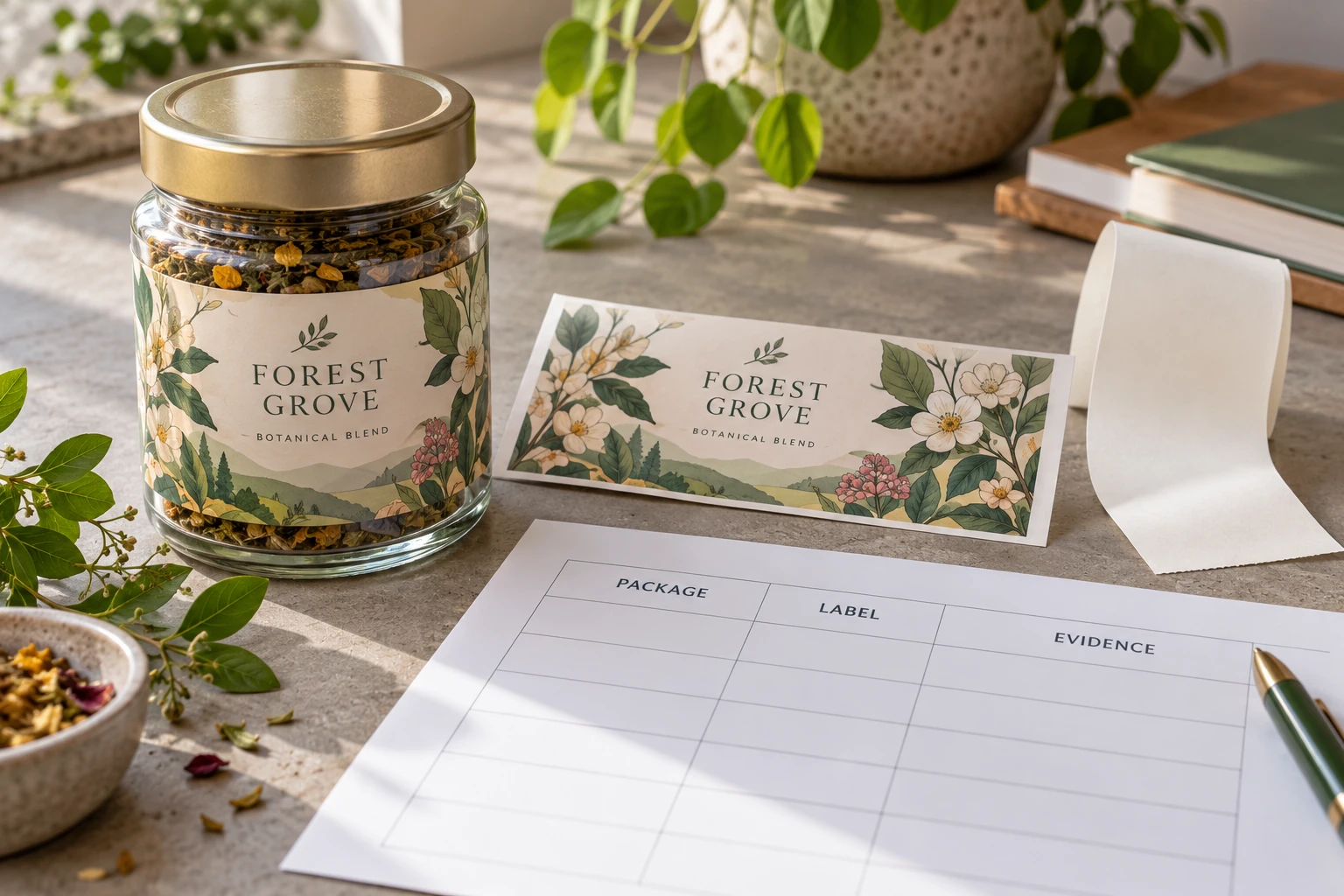
Ask the supplier what the document identifies: product reference, component, version, applicable conditions and any limits. If the offered face material changes, or the proposed label adds another finish, check whether the earlier reference still covers the construction. Do not treat a photograph of a natural-looking paper texture as documentation.
Separate a material statement from a package outcome
| Buyer question | Reference to request | What it cannot automatically settle |
|---|---|---|
| What material is proposed? | Identified component and specification | How the complete package performs in a recycling stream |
| What does a supplier document cover? | Product/version, scope and conditions | Every ink, adhesive, finish or future change |
| How is the package assessed? | Package material, label construction and named assessment route | Collection availability or every market's claim rules |
| What may appear in marketing? | Owner-approved wording and substantiation | A conclusion made solely by the printer |
For plastic packaging, RecyClass packaging guidelines organize guidance by packaging type and discuss components including labels and adhesives. That does not mean a generic sticker, this fictional illustration or a ZC Labels construction has been assessed under those guidelines. Ask the packaging owner which assessment is relevant to the actual package and target system.
The question may be different for a glass jar, a plastic bottle and a paper carton. A material specification that is useful in one discussion should remain linked to its package and scope. Do not infer an outcome for another package simply because its front artwork is the same.
Keep a marketing claim with its owner and evidence
The business responsible for the claim should decide the wording and obtain the appropriate review for the markets where the product will be sold. The U.S. Federal Trade Commission's environmental marketing resources explain that environmental claims require supporting evidence and point businesses to the Green Guides. This guide is a procurement checklist, not a determination that a particular label or advertisement complies with law.
If the proposed artwork includes a certification mark, logo or statement, ask who owns it, what specific product or component it covers and whether use is authorized. A supplier's generic material reference is not permission to print an unrelated mark. If evidence is unavailable, keep the statement pending with its owner rather than manufacturing a reassuring badge.
An illustrative buyer may receive documentation describing only the label face. The next action is to ask whether the adhesive, print, finish and the actual package are covered by the question being asked. The answer may be a narrower supported statement, a different evidence request or an unresolved issue. Do not fill the gap with an assumed result.
Compare practical options without promising an environmental winner
One option may change the label appearance, application method or proof requirements. Another may require additional information about the package or intended processing system. Compare the complete proposed construction and the buyer's actual priorities with the supplier. A natural appearance, a single component name or a broad “green” adjective does not establish the full environmental impact.
If the claim is not ready, the team may still discuss size, artwork placement and application using clearly provisional content. Do not release a final proof containing an unapproved claim merely because the physical dimensions are settled. Likewise, do not assume a material change has no effect on appearance or use; request the reference needed for that separate decision.
The surface-matching guide helps describe the actual application surface. The proof and sample guide separates a digital artwork approval from physical questions. Neither provides an environmental certification.
Send a request that names the intended decision
For an environmental evidence discussion, send the actual package material and photographs, intended label size and construction if known, approved artwork, the exact statement being considered, destination market, quantity by version and any specific assessment or document requested by the packaging owner. Mark the claim as pending if it has not been approved.
Use the custom roll label page for the supply-format discussion. Ask the supplier what information it can provide for the proposed construction and what remains for the packaging or claim owner to assess. A precise question is more useful than asking for an “eco” sticker without a defined meaning.