
The outside of the shop window says come in. The inside needs a different message for people leaving. A proof marked reverse print shows the outside view correctly, but the team has not agreed what appears on the interior face. Printing the first message on clear material does not create a second independently readable design.
For double-sided window stickers, approve two audience views and the separation between them. Name who reads each face, show both intended results upright, and ask the supplier which construction can keep the opposite artwork from interfering. Attachment, glass compatibility and removal still need their own review.
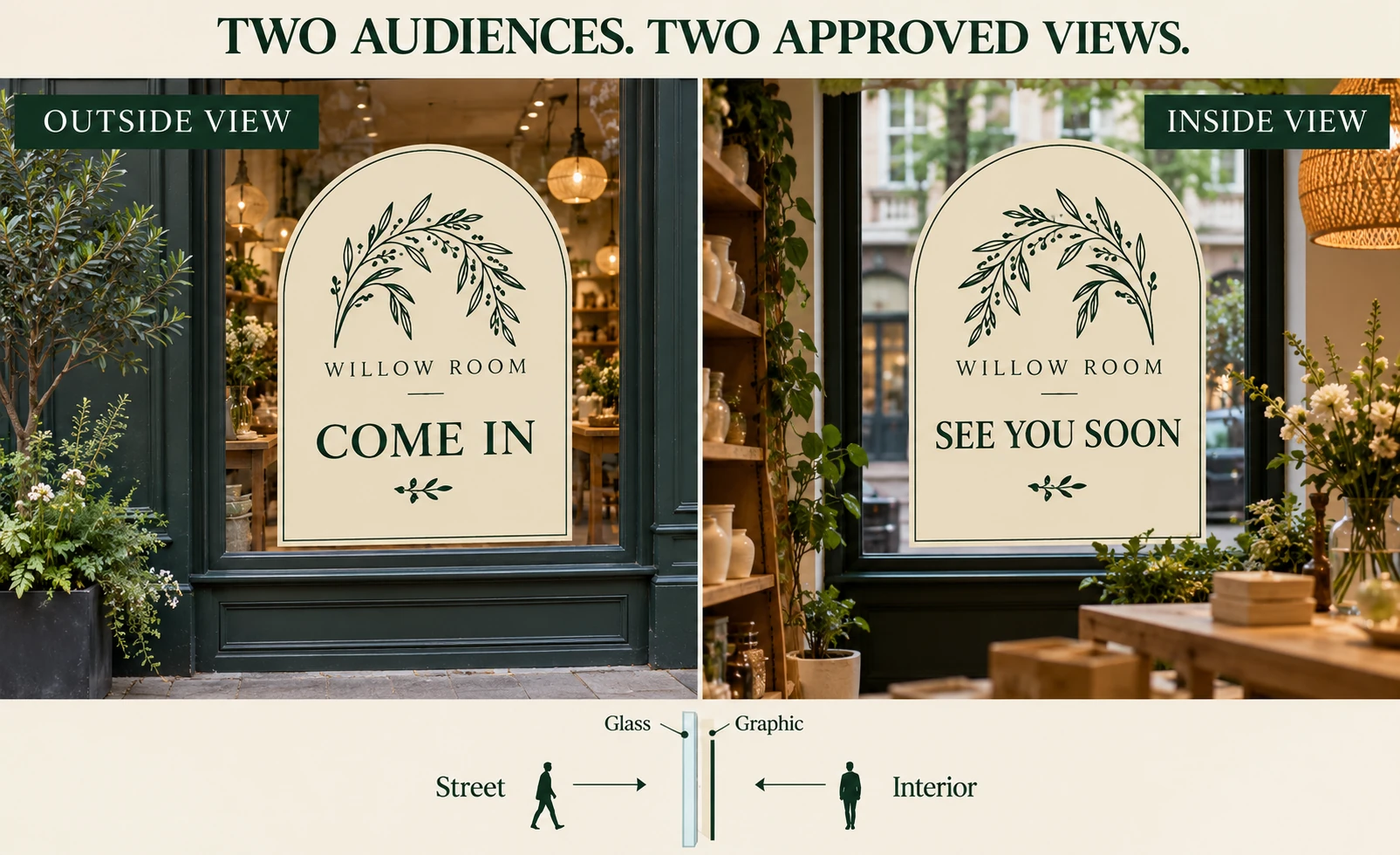
Draw the readers before drawing a print stack
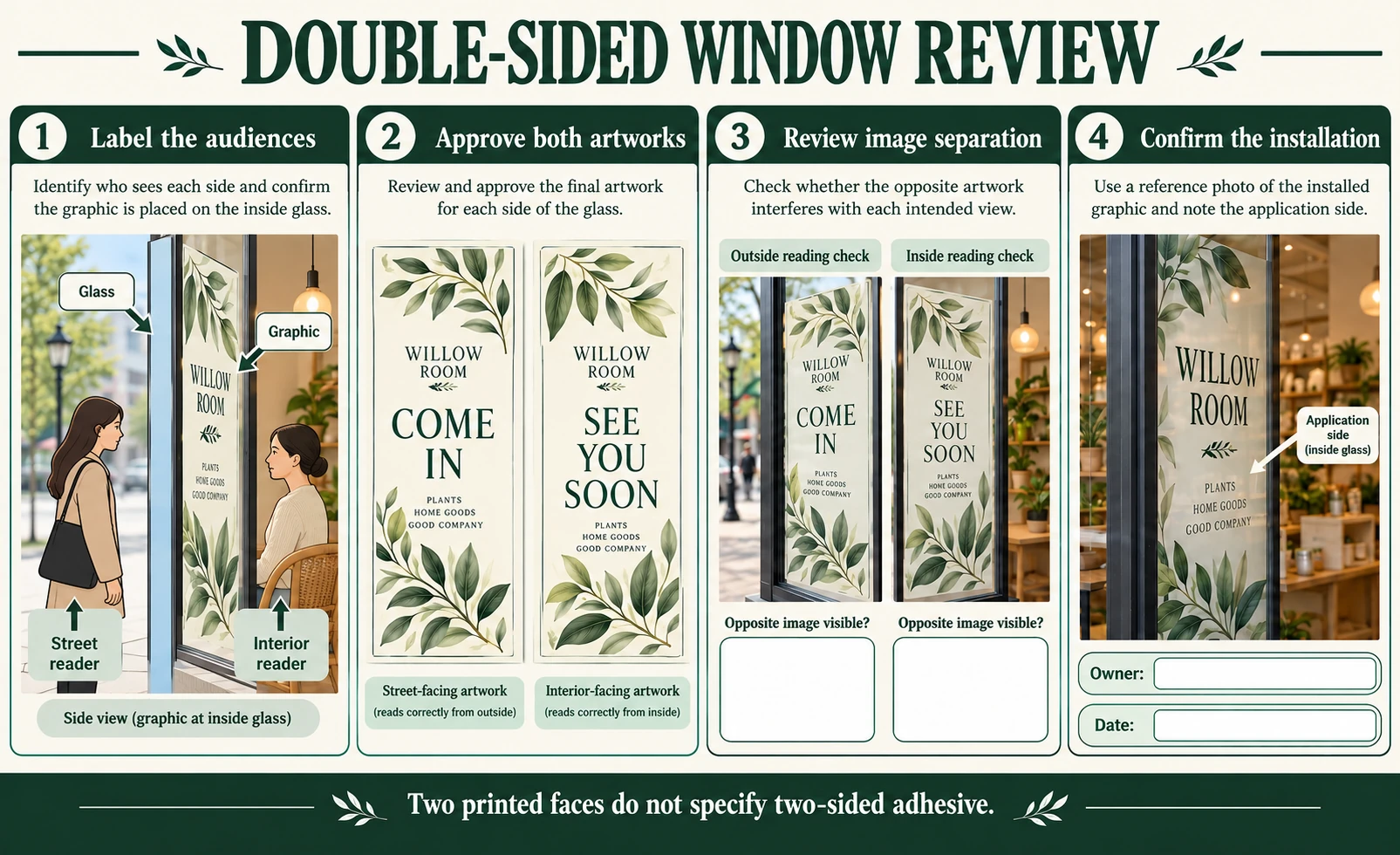
Mark the street, glass, interior and application side on one reference. Then create a separate artwork view for each audience. Name them outside-readable view and inside-readable view rather than relying on front and back, which can mean different things to the designer and installer.
The two messages may share a brand mark while serving different actions. A promotion facing arrivals and an exit reminder facing customers already inside need not use identical copy. The business owner supplies and approves both messages. A second face should not be filled with mirrored artwork merely because no approved interior file arrived.
Keep the final dimensions and top edge connected across both views. Mark which areas coincide and whether the two faces share the same outer shape. If one side has an intentional clear area, show it explicitly; do not assume it can remain transparent while hiding a conflicting image behind it.
Ask how the two images are separated
Drytac describes several double-sided graphic routes, including a multilayer printed construction and a combination of reverse-printed clear media with an opaque printed material. These examples establish that more than one route exists. They are not a universal layer recipe or confirmation that ZC Labels supplies those named systems.
Have the supplier identify the proposed material and image arrangement. Ask which surface contacts the pane, which image reads through the glass and what prevents the other face showing through. An instruction to add white may describe support behind color without defining adequate separation for two competing designs.
Drytac's Polar Blockout product description describes an opaque film used with a reverse-printed clear graphic. Its statements apply to its own identified product and assembly. They do not prove the opacity, lifetime or removability of another label being quoted.
Approve two reading conditions
Request a representative reference with both faces identified. Examine the proposed outside and inside views in their relevant backgrounds and lighting. A pale design against a dark interior is a different reading condition from a dark design facing an illuminated street.
| Review field | Outside audience | Inside audience |
|---|---|---|
| Intended message | Approved arrival-facing artwork | Approved interior-facing artwork |
| Reading direction | Normal from outside | Normal from inside |
| Competing image | Check interior artwork show-through | Check outside artwork show-through |
| Background | Actual interior and reflections | Actual external background and light |
| Obstructions | Frame, handle and display | Fittings, shelving and interior approach |
Use the artwork at its final size and assess important text from the intended approach. Record whether the sample represents the final construction and installation. A cropped picture on a white screen cannot settle cross-face interference on a real pane.
Keep two-sided printing separate from two-sided adhesion
Double-sided can describe two printed faces, adhesive on two sides or another supply arrangement. Spell out which meaning applies. A mounting adhesive that holds a printed sheet to glass has a different role from the layer separating the two images.
The reverse-printed window guide explains a one-audience inside-applied view. Its orientation record is useful here, but the second audience adds another appearance requirement. The cling and adhesive comparison concerns attachment and campaign changeover; it does not establish the two-image construction.
Avoid transferring a removable claim from one component to the complete proposed assembly. Ask what remains on the glass, what is removed, and whether the layers are intended to leave together. If reuse or storage matters, include that exact route rather than adding reusable to the artwork note.
Obtain the pane owner's compatibility decision
Identify the actual glazing and any coating, tint or treatment. Give the responsible glass owner or installer the proposed graphic coverage and material information so suitability can be checked. This article does not establish that a particular graphic is safe for every pane or prescribe a universal installation fluid.
Mark handles, frames and any area that must remain clear. Two readable designs do not justify covering an important sightline or required notice. If the installation has constraints, compare a different position, reduced coverage or another display method with the person responsible for the premises.
For a temporary campaign, agree who installs and removes the graphic and what condition the pane must be left in. A successful appearance review cannot settle retention, removal or the work required to change the display.
Release both views as one controlled set
Keep the artwork pair, dimensions, pane reference, proposed construction and accepted physical evidence together. A change to one face can affect the other if it changes coverage or separation requirements. Recheck the affected relationship rather than accepting the revised side in isolation.
For a two-view window graphic enquiry, send photographs from both reader positions, pane details available from its owner, both approved artworks, marked clear areas, dimensions, campaign dates, quantities and installation plan. Use the custom graphic project route to ask which construction is available. The supplier can then discuss two intended reading results instead of guessing which side of a vaguely labeled front/back proof the customer meant.