
The approved print is flat. The product designer's reference has a clear raised dome. Procurement receives two quotations described as three-dimensional labels and assumes the difference is mainly gloss. Before choosing either proposal, establish what is physically added above the print and how that completed assembly fits the product.
For custom domed labels, I would approve a representative cured construction and its mounted clearance before approving the decorative effect. A flat artwork proof can control wording and shape, but it cannot represent resin flow, the final edge or the way the raised piece sits beside a recess or control.
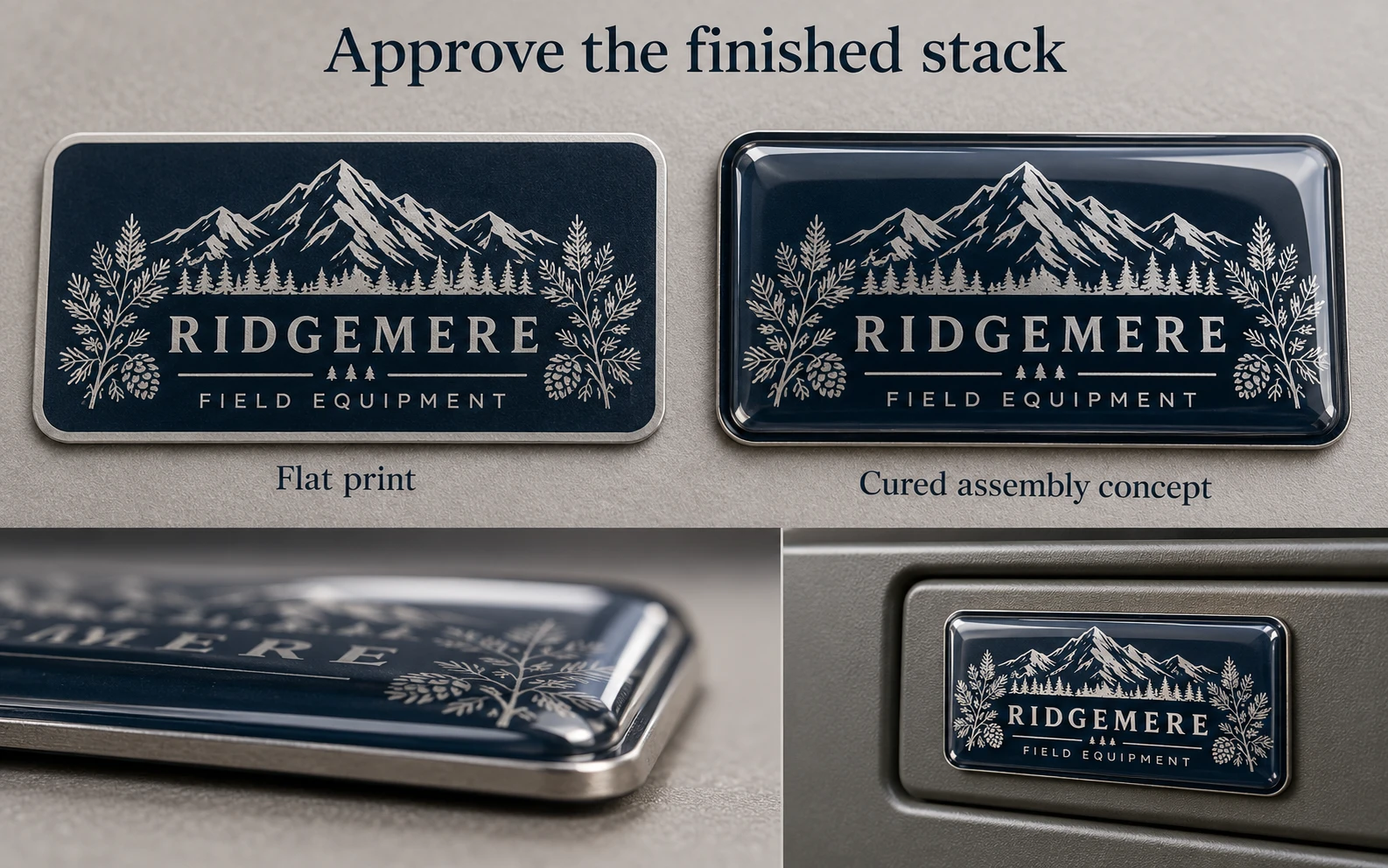
Distinguish doming from another raised finish
A resin dome adds a clear raised layer over printed material. Embossing forms relief through a different construction or process. A thick flat laminate is another possible surface. Their appearances may overlap in a small photograph while the physical requirements differ.
DomeTag's doming explanation describes liquid polyurethane flowing to the label contour before curing. Its contract-doming guidance also discusses interactions among inks, surfaces, coatings and the doming operation. Those are useful reasons to evaluate an identified assembly; its recipes, durations, warranties and performance claims belong to its own service.
If the purpose is tactile relief in part of the artwork rather than a raised clear body, the embossed-label guide addresses that different decision. Establish the intended structure before trying to compare quotations carrying the same visual adjective.
Name the layers and the boundary
Ask the proposed supplier to identify the printed face, relevant print/coating route, adhesive, liner and resin or doming scope. Keep that information linked to the artwork revision. A material substitution beneath the dome can affect which sample still represents the job even when the visible brand mark is unchanged.
Show the intended domed area and the edge of the finished label separately. Where the design includes an opening, narrow projection or sharp internal corner, ask the converter which contour can be produced and reviewed. Do not assume a shape feasible as an ordinary flat sticker is automatically suitable for the proposed dome.
| Proposed reference | Buyer question |
|---|---|
| Flat artwork | Are wording, image and outline correct? |
| Construction description | What will be printed, coated, cured and supplied? |
| Cured physical sample | What edge, profile and appearance does the proposal produce? |
| Sample on actual part | Does it fit the available space and use sequence? |
| Identified retained assembly | Which version represents the accepted result? |
The thickness-layer guide helps distinguish total supplied thickness from the thickness remaining on the product. For a dome, ask how the relevant profile is described and measured rather than requesting a single thickness with no location or layer definition.
Review the print-to-resin interface
A clear upper layer is not evidence that everything below it is compatible. Ask which printed construction the doming provider has evaluated and what project-specific sample is needed. If separate businesses print and dome the label, define who receives which sample and who owns the completed assembly review.
DomeTag's contract guidance specifically asks for swatches where compatibility is uncertain and discusses coatings as part of that decision. Do not copy its preferred materials into an unrelated order or assume its observation predicts another resin system. The procurement lesson is to identify and review the exact combination.
Retain samples with their state clearly identified: printed only, domed but not accepted, or accepted completed assembly. A photograph of the prettiest flat print should not become the reference for the cured surface. If a coating changes after the initial sample, ask which part of the review needs repeating.
Check clearance where the badge will live
Put the completed sample on the actual part or a representative approved part. Examine the relationship to recess walls, adjacent controls, opening seams, mating parts and the normal handling route. Keep attachment suitability separate from available height. A badge can fit within the outline while protruding into another component's working space.
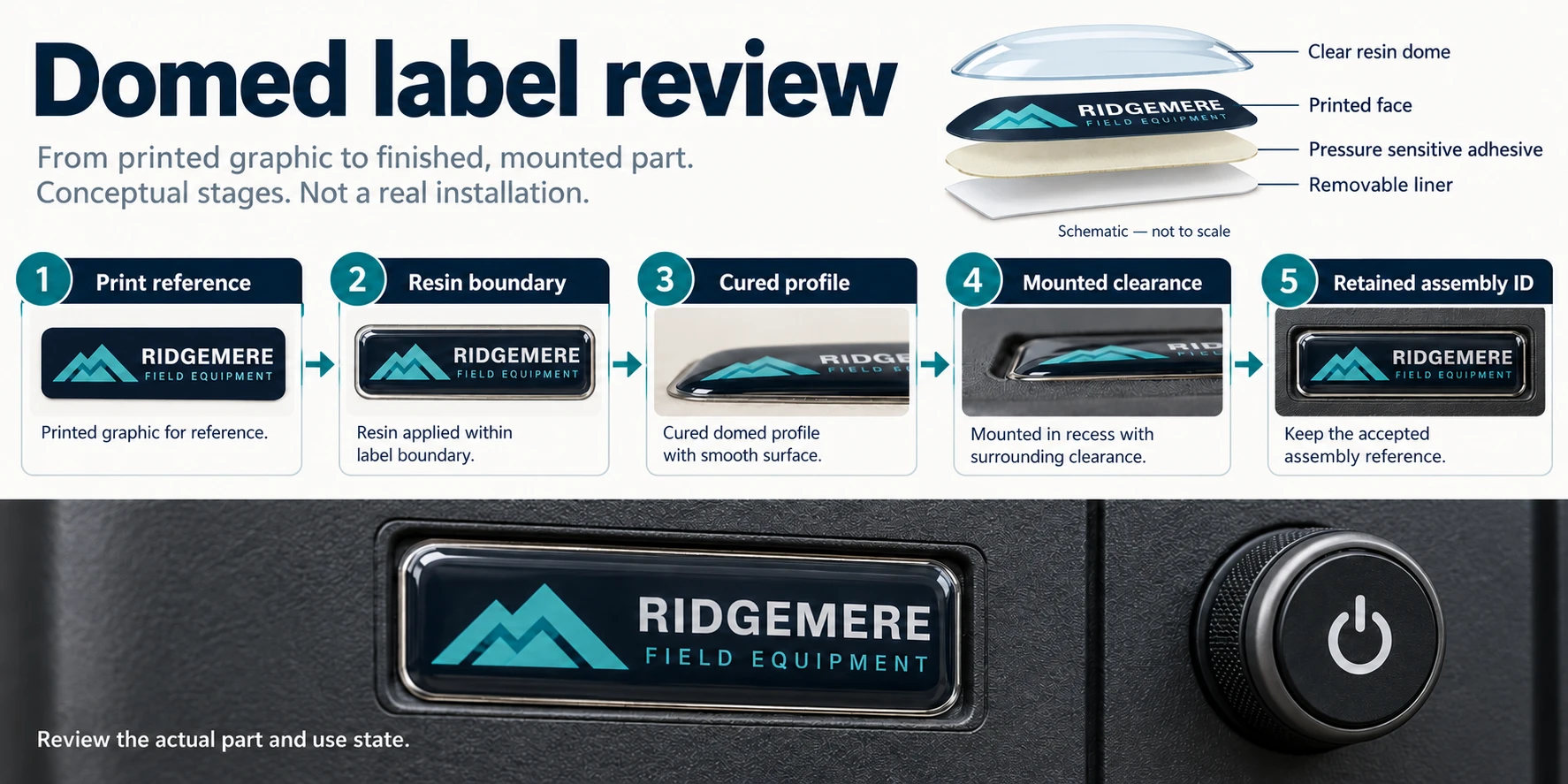
For an illustrative equipment badge, a designer might approve the domed appearance on a flat card while the product has a shallow recess. The next useful sample is the completed badge in that recess. That comparison can reveal a fit question without demonstrating adhesive durability or outdoor life. This is a planning example, not a customer installation.
Have the responsible owner define what matters and how it will be judged. This guide provides no universal protrusion limit, bend radius or clearance allowance. If the surface curves, obtain a specific feasibility review rather than assuming that a flexible-feeling dome will remain suitable on any curve.
Include packing and application in the completed scope
Ask how the finished pieces will be protected, identified and removed from their backing. A domed piece adds a surface that must arrive in the state the buyer approved. A generic count of labels says little about the delivered presentation or handling access.
Where the project uses automated application, confirm that route with the equipment owner. A hand-applied sample is useful for a mounted appearance review but cannot establish that a machine can handle the raised assembly. If manual application is the intended route, review its actual grip and placement sequence instead of paying for an irrelevant machine trial.
Compare alternatives fairly. A flat printed label may fit a tight space and provide the required information without a raised body. A domed finish may be worth investigating when that physical appearance is important and the complete assembly can be accepted. Obtain actual costs, available services and evidence scope before choosing.
Keep the accepted stack attached to the order
Save the artwork, layer description, contour, completed-sample identity and mounted observations together. State which exposure requirements remain unverified. A glossy sample establishes neither a cleaning specification nor a lifetime promise, and another maker's published performance cannot be borrowed as evidence for this order.
Send ZC Labels the badge artwork, actual part photographs, recess or clearance information, intended mounted state, relevant exposure and handling, quantities and destination through the label project enquiry. Use the custom label page for the supply discussion and ask whether the specialist doming scope is available. These details allow a specific feasibility and sample conversation without treating a raised reference photograph as an approved construction.