
The buyer orders a roll described as thermal labels. The packing team opens the carton and asks whether it needs a ribbon. That missing word can stop an otherwise sensible purchase. Two labels can have similar dimensions and carry the same artwork while requiring different printing routes.
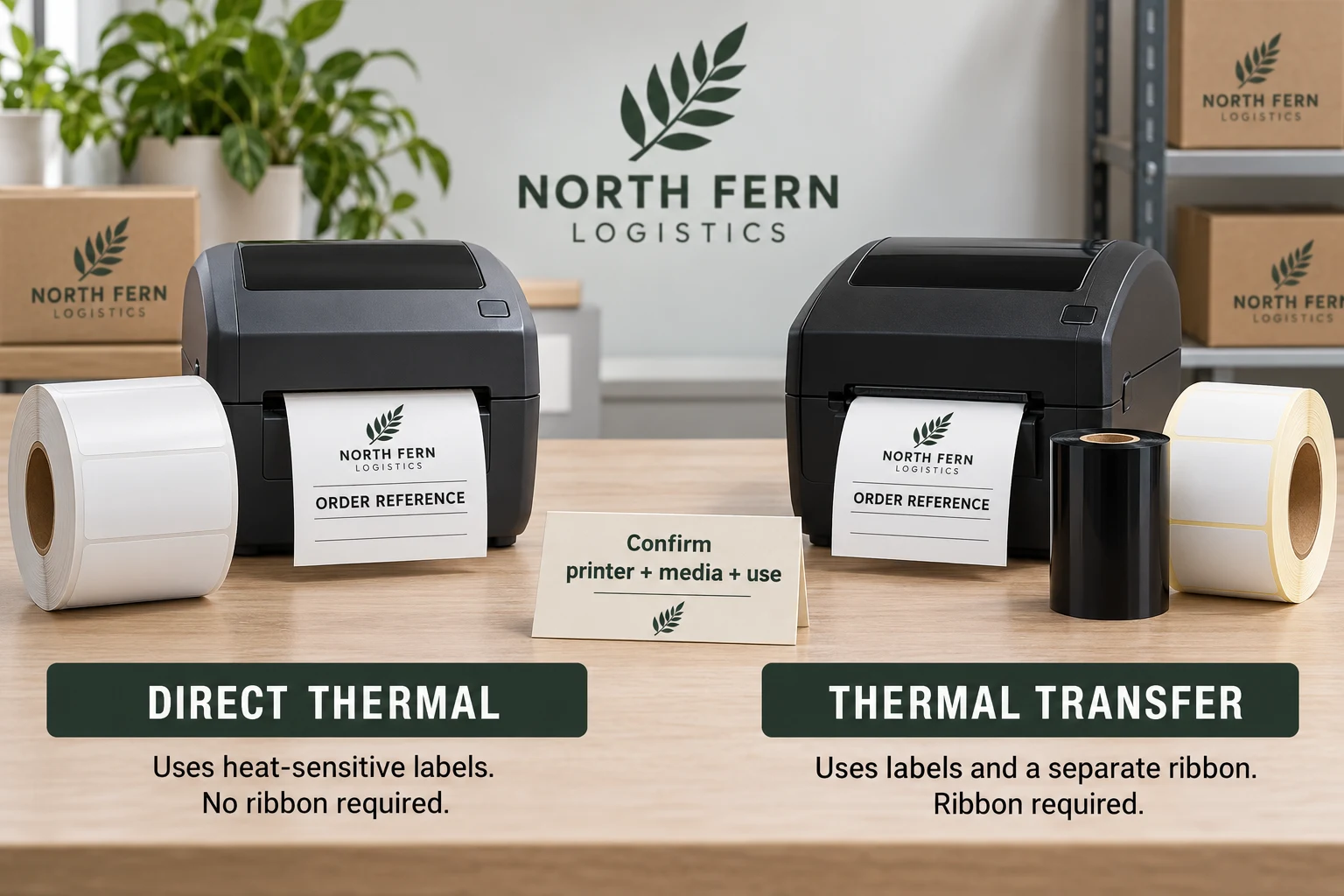
For direct thermal vs thermal transfer labels, start with the actual printer and the life of the information it must produce. Direct thermal uses heat-sensitive media without a ribbon. Thermal transfer uses a ribbon with a compatible receiving surface. Neither name establishes adhesive suitability, barcode acceptance or a guaranteed service life.
Establish what the installed printer supports
Record the exact printer model and configuration, rather than a photograph of its front panel alone. Obtain the applicable equipment documentation and ask the responsible operator which print method is configured. Some equipment supports only one route; another configuration may support both. The presence of a roll holder cannot answer that question.
Also record the supported media dimensions, roll or other feed requirements, core, sensing method and relevant restrictions. A label that is printable by the selected technology can still be supplied in a form the printer cannot load or track. Keep those requirements attached to the order, instead of treating a common label width as proof of compatibility.
If the operation is still choosing a printer, give the equipment provider the real label task first. Buying the cheapest available roll and then asking which printer can consume it reverses the decision. If the printer already exists, avoid proposing a different technology without identifying the equipment and operating consequences.
Separate the imaging mechanism from label attachment
Zebra's thermal-printer explanation distinguishes heat-sensitive direct thermal media from thermal transfer printing through a ribbon. It also identifies light, heat and abrasion as concerns for direct thermal image retention. Those general mechanisms help define a comparison; they do not predict the performance of an unidentified roll.
The printed information and the adhesive have separate jobs. A code can remain dark while the label detaches. A firmly attached label can carry information that is no longer readable. Specify both the contact surface and what the printed content must remain useful through.
Do not assume paper always means direct thermal or synthetic always means thermal transfer. Check the identified material and supported print route. An invoice description such as white thermal stock leaves too much unresolved if it does not identify the intended technology and construction.
Describe the information's actual working life
Ask when the label is printed, when its information is last needed and what happens between those events. A short internal picking task differs from a product identifier that remains relevant through storage and later service. Avoid assigning either task a universal number of days based on its industry name.
List meaningful exposure: lighting, heat sources, abrasion, moisture, cleaning contact and the way the label is packed or handled. Keep known conditions separate from guesses. If a shipment may wait in conditions the buyer cannot describe, identify that gap before accepting a durability claim.
Where the printed information must support a formal receiving or verification requirement, obtain that requirement from its owner. A phone scan or a dark-looking line of text is not interchangeable with a specified barcode assessment. The retail barcode evidence guide explains that separate acceptance decision.
Compare the complete consumable proposal
For direct thermal, request the actual media reference and relevant limits. Eliminating ribbon handling can simplify the local consumable set, but does not remove the need to identify, store and review the media. Any coating or special protection needs its own product evidence.
For thermal transfer, identify both the label and ribbon. A ribbon family name alone is not a complete pairing. The proposed material, coating, ribbon and supported equipment conditions need a representative review. More resistance should not be inferred simply because a ribbon is present.
| Purchase field | What needs confirmation |
|---|---|
| Printer | Exact model/configuration and supported method |
| Media | Identified material, size, feed and sensing requirements |
| Ribbon, if used | Actual reference and supported pairing |
| Information life | Required reading event and intervening conditions |
| Attachment | Package surface, application and end state |
| Acceptance | Who reviews print, data and physical label behavior |
Keep quoted scope comparable. One option may include ribbon while another excludes it; one may require different equipment or additional local handling. Obtain actual costs and responsibilities. This guide supplies no benchmark price or universal lower-cost technology.
Make one representative trial answer the right question
Use actual-size artwork and the longest relevant data. Record the printer, material and ribbon where applicable, together with the template and the conditions the operator used. Retain output that identifies the combination instead of choosing an anonymous good-looking label from a pile.
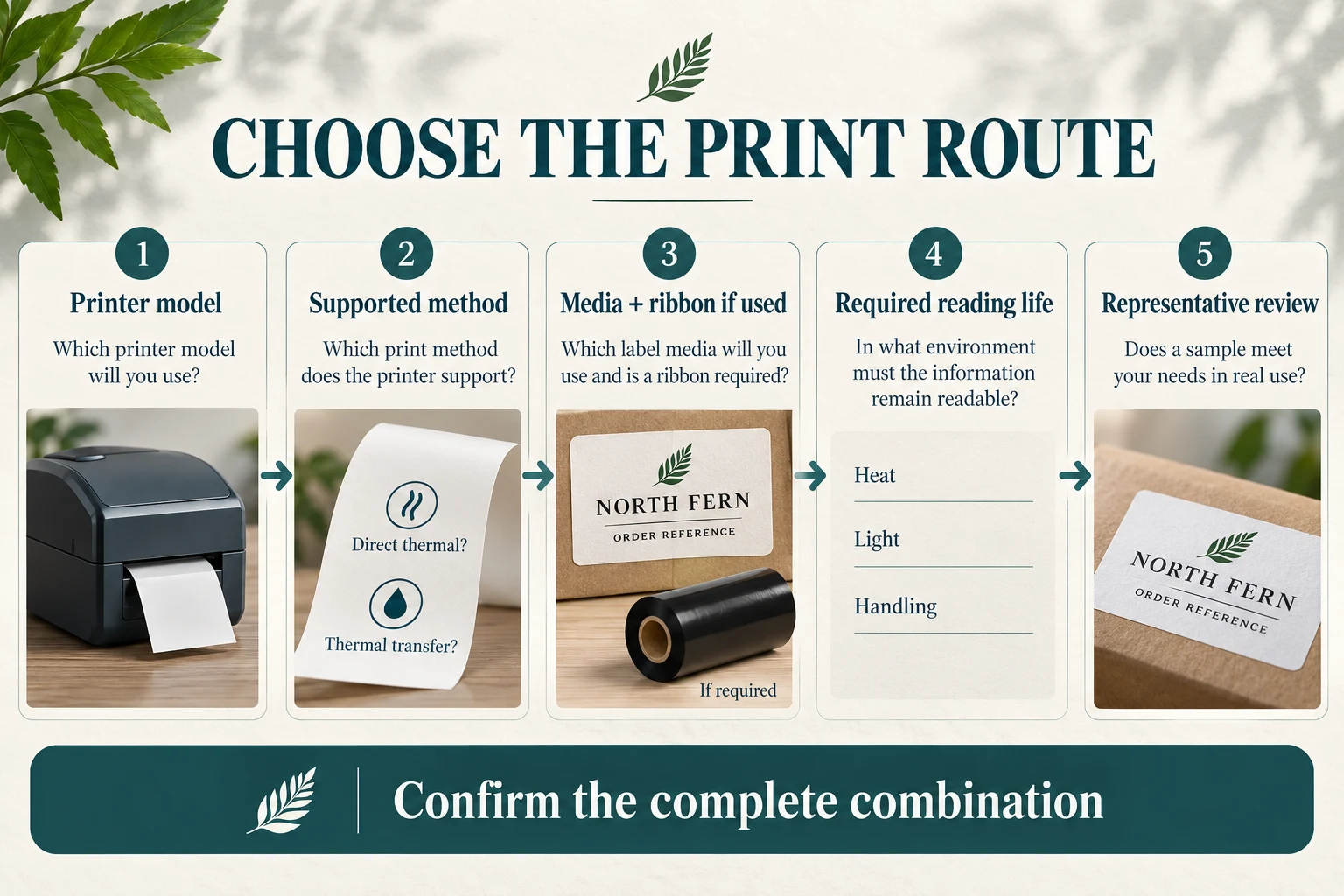
Review the intended reading and handling sequence on the actual package where relevant. A flat print can help examine reproduction but leave curved placement, contact or application unanswered. Have the responsible parties define the observations and limits; this article prescribes no universal heat setting, rub count or acceptance grade.
If a different technology is proposed after the first review, identify what changed and which evidence must be repeated. Keep a printer-mode decision separate from changing the data itself. A new ribbon cannot correct a wrong identifier, and an edited template cannot establish suitability of a different label surface.
Keep preprinted branding and later coding connected
Some projects combine fixed decorative printing with locally added information. Define the later-print field and the surface presented there. A visually pale rectangle may still carry a finish that matters to the second pass. Confirm the complete construction rather than approving the field from its color.
The thermal-transfer overprinting guide covers that narrower two-pass project after the route has been selected. This article's decision is which printing method and consumable set the buyer should evaluate in the first place. For either route, keep the data owner and the print-acceptance owner identifiable.
For the custom roll label supply discussion, send ZC Labels the printer model and supported method, current media and ribbon references if known, label dimensions, actual-size artwork or changing-data example, package photos, required information life, quantities and destination through the label project enquiry. State whether you need a preprinted label, a later-print field or another supply scope so availability can be confirmed. These inputs allow a specific material and format discussion without asking the phrase thermal labels to decide the whole job.