
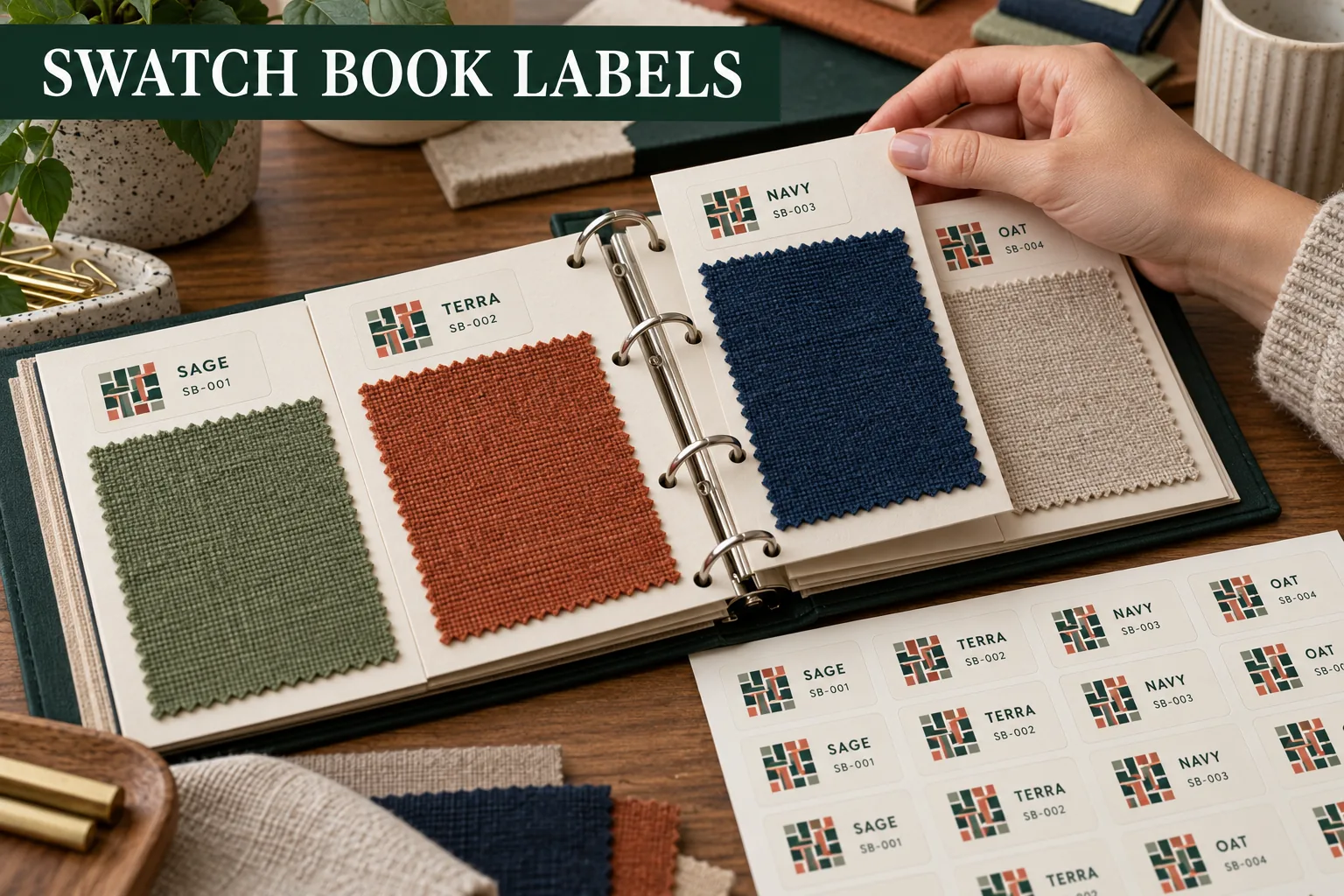
A swatch book gets opened, passed across a table, closed and reopened weeks later. The buyer may remember a blue fabric but not its code. If the label detaches or the tiny SKU cannot be read, the sample stops helping the sale. I would judge the sticker after several people have handled the book, not only in its new-box photograph.
Start by identifying where the label belongs: on a backing card, a plastic tab, a sample envelope or the swatch itself. Directly sticking to fabric or a coated finish can alter the material or make removal difficult. The collection owner should decide whether the sample will be reordered, replaced or discarded after use.
Give Each Physical Sample a Stable Identity
| Field | Purpose | Approval question |
|---|---|---|
| Swatch name | Human recognition | Exact approved spelling |
| SKU or material code | Quotation and reorder | Unique current identifier |
| Collection version | Separates old from new | Who updates the book? |
| Original color cue | Visual navigation | Does it compete with the sample? |
An original geometric icon can distinguish a family of materials, but the real swatch must remain visible. A decorative sticker should not cover the exact texture or color the buyer is evaluating. Use a consistent placement and leave enough room for the longest plausible code, not just the shortest sample in the first batch.
Test Handling and Replacement
Make a short prototype book. Turn pages repeatedly, carry it in a bag and let several people pull sample tabs as they normally would. Check whether label edges catch, type rubs away or a code disappears behind a binder ring. If swatches are frequently replaced, trial removal from the chosen backing card or tab without tearing it.
Printed color on a label is not a guaranteed match to the physical textile, paint or material. Avoid presenting the small sticker as a color standard unless the collection owner has a controlled approval method. The sample itself is the reference; the label supports identity and navigation.
Keep the Book Current
- Send the actual swatch holder or backing card
- Supply approved names, codes and version rules
- Proof the longest code at final size
- Test repeated page turns and sample removal
- Check labels near binder rings and cutouts
- Define how retired samples and labels are replaced
The reorder checklist helps control changing SKU files; the adhesive guide frames replacement tests. Send a photo of the open book and a sample data sheet through the specification planner. A useful swatch label protects the connection between what the buyer touched and what the supplier will quote.
Questions Before You Order
Should the sticker go directly on a fabric swatch?
Only after testing. Direct contact may affect fabric, finish or removal; a backing card or tab can be safer for some sample systems.
Can one label design cover an entire changing collection?
A consistent template can, but each variant needs controlled name and SKU data. Reprint or replace outdated identifiers when the collection changes.
How small can a swatch label be?
Size should be set by the longest real code, readable type and handling method. Print a final-size sample before bulk production.