
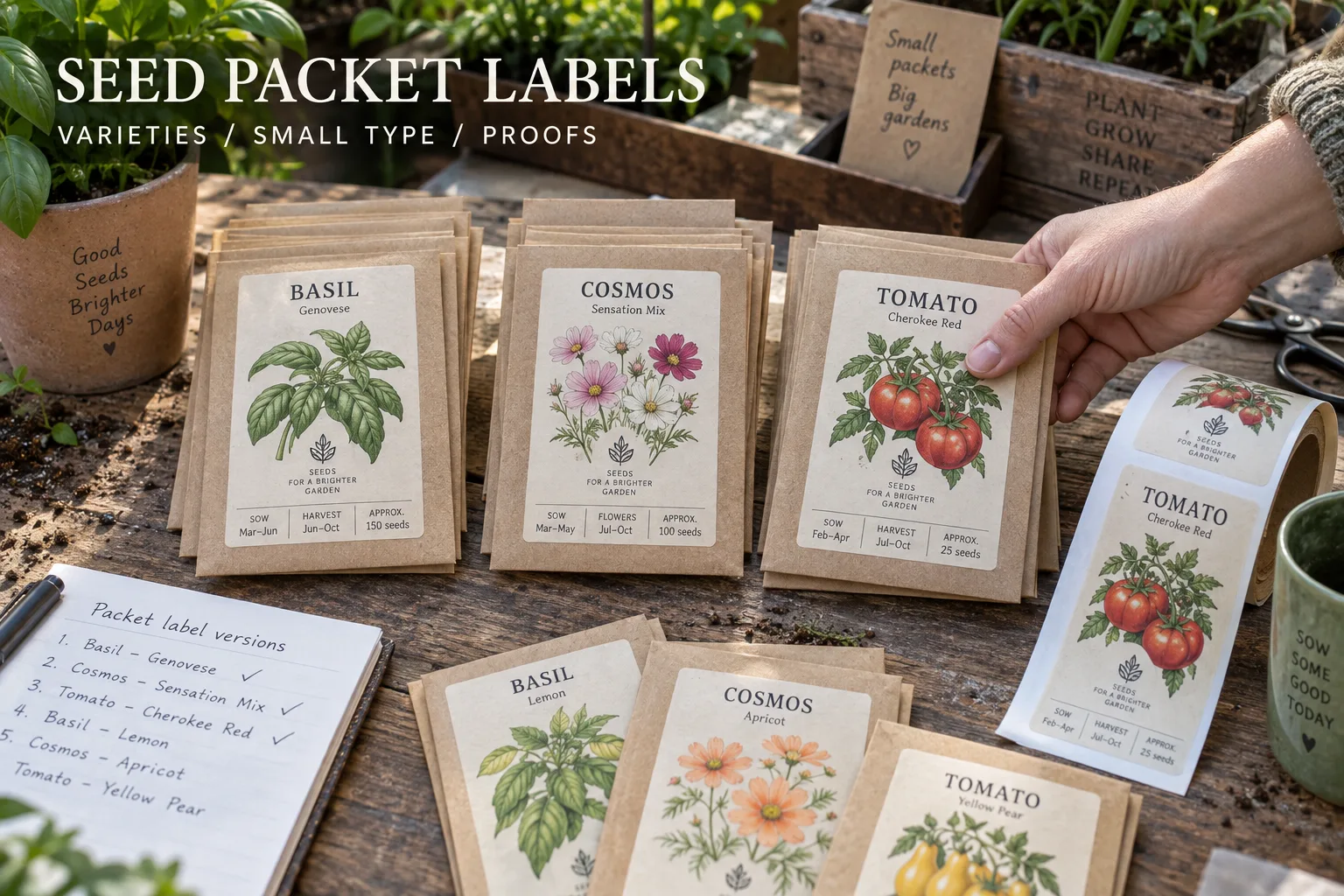
Seed packets invite browsing. Someone picks up basil, puts it back, compares a second herb and reads the tiny line that tells them what they are buying. That is why I would not treat a seed packet label as a miniature poster. It is an identification system for a growing set of varieties.
The first packet in a range is easy to design. The twentieth is where version control begins to hurt. A plant illustration gets copied, a variety name changes, an older file sits beside the approved one. The design work and the file work need equal attention.
Build a Range Before Polishing One Packet
Lay out several planned packets together: a leafy herb, a flower and a vegetable are a useful spread. Decide which parts stay in the same position. The variety name, a recognizable plant image and the seller's mark should have a stable hierarchy, even when the illustration changes.
I would use original botanical drawings with distinct silhouettes or color cues. A blank white label protects no one from a confusing range. At the same time, a dense watercolor can compete with the variety name. Print three designs at actual size and look at them from a shop shelf, not only on a monitor.
| Information layer | Source to confirm | Print review |
|---|---|---|
| Variety name | Approved SKU list | Fast recognition across the range |
| Plant artwork | Original or licensed file | Contrast at final size |
| Growing text | Seller-approved copy | Readable small type |
| Batch or lot area | Operational plan | Space for the chosen marking method |
| Barcode or code | Final supplied code | Scannability on a real packet |
Measure the Envelope With Its Fold and Fill
Paper seed envelopes can have seams, a folded top and a little thickness after filling. Measure the usable front panel in mm on the final packet. A label placed across a moving fold may not sit the same way as it did on the empty envelope.
If the seller uses several packet sizes, keep the visual family but prepare separate dimensions. Shrinking the same artwork for every size can make the smallest directions unreadable. I would identify the essential front information first, then decide which details belong on the back or on an insert.
Small Type Needs a Physical Proof
Names, instructions and quantity information can be subject to market-specific requirements. The seller must supply and approve that copy. The printer can check whether it fits and reproduces clearly, but should not invent the content or confirm a growing claim that has not been substantiated.
Fine type, textured paper and pale colors are a risky combination. A final-size proof should answer whether the important words remain readable. If the QR code or barcode is essential, test the actual supplied code on the finished packet. Our QR code testing guide describes the same discipline for codes.
Keep Seasonal Changes From Becoming New Errors
A seed range can change without a full redesign: new varieties arrive, names are corrected and quantities shift. I would keep a version table with SKU, file name, revision date, packet size and order quantity. One person should approve the final set. A proof for the basil packet is not approval for the tomato and cosmos packets.
Do not quote only the total number of labels. A request for 5,000 across 20 varieties could mean very different splits. Give the real quantity by design, plus any agreed spare allowance. If some versions are intended for next season, mark them separately so an old packet does not slip into a current shipment.
- Send final filled envelopes and dimensions
- List every variety and version identifier
- Provide approved growing and market text
- Check artwork and type at printed size
- Test supplied barcodes or QR codes
- State quantities by variety, not just total
- Retain one approved finished packet per design
Our plant pot label guide covers a different garden surface. The artwork guidelines and specification planner help turn the seed range into a clear brief. I would end with the full packet set on a table. If one variety looks like it belongs to another, the system still needs work.
Questions Before You Order
Can one seed packet label template cover many varieties?
A common layout can help recognition, but each variety still needs its own approved name, artwork, information and quantity. Review all versions at final size.
How small can seed packet text be?
There is no universal size to promise from a screen mockup. Print a final-size proof on the chosen material and check the important text under normal reading conditions.
Who confirms germination or growing claims?
The responsible seller supplies and approves all variety, growing and market-specific statements. The printing review focuses on artwork reproduction and legibility, not independent validation of those claims.