
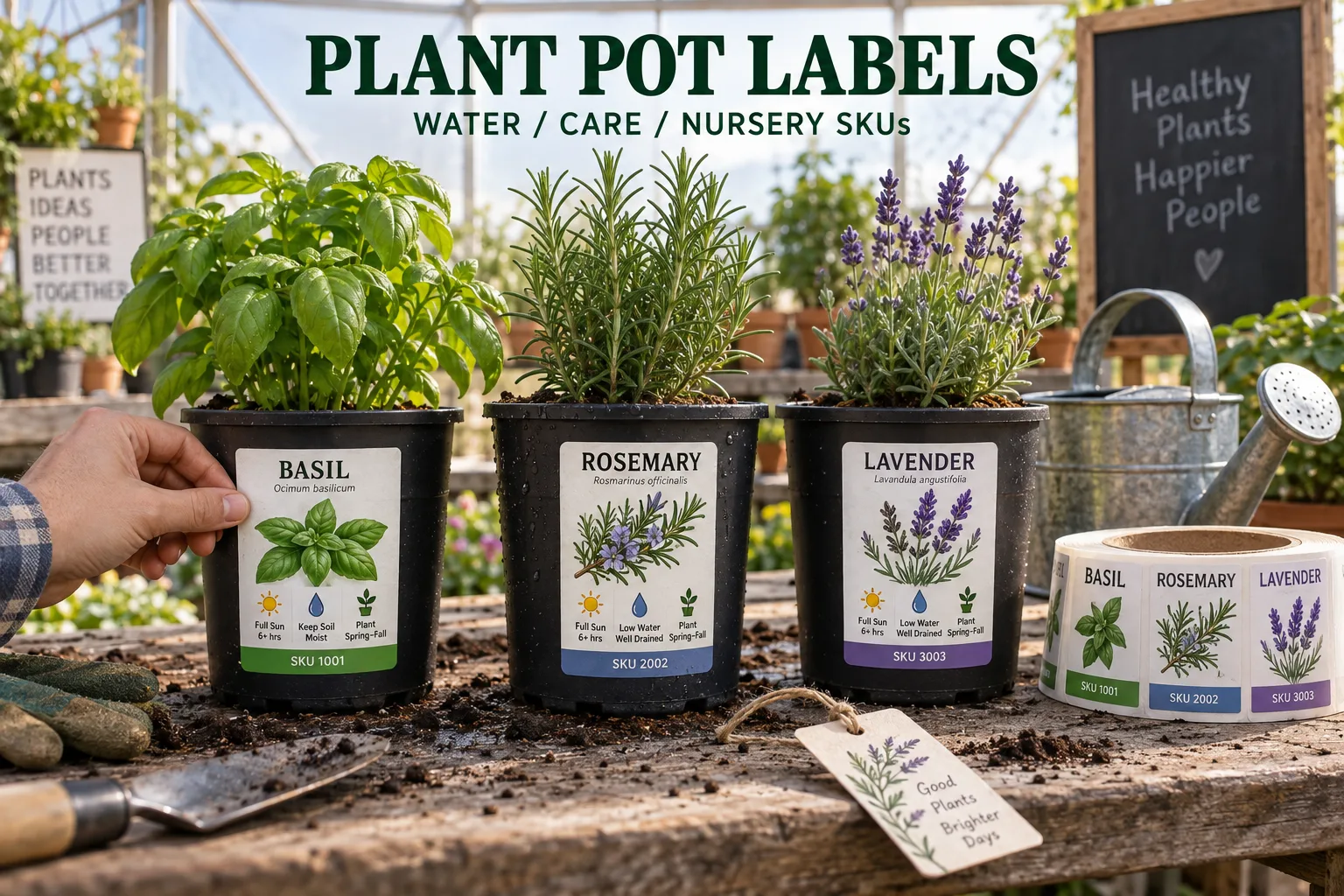
A nursery label can be neat when the pot leaves a packing bench and almost invisible by the time it reaches a garden-center trolley. Leaves cover it. Soil touches it. Water runs down the plastic. I would review custom plant pot labels in that order, rather than begin with a choice between matte and gloss.
The buyer has two customers to satisfy: the staff who need to sort the plants and the shopper who needs to recognize and care for them. A lovely leaf illustration serves the second customer only if the cultivar and practical information remain easy to find. A barcode serves the first only if its position works on the curved pot.
A Pot Sticker and a Hanging Tag Solve Different Jobs
Start with the point where the information belongs. An adhesive label keeps identification on the container. A hanging tag or insert can offer more space and avoid a difficult adhesive surface. If the pot is heavily textured or rarely dry at application, I would let the tag compete fairly instead of insisting that a sticker must be the answer.
Consider a nursery selling small herbs at a local stall and a grower shipping shrubs through retail distribution. The herbs may need a compact name and care cue. The shrub line may need cultivar, pot size, handling information and a retailer's identification system. One generic layout is unlikely to serve both efficiently.
| Detail | Record before quoting | Production question |
|---|---|---|
| Pot surface | Plastic type and texture | Where can the construction be trialed? |
| Label area | Usable width and height in mm | Does the artwork follow the curve? |
| Application condition | Dry, damp or soiled surface | What preparation is feasible? |
| Watering route | Spray, drips and handling | What exposure should the test include? |
| Plant variants | Cultivar and size list | Which text and codes change? |
Review the Surface Before Increasing Adhesive Strength
A lifting corner is not automatically solved by asking for stronger adhesive. The label may span a ridge, start on contamination or resist a tight curve. Measure the panel, inspect the pot and discuss the condition at the moment of application.
Apply trial labels before and after the intended preparation method. Record that method so the test can be repeated. If a nursery cannot keep the surface clean and dry, say so in the inquiry. A sample applied under perfect studio conditions will not explain how the real packing bench behaves.
Care Icons Should Carry Useful Information
Original leaf illustrations, sun symbols, water droplets, flowering cues and simple plant silhouettes give the label a recognizable identity. There is no reason to replace all that with a blank white sticker. Keep the artwork closely connected to the plant and its intended use.
Accuracy matters more than the number of symbols. The grower should approve the plant name and care information. Avoid letting a decorative sun icon accidentally communicate a specific care instruction that nobody has checked. Pair important cues with readable text, especially when an icon could be interpreted in several ways.
Print and Scan at the Final Size
A paper prototype on the pot is useful before a material trial. Hold it at normal shopping distance and check what foliage covers. If a barcode or QR code is required, test the final printed code on the actual curved container using the intended reader or device.
A flat proof cannot settle a curved-surface scan. Moving a code away from a seam or reducing unnecessary artwork around it may help the layout without enlarging the whole label. Keep the destination and code file under the buyer's control.
Seasonal Changes Need a Quiet Version System
As a planning example, eight cultivars in two pot sizes create sixteen combinations, even when the graphic template is shared. List the quantity and file version for each combination. Do not call sixteen SKUs one design merely because they have the same green border.
Confirm what carries forward to the next season: stable brand artwork, plant names, care content, price information or retailer codes. Variable data can become the real source of waste when a sale period changes. A smaller, well-controlled version run may be more useful than a larger batch made for a price break.
- Photograph the actual pot and usable panel
- Measure dimensions in mm
- Describe surface preparation and watering
- Approve cultivar names and care information
- Test edge retention after the intended handling
- Check code readability on the filled pot
- Separate quantities by cultivar and pot size
- Confirm packing and reorder records
Use the label specification planner to assemble the brief. Our guides to outdoor exposure and code scan testing cover the follow-up questions. I would judge the label after watering and sorting. That is when the nursery needs it to keep doing its job.
Questions Before You Order
Can adhesive labels be applied to wet or dirty plant pots?
Do not assume a construction intended for a clean dry surface will work on a wet or dirty pot. Describe the actual application condition and test preparation with the proposed label.
Are pot stickers better than hanging plant tags?
They solve different jobs. A sticker can identify the container; a hanging tag offers space and may avoid a difficult surface. Compare the handling route and information required.
What artwork should appear on a nursery label?
Use accurate plant identification plus approved care information, original botanical graphics and readable icons. Keep variable cultivar, size and barcode fields controlled by SKU.