
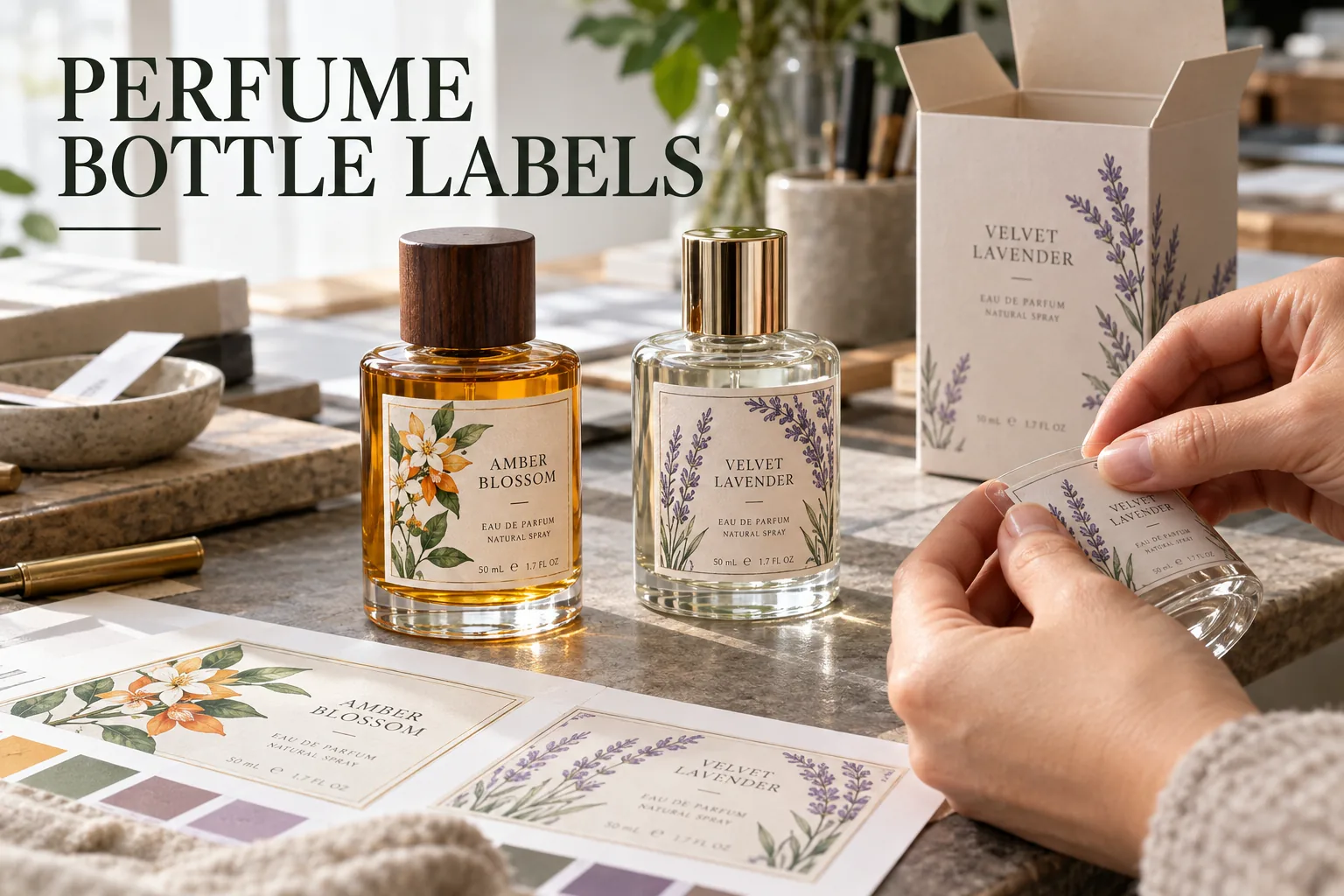
On a perfume shelf, the eye goes to the bottle before the label. At a packing bench, the order reverses: someone must place that label straight on glass, fit the cap and slide the bottle into its carton without scuffing the print. A beautiful flat mockup does not answer whether the label survives those three movements. I would put the actual filled bottle and box beside the artwork before choosing a material.
Small fragrance brands often want one visual system across several bottle volumes. That is a good aim, but one label size is not automatically the economical answer. A narrow bottle can make the same copy curve out of view. A wider bottle may leave too much empty glass around it. Start with a family of bottle measurements, not just a family of logos.
Measure the Visible Panel, Not the Glass Circumference
Take a photograph from the position where a buyer sees the bottle on the shelf. Mark the front area that stays reasonably flat and visible after the bottle is filled. Measure that area in millimeters. Then check the back for directions or other approved information. A wraparound label may work, but its ends, seam and small copy have to be reviewed on the real curvature.
| Decision | What to send | What can go wrong |
|---|---|---|
| Bottle shape | Filled bottle dimensions and photos | Text bends away from the front view |
| Front artwork | Final-size print file and intended position | Fine details disappear at shelf distance |
| Back information | Owner-approved copy by fragrance and market | Late text changes crowd the label |
| Handling | Filling, wiping and packing sequence | Oil or friction marks a finish |
| Carton | Actual box and insert | Label edges rub during packing |
Test Oil and Friction as Separate Questions
A fragrance bottle may meet product residue during filling, skin oil in a shop and friction inside a gift carton. Those are different exposures. I would not approve a label because someone calls a film 'waterproof.' Ask for a sample construction, apply it to the cleaned production bottle and handle it in the same way the product will be packed and displayed.
Glass preparation matters as much as the face stock. If application happens after a bottle is wiped, document what the wiping step leaves behind. If labels are applied before filling, test the later filling and cleaning routine. No finish can compensate for an unknown application surface.
Keep the Original Design Legible at Handheld Distance
Original botanical marks, abstract scent notes and a restrained color family can make variants easy to recognize without borrowing a luxury brand's visual identity. The artwork should still identify the fragrance when the bottle is held at a normal distance. I would check the smallest important type in a physical print, not on a zoomed monitor.
It is tempting to make the front tiny and put all information on the carton. That may be appropriate for a particular market and product, but the responsible brand must approve what belongs on each surface. Treat the bottle, carton and any insert as one information system, with an identified version for every fragrance.
Proof the Bottle, Cap and Carton Together
- Photograph each filled bottle size from the front and side
- Measure usable front and back panels in mm
- Print the smallest approved copy at final size
- Test a proposed label on cleaned production glass
- Run the normal fill, wipe and packing sequence
- Check the bottle inside its real carton or insert
- Approve artwork, copy and quantity by fragrance variant
The essential oil label guide covers another small bottle with different use conditions; our color matching guide helps with a coherent range. Send bottle photos and a variant list through the label specification planner. The best proof is the bottle someone can actually hold, not the rectangle on a screen.
Questions Before You Order
Can one perfume label fit several bottle sizes?
Only if the usable panel, curvature and artwork readability work on each filled bottle. Measure and proof every bottle size before reusing one die.
Will an oil-resistant finish solve every handling problem?
No. The bottle surface, adhesive, application method and exposure all matter. Test the proposed construction with the actual fragrance and handling routine.
Who checks the wording on a fragrance label?
The brand owner approves product identity, ingredients, claims and market-specific wording. The print review checks the approved copy at final size.