
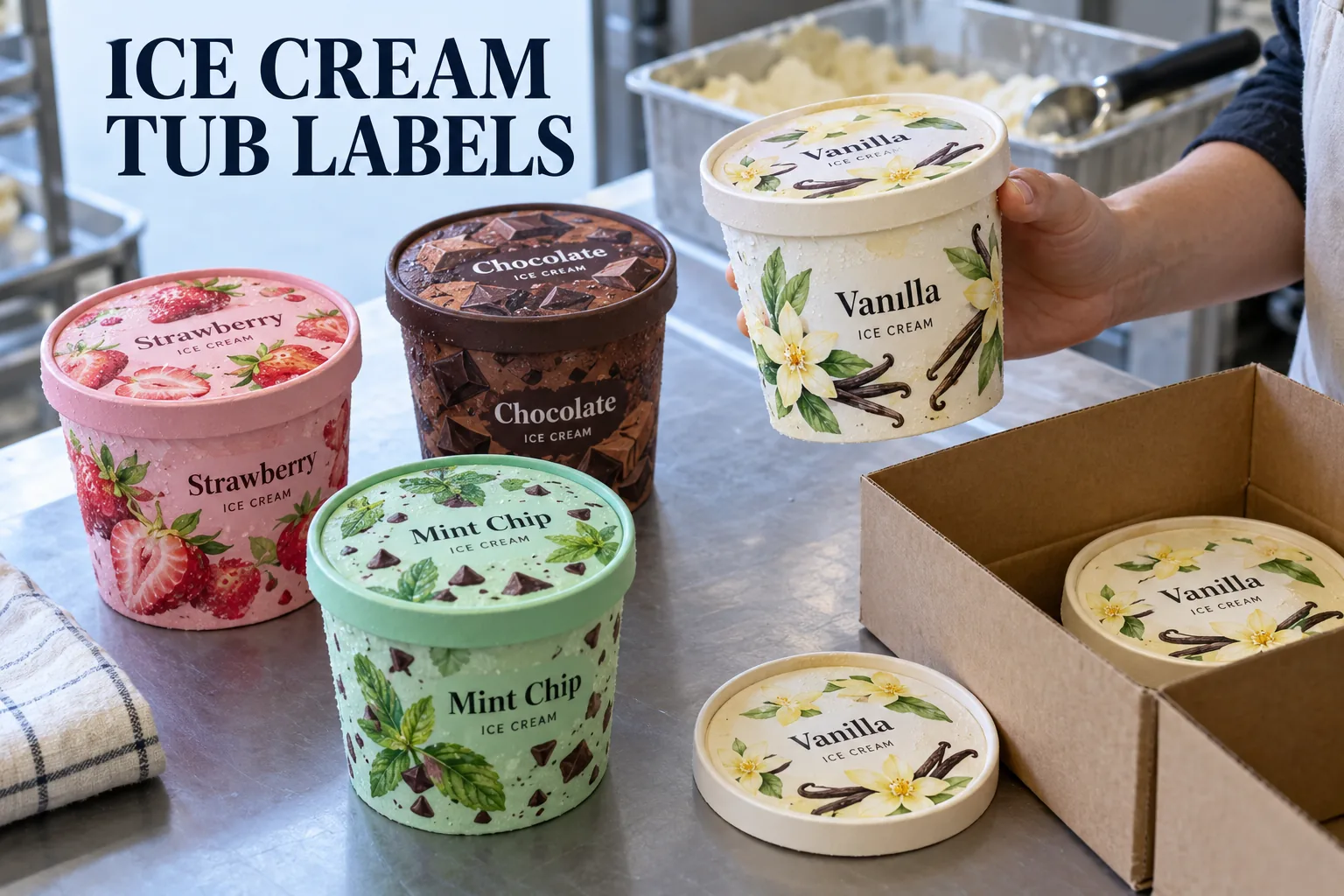
An ice cream tub has two front doors. In a freezer chest, the buyer may see only the lid. On a shelf or in a delivery bag, the side label has to do the work. I would not solve both with one stretched artwork file. The two surfaces are viewed from different directions, and one of them may spend time under condensation.
The production question begins even earlier: is the label applied before the tub is chilled, or to a cold container? A sample that sticks to a dry room-temperature tub is not evidence for every cold-chain step. Write down the actual filling, labeling, freezing, storage and delivery order before choosing a material.
Separate Lid Recognition From Side Information
The lid needs a flavor cue that survives a quick look from above. The side often carries more text and may be curved or tapered. Measure the usable lid circle and side panel in mm on the physical tub. Account for the lid rim, tamper band if present and any vertical seam. A label reaching onto a moving lid edge can wrinkle or lift.
| Surface | Buyer task | Check on a sample |
|---|---|---|
| Lid top | Recognize the flavor from above | Visible area inside the rim |
| Side wall | Read product and approved details | Curvature, taper and seam |
| Application point | Know when the label is placed | Surface temperature and dryness |
| Storage | Keep information legible | Condensation and handling |
| Delivery | Avoid scuffing in bags or cartons | Pack-out and contact points |
Describe the Cold Chain Without a Blanket Claim
There is a meaningful difference between a label applied warm and then frozen, and a label applied to a tub already cold or damp. Give the supplier the application point, expected storage condition and container material. Ask for a construction to trial through the actual sequence. 'Freezer safe' on its own is too broad to approve artwork or adhesive.
Condensation may appear when tubs move between spaces. Test whether the important text and artwork remain readable after that move. If the finish scuffs against neighboring tubs or a delivery carton, discover that before the full flavor range is printed. These are trial questions, not claims about a guaranteed lifetime.
Make Flavors Distinct Without Losing the Brand
Original fruit drawings, cocoa shapes and small ingredient icons can make a range feel considered. I would keep the brand structure stable and change the flavor cue decisively. Five pastel tubs with only a tiny flavor word can look elegant in a lineup photograph and become a picking error in a freezer.
Ingredients, allergens, net weight and other required or claimed information belong to the responsible brand owner for the destination market. The print review should use approved, versioned copy. If a seasonal flavor changes recipe, do not reuse last season's back label because the front color still looks right.
Proof One Finished Tub Per Flavor
- Measure lid and side panels on the production tub
- Record when labels are applied in the cold-chain sequence
- Print the smallest approved text at final size
- Apply a proposed construction to a real tub
- Move a sample through relevant storage and handling
- Line up all flavors and check quick recognition
- Approve artwork, copy and quantity by flavor
The broader freezer label guide explains cold-use questions; the color matching guide helps with a multi-flavor system. Use the specification planner to send tub photos, dimensions and the labeling sequence. A good proof should look right after the lid is closed and after the tub has left the packing bench.
Questions Before You Order
Can a label be applied to a frozen tub?
Application temperature depends on the exact label construction and surface condition. Tell the supplier whether labeling happens before or after freezing and test that sequence.
Should lid and side labels use the same artwork?
They can share a visual system, but the lid is viewed from above while the side is seen on a shelf or in a hand. Review both at final size.
What information should the ice cream brand approve?
The brand owner must approve flavor identity, ingredients, allergens, weights, claims and any market-specific information before print proof is finalized.