
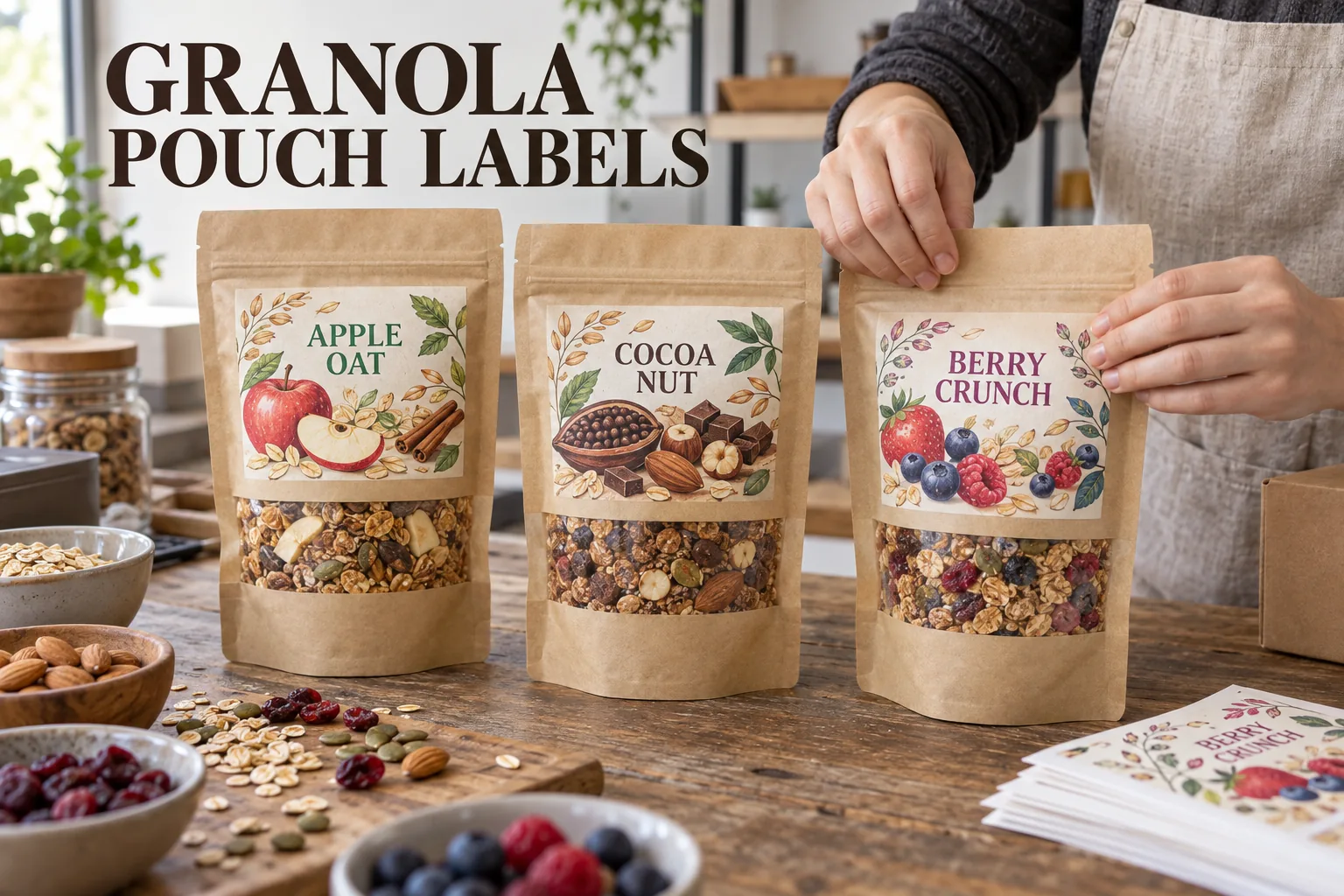
A stand-up granola pouch looks generous on a desk. Fill it, seal it and place it on a shelf, and the flat front becomes a curved surface with gussets competing for space. The buyer wants the oats and fruit visible through the window. The packing person wants a label that does not catch a fold. I would settle that disagreement with one filled pouch, not with a larger logo.
Granola also changes by flavor and season. An attractive master design is useful only if the person picking a pack can tell the variants apart and the team can keep the printed copy matched to each recipe. Label planning therefore has two jobs: physical placement and version control.
Design Around the Filled Pouch
Ask for the actual pouch material and size, then fill one to the normal level. Photograph it upright, from the side and after the top seal is made. Mark the area that stays visible without crossing the window, bottom gusset or top heat seal. Measure the usable panel in mm. This step can save a label that looked perfect on an empty dieline but wrinkles after filling.
| Pouch feature | Planning question | Proof action |
|---|---|---|
| Clear window | How much product must remain visible? | Mark the window on a filled bag |
| Top seal | Does the label enter the sealing area? | Seal a sample at normal fill |
| Bottom gusset | Does the label buckle when the pouch stands? | Place it on a shelf |
| Back panel | Is approved copy readable around folds? | Print at final size |
| Flavor range | Can staff distinguish variants quickly? | Line up all SKUs together |
Separate the Brand System From Flavor Information
An original grain illustration can make the range recognizable. Give each flavor one strong cue, such as a color field and its own ingredient drawing. A tiny flavor name below a shared illustration asks the packer and the shopper to work too hard. I would put the pouches next to each other and ask whether the difference survives a quick glance.
Ingredients, nutrition panels, allergen statements, weights and any claims are the food brand's responsibility to approve for the target market. The print discussion can check whether the supplied copy fits and remains readable. It should not invent or silently shorten that content to make a design work.
Check the Real Packing Environment
Nut butter, dried fruit and oil can leave traces on a packing bench. A pouch may also have a soft surface or a coating that changes adhesion. Describe the actual sequence: when is it filled, wiped, labeled and boxed? Test a proposed material on the same pouch, at the same stage. A generic 'strong adhesive' description is not a substitute for that trial.
For multiple flavors, list the label count by SKU instead of giving only a total. A 4,000-label order split across six designs is a different packing and inventory problem from 4,000 of one design. That number is an example of how to brief a supplier, not a claim about minimum order size.
Approve One Shelf-Ready Pack of Every Flavor
- Fill and seal the actual pouch before measuring
- Mark window, seal and gusset boundaries
- Print front and back labels at final size
- Check flavor recognition with the range side by side
- Apply a trial label during the normal packing step
- Approve all market-specific text by SKU
- Confirm quantities and how variants will be packed
For another flexible pack, see the coffee bag label guide. The surface matching guide can frame material questions. Send a filled pouch photo, artwork and version list through the specification planner. I would rather move a label five millimeters in proof than discover it covers the best part of the product window.
Questions Before You Order
Should a granola label go across the pouch window?
Usually start by keeping the main window clear if product visibility is part of the pack design. Test placement on a filled pouch because the front panel changes shape.
Can one artwork template cover several flavors?
Yes, if each version has a clear flavor cue and the approved ingredient and nutrition information stays correct. Maintain a version list and quantities by SKU.
What do I send for a pouch label quote?
Send the exact filled pouch, front and back photos, usable dimensions in mm, artwork versions, approved copy, quantities by flavor and packing format.