
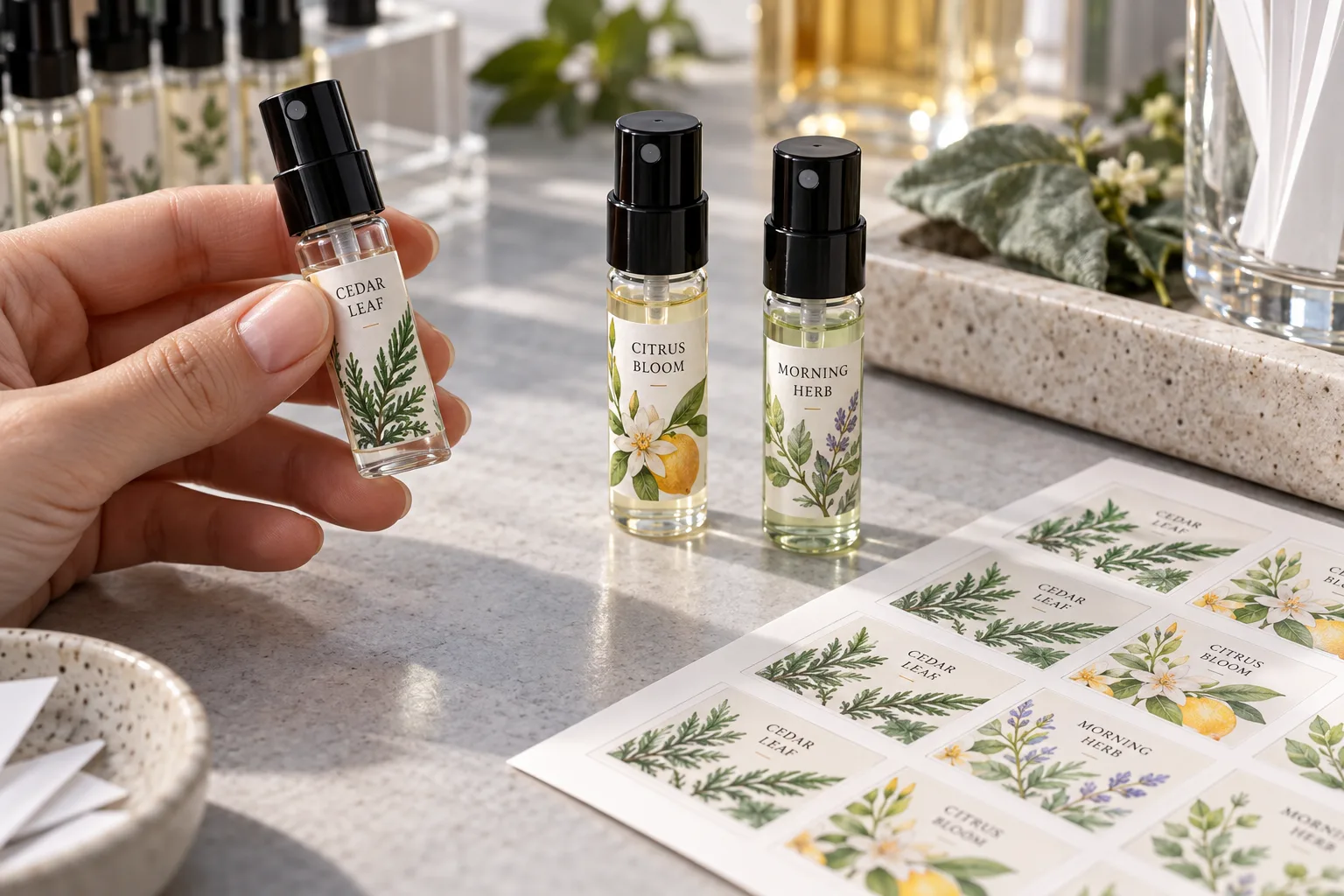
A fragrance sample vial is the package people are most likely to hold close to their eyes. It is also the package where a designer may try to shrink a full bottle label to one quarter of its size. I would not approve that shortcut. The illustration can survive; the text hierarchy usually cannot.
Start With the Filled Vial and Closure
Measure the straight printable area below the cap, including the radius of any shoulder. Wrap a plain paper strip around a finished vial to locate the joint and see whether the label covers the product view. A rollerball, spray vial and tiny screw-cap bottle each leave a different usable panel. Ask whether the vial is glass or plastic and how the sample will be packed with other vials.
Keep a complete original botanical or geometric mark, but give the scent or product name priority. If several scents share a design family, use a second cue besides color so a person sorting samples can distinguish them in a dim stockroom. Do not let the seam hide the only variant name.
Proof Actual-Size Type and Handling
Print the longest approved name at final size. Apply it to a filled vial, place the cap, then read it in ordinary light. If the back panel needs more owner-approved copy than the vial can carry legibly, the brand must decide how the outer pack and vial share information. The printer should not compress legal or ingredient wording until it is technically present but unusable.
Check whether fragrance oil, water, or repeated fingers touch the label during use. Trial the proposed material and print protection under the intended handling route. The word waterproof does not tell you how an adhesive behaves on a narrow curve or whether a small edge starts to lift inside a sample kit.
- Provide filled vials with final caps
- Measure the straight printable area
- Identify the front and label joint
- Print the longest name at actual size
- Check handling and product contact
- Approve every scent and pack version
Compare the small bottle label guide and the small-type proofing guide. A vial photo and approved copy are useful starting points for the label specification planner.
Questions Before You Order
Can a full bottle label be scaled down for a vial?
Usually that makes the type and details too small. Rebuild the hierarchy around the vial and owner-approved information.
Should the label cross the cap seam?
Only if that placement has a defined purpose and is tested on the real closure. A front identity label often works better below the cap.
Who approves cosmetic sample text?
The responsible brand or distributor must approve market-specific ingredients, warnings and claims. The label supplier can flag fit and readability problems.