
The front artwork is ready, and the buyer asks to put a thank-you message on the back. Before adding another file, identify which surface the recipient should read. The reverse of the disposable release liner, the exposed margin around a kiss-cut sticker and a separate backing card are three different places. They can carry similar words while creating different products.
For custom stickers with printed backing, I would start with a drawing of the complete supplied piece. Mark the face that stays on the recipient's chosen surface, the backing removed during application and the location of the extra message. Ask the supplier to confirm the feasible route before treating a second design as an accepted production option.
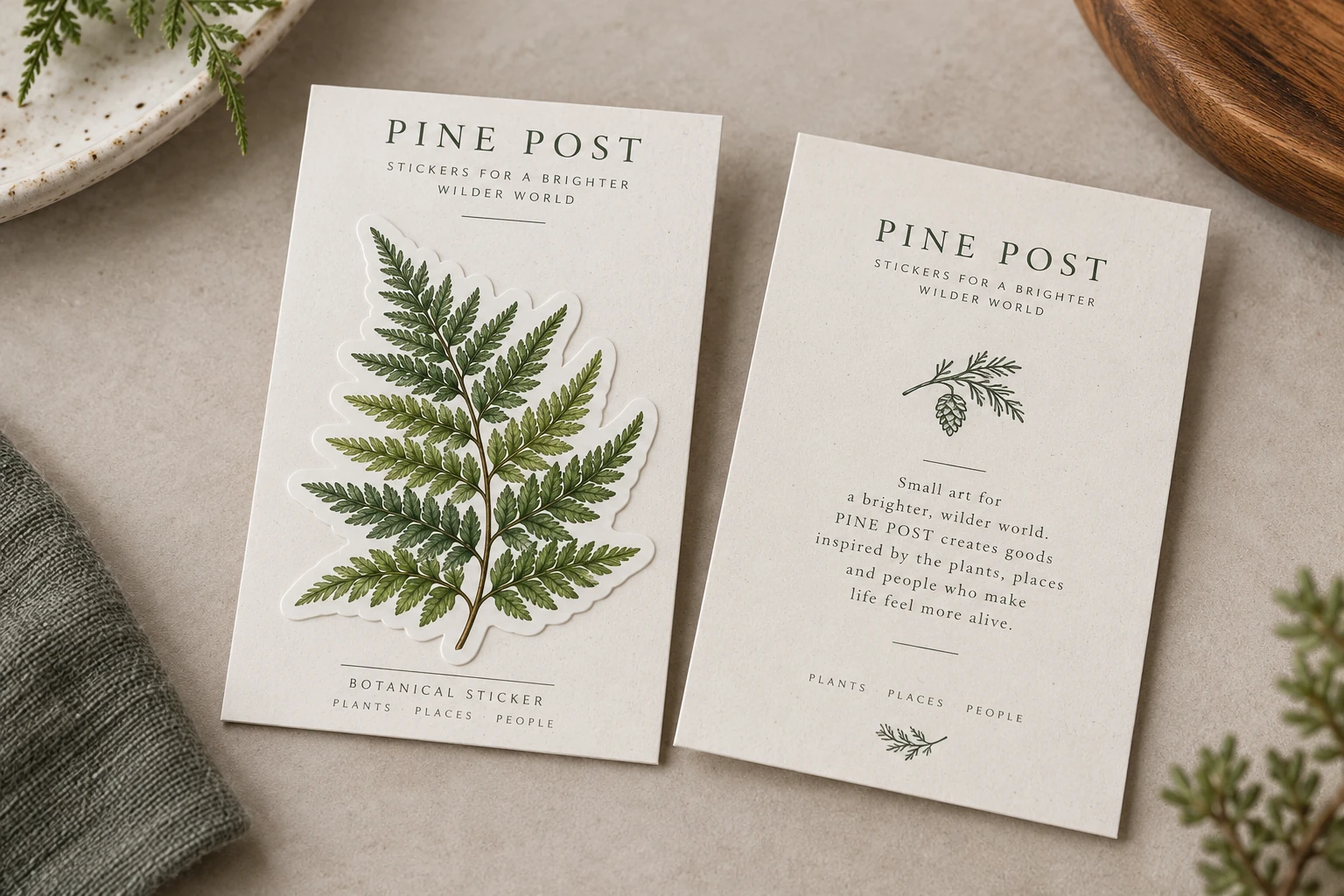
Name the surface, then name the reading moment
A person receiving a loose sticker can turn the backed piece over before peeling it. A person receiving a sticker already applied to a parcel cannot normally read a message on the discarded liner. Establish that handoff first. If the content is important after application, a throwaway backing may be the wrong place for its only copy.
A printed margin on the front of an oversized kiss-cut backing is visible alongside the sticker. It may provide room for a brand name or instruction without reverse printing, but changes the supplied outline. A separate card can remain with the recipient after the sticker is applied. It introduces another component and packing decision. Compare those consequences against the actual information task.
| Proposed location | Decision to confirm |
|---|---|
| Outside rear of release liner | Is the message read before peeling, and does the supplier offer this construction? |
| Front margin around a kiss-cut face | Does the complete backing fit distribution and show the required information? |
| Separate printed card | Must the recipient retain the message, and who inserts the card? |
| Applied sticker face | Must the information remain visible after application? |
Keep back printing separate from a hidden reveal
Drawing an image on the outside rear of the liner does not specify an image underneath the adhesive face. If the intended experience is a hidden message revealed when the sticker lifts, say that explicitly and request a construction review. Do not assume that an ordinary backing print will produce it.
Likewise, a clear sticker may let underlying surfaces influence the front appearance. A two-sided illustration cannot establish opacity or demonstrate which print is visible through a transparent material. Show the intended viewing route and have the supplier identify the actual layers. Use a representative sample where that relationship matters to the design.
Ask for a paired front-and-back proof
Give both artwork files the same item reference and identify their sides in a simple reference drawing. Include the finished backing outline and the intended orientation when the recipient turns the piece over. The direction used to flip a screen preview can otherwise hide an upside-down rear panel.
Check the full-size message, not merely a large presentation. Read the longest instruction and any important contact detail. If a code is included, use owner-approved data and review the final physical version through the intended scan route; a placeholder square does not prove it works. A text or code change needs a controlled revision rather than an untracked replacement file.

Review the backing as part of the supplied product
The liner still has a release and handling job. Ask which backing and peel arrangement the supplier proposes with the extra printing. If the design relies on an uninterrupted rear message, find out whether a split, cut or other feature changes that area. Do not remove a functional peel feature from the design without reviewing the consequence.
Compare a physical reference in the states the recipient will encounter: received, turned over, peeled and separated. Observe whether the message is visible at the intended moment and whether the piece can be handled as planned. Agree any needed print-contact or handling assessment with the supplier. This guide specifies no universal ink, drying interval or release threshold.
Supplier offerings differ. StickerGiant describes a dedicated liner-backprinting product, while Sticker Mule's FAQ points buyers toward a printed kiss-cut margin instead. Those are examples of distinct offered routes; their specifications and availability are not ZC Labels' production commitments.
Compare the quotation against the complete delivered piece
Keep the sticker size, backing size, artwork versions, quantity by design and packing scope visible in the comparison. A quote for one-sided stickers plus loose cards covers different work from a backprinted unit. Ask which proofing, additional component, sorting and packing tasks are included, and obtain the provider's actual timing.
If one rear design serves several front designs, list the intended pairings. Shared branding does not authorize an unrelated promotional message or a different campaign date. Where the buyer accepts a common rear message, retain that decision with the artwork reference so a reorder does not silently inherit obsolete text.
The finished sticker and backing format guide covers the supply outlines. The peel-access guide addresses how the user starts separating the face. Keep the message-location decision connected to those physical choices.
For a printed-backing project discussion, send both designs, the intended reading moment, a marked side-and-orientation sketch, finished face and backing dimensions, quantities per paired version and the proposed delivery format. Ask which available route can meet that brief and what sample evidence is needed before approval.