
A personalized gift-sticker enquiry needs a layout and a price. It does not necessarily need the buyer's complete guest or customer spreadsheet. Names, contact details, internal notes and delivery information may have accumulated in the same workbook even though only one printed field belongs on the sticker.
Before sending a personalized sticker list, separate the information needed for the current review from the actual data required for an agreed production step. Use clearly fictional records where they can answer a layout question. Agree the recipient, exchange method and handling scope before releasing real personal information.
Ask what the supplier needs to decide now
At quotation, the supplier may need the dimensions, artwork, number of versions, quantity per version and a description of the changing fields. For an initial layout review, representative text lengths and character features may be enough. Ask which inputs are actually needed rather than forwarding an entire operational workbook by default.
The ZC Labels gift-sticker page asks buyers to identify artwork variants, including recipient-name variants. That provides a product route for the discussion. It does not establish a dedicated personal-data portal, a particular security certification or a commitment to process every proposed dataset.
Keep the commercial contact and shipping task distinct from printed personalization. A destination may be needed to assess freight, but that does not mean every guest's address belongs in the artwork file. If the project includes individual delivery rather than bulk supply, have the parties confirm whether that arrangement is available and which separate information it requires.
Make a field-purpose list before exporting records
Take a copy under the buyer's normal controls and identify the intended handoff fields. A column hidden in a spreadsheet is still part of the file. A red rectangle placed over a screenshot is not proof that the underlying source has been removed from every attached document. Have the responsible file owner inspect the actual deliverable.
| Possible field | Question for the current task | Handoff decision |
|---|---|---|
| Printed name or approved wording | Is real text needed now, or can a fictional example demonstrate the layout? | Identify demonstration or authorized release status |
| Quantity and stable record reference | How are outputs reconciled without importing unrelated records? | Use an owner-approved reference and stated quantity basis |
| Contact, address or event-planning notes | Does this recipient need it for the agreed work? | Exclude from the print brief unless a defined separate task needs it |
| Working comments and older revisions | Are they part of the accepted instruction? | Keep them distinct from the current release |
The FTC's Start with Security guide discusses limiting unnecessary information, access and retention, including using fictitious information where real records are unnecessary. Those principles support asking what this print review needs; they do not certify a supplier's system or settle the legal basis for a particular transfer.
Use a demonstration that still tests the layout question
Fictional wording should preserve the feature being checked: a long line, a compound name, punctuation, required accented characters or another owner-identified difficulty. Replacing every name with a short word may conceal the very fit problem the proof is meant to expose. Mark each demonstration file and proof conspicuously as not for production.
A stable dummy reference helps reviewers discuss a specimen without attaching a real person to it. Replacing a name with a code in an otherwise real dataset does not automatically make the dataset anonymous. The responsible owner should assess what can still identify a person and which information is appropriate to exchange.
A demonstration can support artwork discussion within its scope. It cannot approve the spelling, quantity or record mapping of the later production list. The personalized favor guide addresses exact source-to-output reconciliation and late corrections. Keep that separate review when the real authorized release is ready.
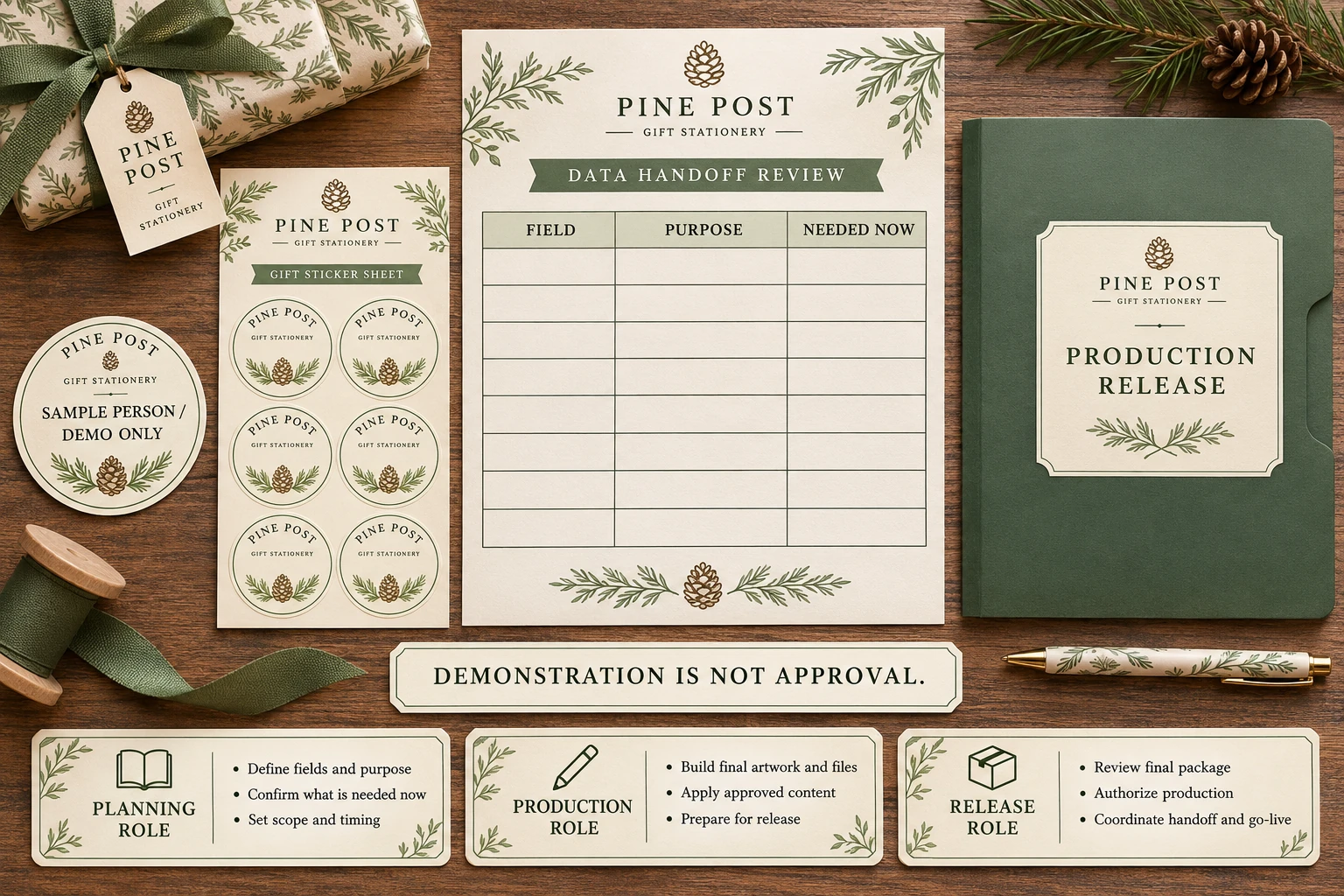
Confirm the exchange before sending the real list
Identify the authorized sender and intended recipient through the agreed business channel. Ask how the file should be transferred, who needs access for the accepted work and what confirmation establishes receipt of the correct revision. A link that opens for anyone holding it is not the same arrangement as access limited to named people.
Ask the relevant privacy or security owner which safeguards and agreements apply to the actual parties and locations. For projects subject to EU data-protection requirements, the European Commission's principles overview addresses purpose, necessary information, retention and confidentiality. It does not determine whether this specific transaction is covered or approve its transfer arrangements. Obtain the project-specific review rather than assuming one channel or permission suits every order.
If the exchange or handling scope is unresolved, continue with a suitably marked demonstration where useful and hold the real list. Do not paste personal records into a public page, shared sample image or generic enquiry text to work around the unanswered question. The website's quotation form is not evidence of a specialist data-transfer facility.
Control both the released file and its printed consequences
When authorized release becomes appropriate, identify the exact file, included records, field definitions and quantities. Keep the dummy material out of the print-ready set. Ask the receiver to acknowledge the release reference and route unclear or changed records back to the named owner.
Include proof exports and physical samples in the handling discussion. A photo of personalized pieces can reveal the same information as the spreadsheet. Separate any public portfolio or sales-sample use from the order itself; the artwork permissions guide explains that distinct use decision.
Agree how long the parties need the relevant records and what happens to superseded files, proof copies and printed rejects. Keep necessary business or legal retention requirements with the responsible owner. Do not promise instant deletion, a fixed retention period or destruction of every copy without an agreed and supportable process.
Start with a personalized gift-sticker brief: artwork, dimensions, quantities, changing-field description and a clearly fictional layout example. State that an authorized real-data release would need an agreed exchange and handling arrangement. Ask ZC Labels what the proposed work requires before sending the actual list. Physical sample scope, charges and timing remain subject to the project-specific sample policy.