
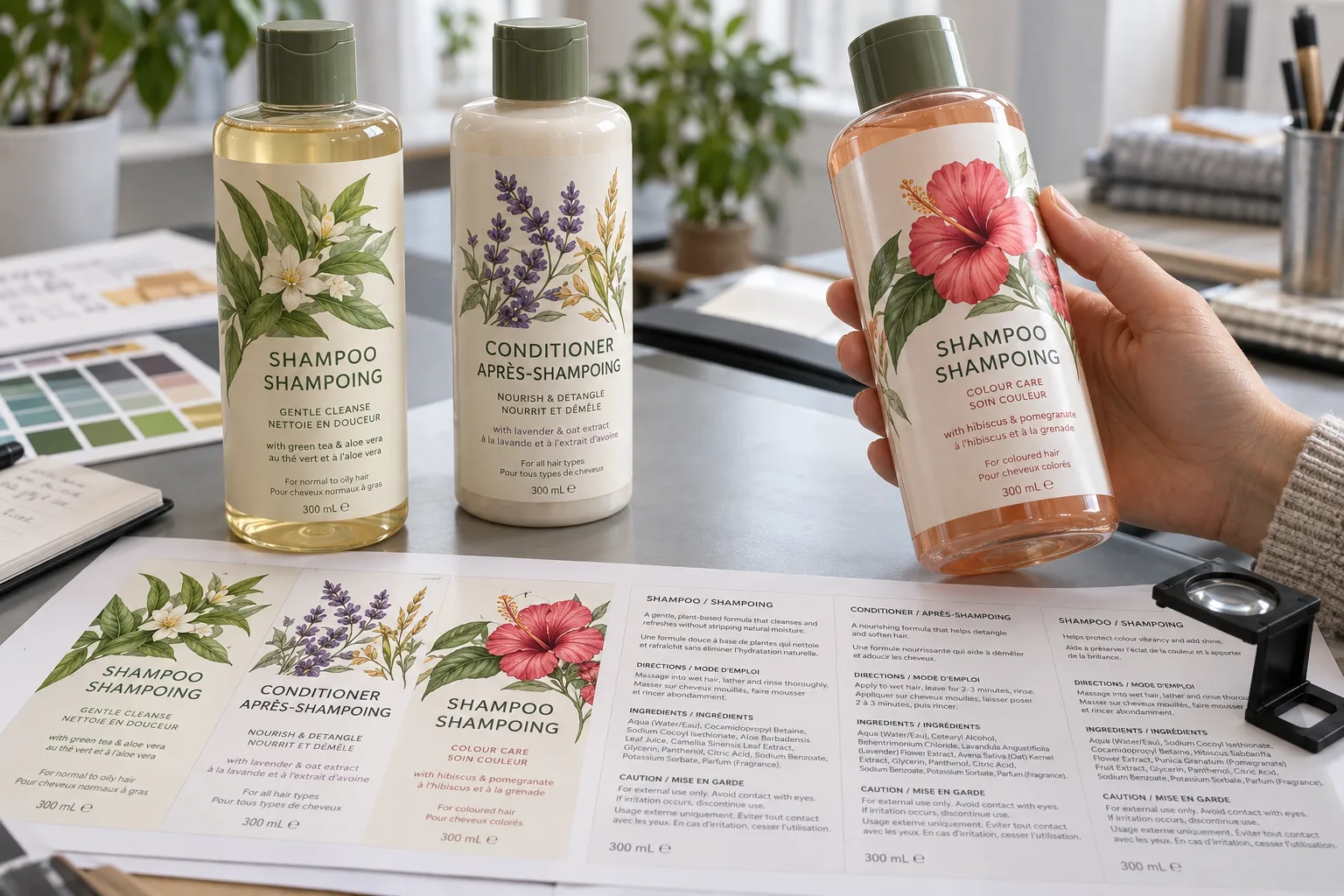
A shampoo label can look settled until a second market is added. The front panel still needs the product name; the back now has twice the words, and the bottle has not become any wider. The usual temptation is to shrink everything. I would stop there and ask which information a shopper must find first and which wording the brand has actually approved.
Start with the physical bottle. A drawing of a flat label does not show where a curved shoulder hides the final line or where a pump blocks the top of the front panel. Measure the usable area after the bottle is filled and capped. If the design uses an original leaf or fruit illustration, keep it complete but give the product name enough space to do its job.
Separate Hierarchy From Translation
Make a content map for each destination market: approved product name, variant, ingredients, directions, caution text, responsible-party details and any other owner-supplied fields. The responsible brand or distributor must confirm what is required and approve every translation. The label supplier can flag a line that becomes too small or a field that falls into an overlap; it should not create legal copy to fill a template.
Decide whether one bilingual artwork serves both markets or separate labels make more sense. One shared file simplifies inventory only when the full copy remains readable. Two versions add version-control work but may preserve clearer typography. Compare the cost and operational risk together instead of making the decision from print price alone.
Proof the Longest Variant on the Bottle
Use the longest product name and the longest approved translated line in a full-size print proof. Apply it to the actual bottle, not a generic cylinder. Check the label seam, the area under the pump, glare in wet light and the smallest type. Then proof each fragrance or formula separately so one variant does not accidentally inherit another variant's ingredient panel.
- Supply final bottles and cap or pump
- Provide approved text for each market
- Compare shared versus separate artwork
- Print the longest text at finished size
- Inspect front, back and seam on the bottle
- Track approvals by language and formula
The shampoo bottle guide covers the base material and use conditions; the small-type guide helps with proof review. Send bottle dimensions and approved copy through the quote form. More text is manageable when it is treated as a packaging decision early.
Questions Before You Order
Can the printer translate ingredient and warning copy?
The responsible brand should provide and approve market-specific wording. A printer can identify layout pressure but should not invent translations or regulatory copy.
Is a wrap label always the answer to extra languages?
No. A wrap can add area, but bottle curvature, overlap, application method and readability still need a physical proof.
Can small type be checked on a screen proof?
Not reliably. Print at final size, apply to the final bottle and review it under ordinary lighting.