
The buyer asks for a food-safe label certificate. The artwork is ready, but the supplier has not been told whether the sticker goes on the outside of a carton, directly on produce or on a surface that changes position when the package is opened. One broad request is being used for several different intended uses.
Draw the actual contact route before requesting documentation. Identify the proposed label construction, where it sits and the relevant conditions. Then have the responsible food-business or compliance owner determine which evidence is applicable. A generic material description or an attractive food-packaging photograph cannot establish suitability for an unspecified use.
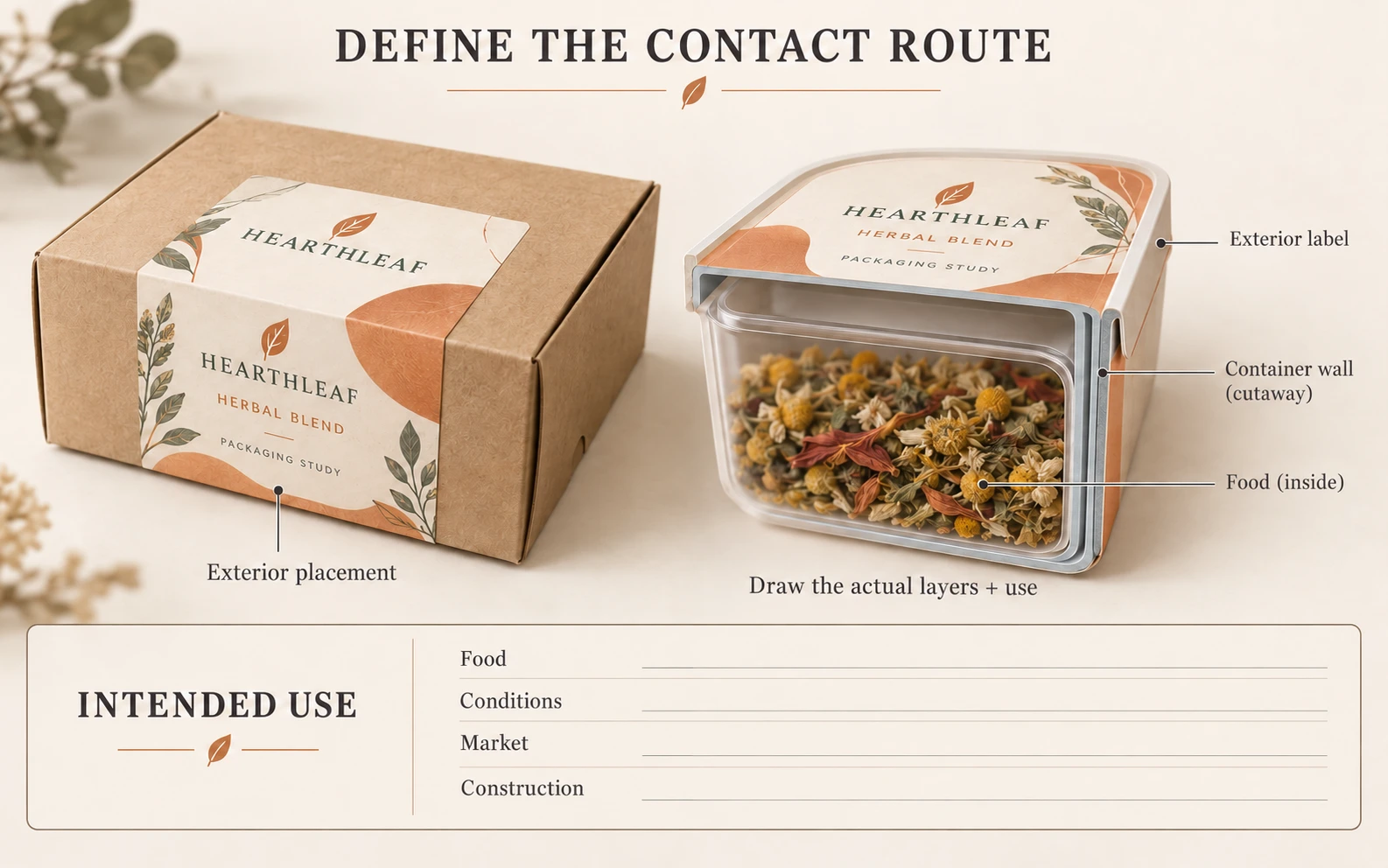
Describe where every relevant surface goes
Start with an annotated package drawing. Show the label, food, packaging between them and the supplied and filled states. Mark whether any label component is intended to contact food directly. Include opening, stacking, storage or preparation states relevant to the actual process, rather than describing only the closed display pack.
An exterior label on a closed container and a sticker placed directly on a food item are different briefs. Exterior placement should be described accurately without assuming it resolves every material question. Ask the responsible owner to consider the actual contact and transfer routes for the complete packaging system.
If a detail is unknown, state it. The printer should not guess which side faces the contents or invent a barrier from a photograph. Obtain the relevant packaging reference from its owner before asking for a conclusion about documentation.
Connect the request to an intended use
The FDA's food-contact explanation includes packaging components such as adhesives and colorants in its discussion of food-contact substances. It describes assessment and authorization in relation to intended use. That is a reason to define the use carefully, not evidence that a particular label has FDA approval.
Record the destination market and the food-business owner's requirements. Ask that owner or its qualified adviser which documentation and interpretation are needed. This guide organizes the purchasing request; it does not determine the legal status of an unreviewed construction or replace market-specific assessment.
Avoid using waterproof, natural, paper or food grade as a substitute for an identified material and applicable evidence. Those words may describe a commercial category, an appearance or a separate performance question. They do not tell the reviewer which components or conditions a document covers.
Request construction-specific evidence
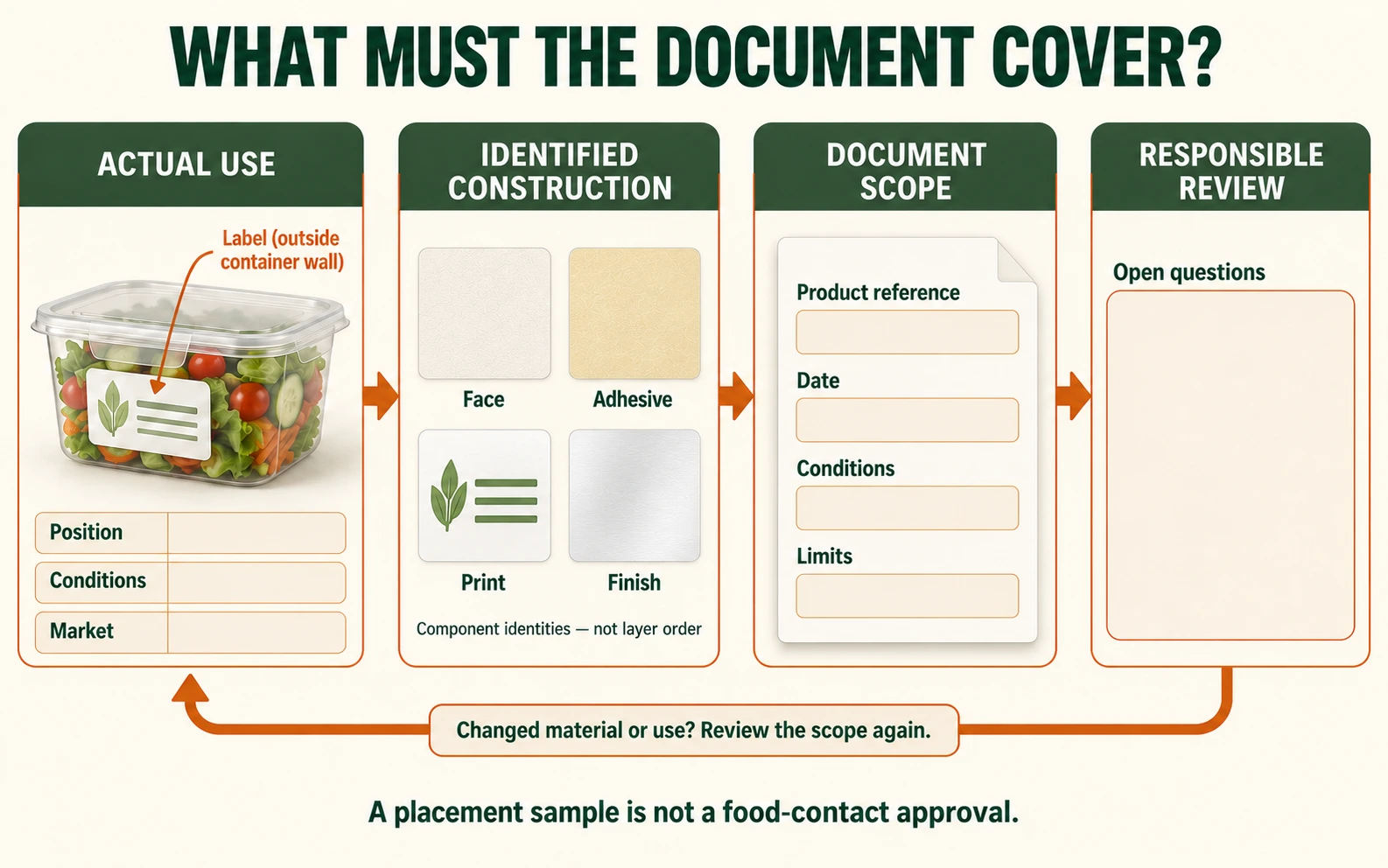
Identify the face material, adhesive, print and any additional protection in the proposed finished label. Ask the supplier which references correspond to those components and to the complete proposed use. Keep the product codes and document dates visible where supplied.
| Information to supply | Why it matters to the request |
|---|---|
| Package and label position | Defines the intended contact arrangement |
| Food and relevant conditions | Lets the responsible reviewer identify the scope needed |
| Application and handling route | Shows when the different surfaces can meet |
| Proposed construction | Connects documents to the material actually being discussed |
| Destination and owner requirements | Identifies the applicable review question |
| Open items | Prevents an assumption being read as confirmation |
Ask what a document does and does not represent. A statement for one adhesive, product family or specified condition should not silently become a guarantee for a different finished label. If supporting information is confidential, ask how the responsible reviewer can obtain enough identified evidence through an appropriate route.
Keep physical trials within their scope
A sample on the real package can help review placement, attachment, handling and readability. It does not by itself establish food-contact suitability or migration behavior. Do not turn a photograph of a neat applied sticker into a compliance record.
The bakery-package guide considers box geometry and exterior labeling conditions. The food-prep writing guide addresses approved changing information and its physical use. Neither guide authorizes transferring a material to a different contact route.
Keep functional observations and regulatory assessment connected to the same identified proposal while recording them separately. A label may fit a lid and remain readable while its documentation is still unresolved. Conversely, receiving a relevant component document does not approve a poorly placed or unreadable consumer label.
Review substitutions before relying on the old file
If the adhesive, face, ink, protection, package or intended conditions change, tell the responsible reviewer which reference changed. Ask whether earlier documentation still addresses the revised proposal. A visually similar product should not inherit the first material's evidence simply because the artwork remains the same.
Retain the accepted construction reference with the purchasing record. If a supplier proposes an alternative, keep its evidence and open questions identifiable rather than replacing the original code with a generic equivalent note. Availability and documentation scope both need confirmation.
For a reorder, compare the actual proposed use with the previous one. A label that was discussed for an outside carton may later be requested for a different food application. The old file name cannot make those uses equivalent.
Send a question the next reviewer can answer
For a food-label documentation enquiry, send the contact drawing, package specification and photographs, intended food and relevant conditions, labeling/handling sequence, destination, dimensions, artwork, quantities and the responsible owner's document requirements. Use the packaging label project route to ask what identified construction and supporting information can be provided.
Mark the decision still needed: confirmation of a contact arrangement, interpretation of a document's scope or assessment of an alternative construction. Those are more useful next steps than asking a printer to certify that every product described as a food label suits every food use. Release should follow the responsible owner's accepted evidence for the actual project, with unresolved assumptions still visible.