
The approved information no longer fits on the package label. A booklet or peel-back format appears to solve the space problem. Yet the new artwork set has no clear opening cue, and nobody has checked whether the reader can find the intended section once the panel is lifted. More printed area has been purchased without approving the reading route.
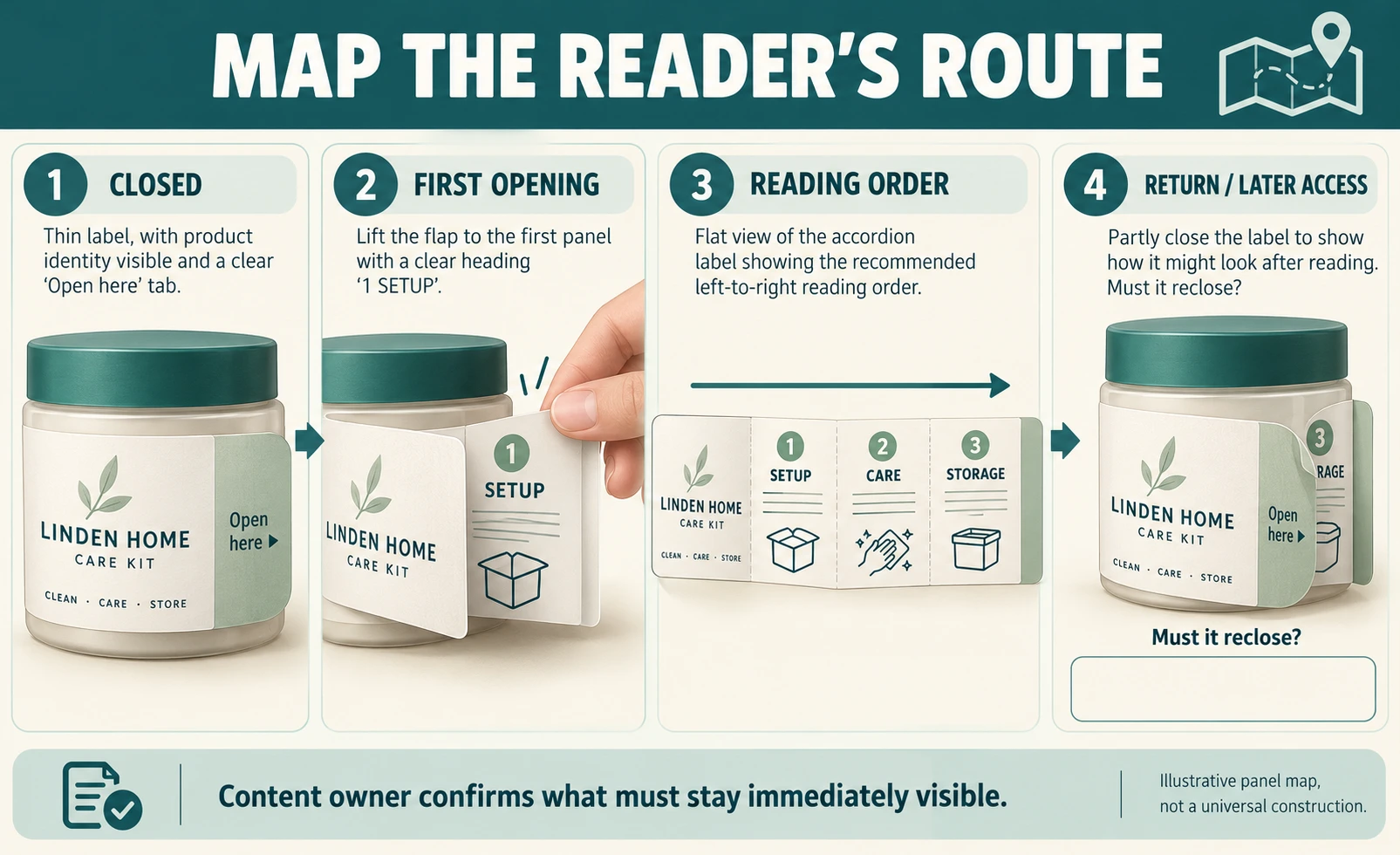
For expanded content labels, map the closed, opened and returned states before committing to a format. Decide what must be visible immediately, where the user starts and how the relevant information is reached. The responsible content owner determines which information may appear where; a printing format does not authorize hiding required wording.
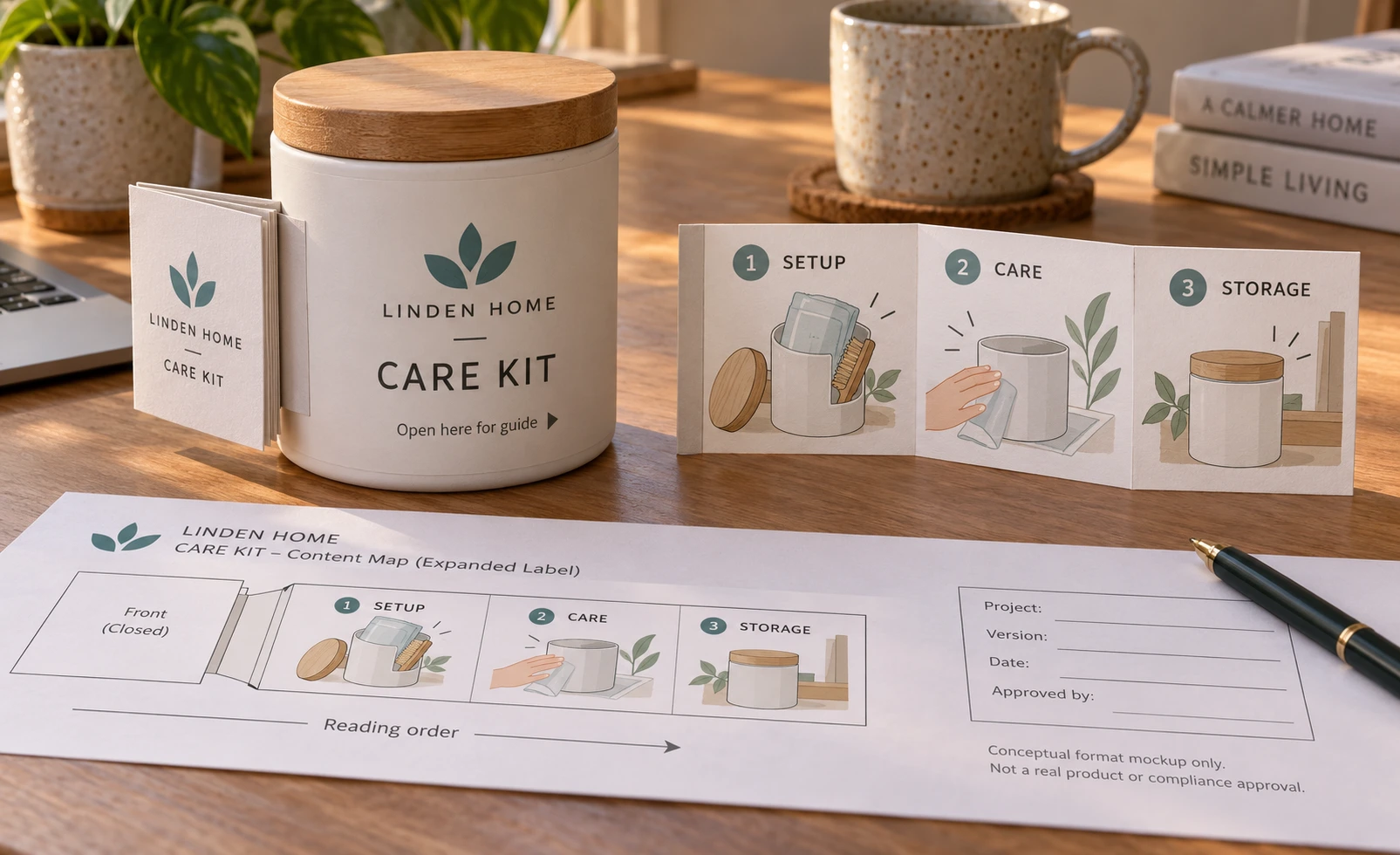
Establish the information job first
List the actual content by product and revision. Identify the audience, language and point of use for each block. A short first-use instruction, a translated description and an extended reference section have different access requirements even when they all occupy additional panels.
Ask the product or documentation owner which wording must remain visible without opening and which placement arrangements are permitted for the intended market. Keep unresolved questions in the record. The supplier should not move a warning beneath a flap simply to make a neat cover layout.
CCL describes expanded content labels as a family that can include booklet, fold-out, peel-back and multi-ply formats. That supports comparing different physical information routes. It does not make those formats equivalent, establish compliance for this project or confirm availability from ZC Labels.
Choose a route through the panels
Draw the item as supplied and applied, then number the intended reading faces. Identify which side is visible at each opening action. Do not confuse a flat production layout with the sequence experienced by a person holding the package.
Mark the opening edge and the direction of movement. Show whether the reader unfolds a panel, lifts a face or turns booklet pages. Ask the supplier which construction can support that route and what sample can represent it. Avoid specifying an arbitrary layer count before the available arrangement is understood.
| State | Define in the brief | Question to resolve |
|---|---|---|
| Closed | Owner-approved immediately visible content | Can the reader identify and start the intended action? |
| First opening | Opening cue and first exposed face | Is the next section apparent? |
| Extended reading | Panel order and language/product association | Can the relevant information be found? |
| Return | Intended closing or retained-open state | What information and attachment must remain usable? |
| Later access | Whether another reading is expected | Can that route be represented and reviewed? |
If repeated access matters, state it. A construction that opens once and one intended to reclose address different requirements. Do not infer a cycle life or closure performance from the word booklet.
Check the object on the package
Use the actual available panel and package geometry. The closed footprint, opening sweep and space for a hand all matter. Ask whether the opening action encounters a cap, seam, handle or another label. A layout that works flat on a desk may become awkward on a narrow curved area.
Review the proposed construction with an identified representative sample. Record its differences from the intended order, including page count, material, dimensions and printed coverage. Ask the supplier which aspects the sample can establish rather than describing every demonstration as production approval.
The instruction-label guide addresses a short cue at the action point. An expanded label has an additional physical navigation task. Keep essential actions accessible according to the responsible owner's requirements instead of assuming that extra pages automatically improve communication.
Reconcile copy across faces
Assign a reference to each content block and connect it to its final panel. Keep the approved wording separate from the production layout while checking that the rendered set contains the intended fields. A page can be present and still belong to the wrong variant or language.
Use the longest real approved content in the layout review. Placeholder copy can conceal crowding and page-order problems. If content changes after the physical reference is prepared, determine whether the change affects only wording or also the panel count, opening route and package fit.
The multilingual text-transfer guide covers source-to-layout reconciliation. Here the extra check is that each approved block remains accessible in the physical sequence. Translation approval and navigation approval are separate decisions, even if one person coordinates both.
Compare an insert or separate version honestly
An attached expanded label may keep information with the package, but introduces an opening object that must fit and remain usable. A separate insert can provide more space while creating a packing and association task. Separate market versions can reduce content on each item while increasing inventory control.
Ask for availability and quotations based on the actual content set and quantities. Do not assume that one combined version is automatically cheaper or more compliant. Compare the additional printing and assembly with the work of keeping versions, inserts and products correctly associated.
For an item requiring only a short cue, additional panels may be unnecessary. For a substantial approved procedure, squeezing everything into smaller print may be the wrong compromise. Let the required access and available package space guide the format discussion.
Preserve the accepted sequence at reorder
Retain the artwork set, panel map, opening reference, package identity and scope of physical observations together. Identify any state not represented by the sample. If the package, content length or construction changes, review the affected access route before treating the old approval as transferable.
For an expanded-label feasibility enquiry, send approved content by block and language, required immediately visible fields, package photographs and dimensions, intended opening/return sequence, quantities by version and destination. Use the roll-label project route to ask whether a suitable construction or alternative is available. Those records let the next discussion address information a reader can actually reach, rather than treating extra printable area as the whole purchase decision.