
“We need the stickers on Monday” sounds clear until the supplier asks which Monday milestone matters. Is that when printing should finish, when the cartons should leave, or when a packing team needs usable stock at its station? An answer about production duration cannot settle all three.
Start a custom sticker lead time discussion with the required receiving event and work backward through the actual approvals and handoffs. Ask the supplier which milestones it can confirm, what starts each period and which dependencies remain open. Do not turn an attractive estimate into a promised arrival date by leaving its starting point unstated.

Put a physical event beside the deadline
Name the site and what must happen there. Stock received at a central warehouse is a different event from stock released to a contract packer. If receiving inspection, local transfer or a packing appointment matters, identify it separately rather than assuming that a delivery scan means the labels are ready to use.
Include the destination and any receiving arrangements the buyer already knows. A date without its location, time zone or access requirements can be misunderstood even when everyone is trying to help. Keep sensitive address details in the actual order channel; a public article or sample image should never invent a consignee.
Mark the business requirement as a requirement. The supplier still needs to assess whether it can support it. A buyer's event date does not establish an available production slot or transport commitment.
Find the real starting conditions
Ask what must be settled before the supplier can confirm the relevant schedule. That may involve an accepted specification, identified artwork, an approval or another agreed commercial condition. Obtain the answer for this job instead of copying a timing statement from an unrelated product page.
If the artwork is provisional, say which decision is outstanding. A changed label size can affect both layout and material planning. A missing quantity by design can prevent the supplier from evaluating the proposed run. Keep the dependency attached to its owner so a preliminary enquiry does not look like a complete release.
The factory ordering guide explains the release record. Here its purpose is scheduling: identify the exact accepted references that allow the next stage to begin, and record when those references actually became current.
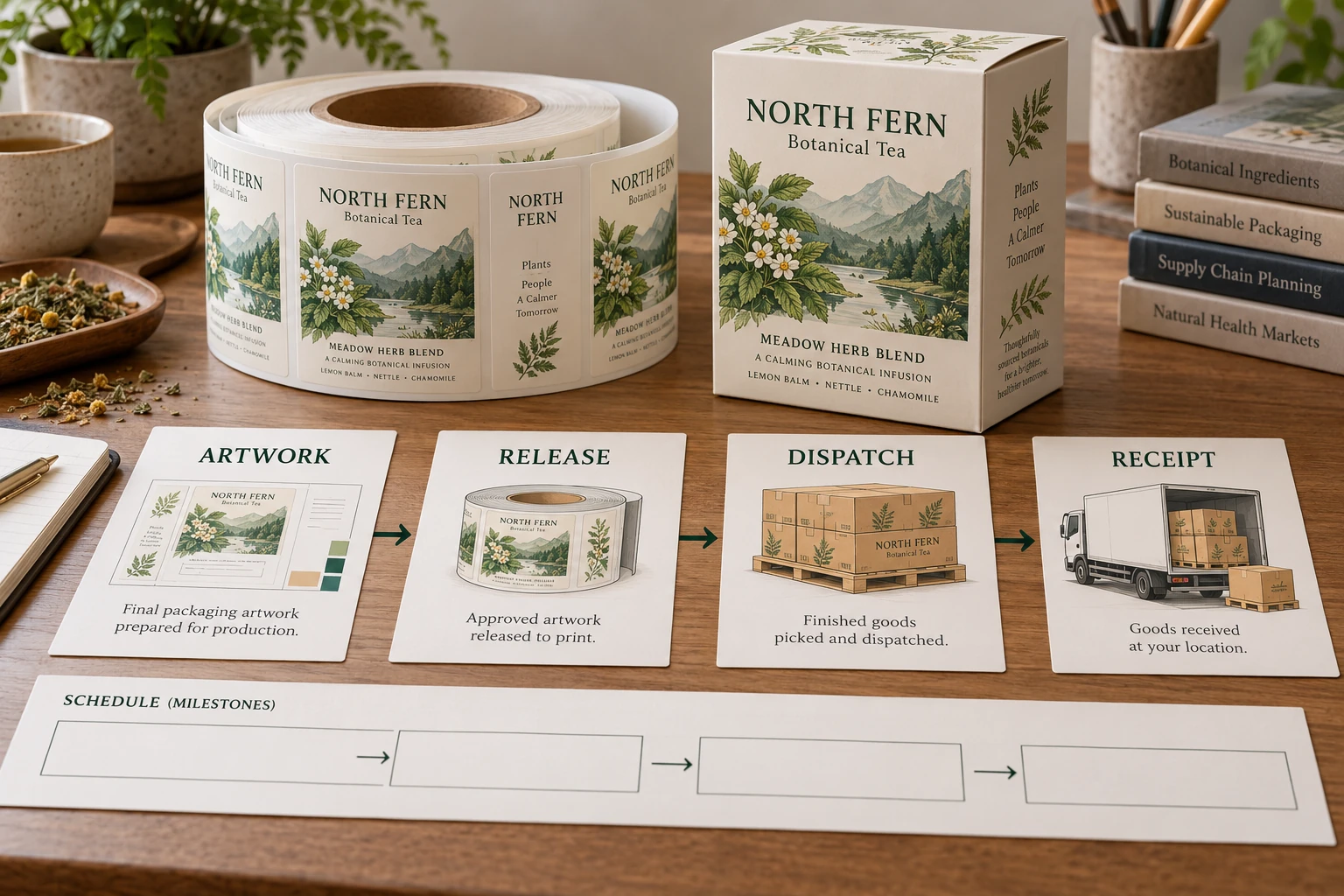
Keep the stages separate in one short record
| Milestone | Question to resolve |
|---|---|
| Artwork and specification ready | Which version and owner can close the open decisions? |
| Production release | What conditions must be satisfied and who confirms receipt? |
| Ready for dispatch | What finished packing and checks does that event include? |
| Carrier handoff | Which transport arrangement and collection event apply? |
| Required receipt or use | Which location and downstream operation need the stock? |
These are planning fields, not a prescribed ZC Labels timetable. Some work may overlap when the responsible parties agree it can. Other work depends on an earlier decision. Ask about that relationship rather than assuming every row takes a fixed number of days or must happen strictly in sequence.
Keep estimates, targets and confirmed commitments visibly different. If a supplier gives a range subject to final approval, retain that qualification beside the range. Removing it from an internal summary does not remove the underlying uncertainty.
Price an acceleration against what changes
If the required event is at risk, ask which options are feasible. A stable design might allow a simpler finish or packing scope to be considered. Another project may need a partial allocation at an earlier time. Those are proposals to review and quote, not services or savings promised here.
Do not simplify a requirement that protects the actual use. Dropping a needed material review or accepting an unresolved code may move the paperwork faster while leaving the product unsuitable. The sensible tradeoff is between confirmed alternatives that still perform the required job.
Transport is another decision. A faster advertised service cannot repair a missed release condition, and a dispatch estimate cannot itself establish arrival. Ask the responsible transport party what it can confirm for the actual route and shipment, with any limitations recorded.
A late artwork change needs a new dependency check
Suppose, as an illustrative scenario, the label's product name changes after the schedule was discussed. If the correction affects only a supplied file that has not been released, the consequence may differ from a change after relevant work has begun. Ask what stage the job has actually reached.
Identify the affected reference and obtain confirmation of the revised schedule or unchanged commitment. Do not assume every correction restarts the entire order, and do not assume an apparently small change is free of timing consequences. The party doing the work needs the chance to assess it.
The proof and sample guide helps keep approval scope explicit. A physical sample request should have a defined decision purpose so the team can discuss its place in the plan without treating sampling as an unexplained delay.
Name the work covered by an early authorization
Where the supplier offers a way to begin some work before every decision is closed, identify exactly which work the buyer is authorizing. An email accepting the artwork for a particular purpose should not quietly become permission to print the complete order while its material or finish is still pending. Ask whether the proposed sequence is feasible for the actual job before relying on it in the schedule.
List the inputs that are fixed for that step, the references that remain provisional and the later work still held. Record who can authorize the next step and how the supplier will acknowledge the instruction. This is a coordination record; the actual commercial consequences and order terms need confirmation between the parties.
| Early-work field | Question for the schedule discussion |
|---|---|
| Authorized task and version | What may actually begin now? |
| Fixed input | Which identified dimensions, artwork or specifications does that task depend on? |
| Remaining hold | What must wait, and which owner can close the gap? |
| Changed assumption | What timing or commercial effect must be confirmed if an input changes? |
For an illustrative job, a buyer might ask whether an identified layout review can proceed while the final finish reference is considered. The supplier must confirm the available route and its limits. If the unresolved finish can change the construction or appearance being approved, keep that dependency explicit. Do not call the entire project released merely because one task is under way.
Compare the offered sequence with waiting for a complete release. Starting earlier may preserve useful progress, or it may expose the buyer to work that needs revision. Obtain actual scope, charges and schedule qualifications instead of assuming an early start saves a fixed number of days. If no appropriate partial route is available, retain the open dependency and request the next realistic milestone. The factory release guide keeps the final instruction connected to the accepted references.
Ask for an update that another person can use
Record the latest confirmed milestone, remaining condition, responsible party and next update. “In progress” is less useful than knowing whether the specification is accepted or whether dispatch arrangements are still open. Avoid filling the gap with a guessed percentage complete.
For the custom roll label supply route, collect size, construction or actual-use requirements, artwork status and quantities by design. Send those with the destination, required receiving event, downstream packing date and known open approvals in a schedule review enquiry. That gives the supplier a concrete event to evaluate and a clear place to explain what it can actually confirm.