
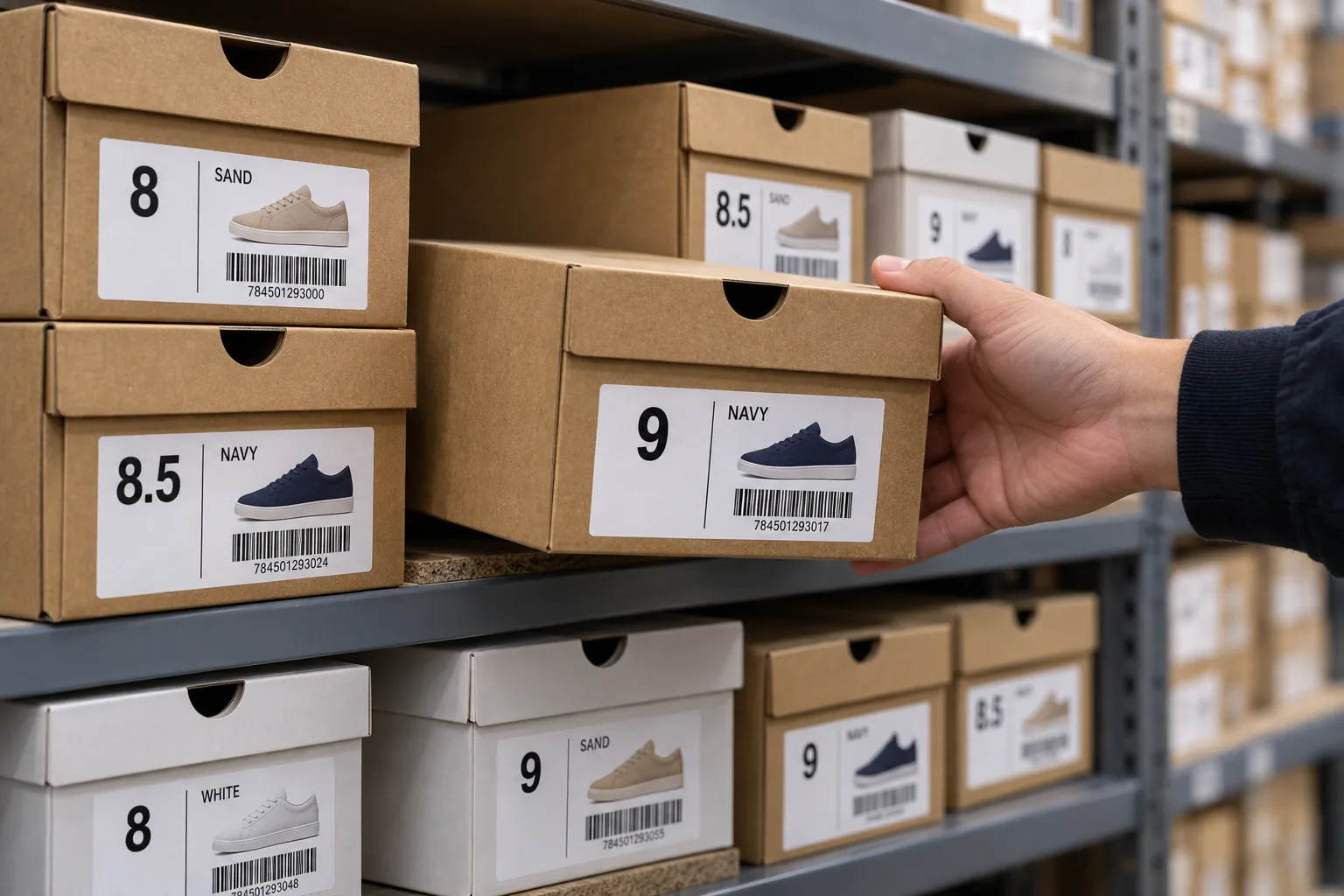
A wall of shoe boxes looks organized until a picker has to distinguish size 8 from 8.5 in a hurry. A beautiful side panel will not help if the size is buried under a small brand mark. I would start with the shelf view: which face stays visible when the boxes are stacked, and what does the worker need to read before touching one?
The label is a compact data system, not just packaging decoration. Agree on the brand's size notation, color name, style code and approved SKU. If several markets use different size systems, the brand must supply the conversions. A printer should not improvise them from a web chart.
Make the Shelf Face Work First
| Field | Design check | Picking consequence |
|---|---|---|
| Size | Read from standing distance | Wrong pair leaves the shelf |
| Color | Spell out similar shades | Variants get mixed |
| Style code | Use approved data | Reorder mismatch |
| Barcode | Scan on the finished box | Manual lookup slows packing |
An original small shoe silhouette or color swatch can help someone orient quickly, but it should not outrank the size. Try the longest color name and the widest style code on the actual label width. Keep the barcode away from box folds, tape and heavy printed patterns.
Test the Carton, Not the Screen
Apply labels to the production shoe carton after the same handling the packing team uses. Coated paperboard, rough recycled stock and laminated finishes need different attention. Stack the boxes, rub the exposed edge and scan through the normal warehouse light. If the label must peel off for returns, check removal after realistic dwell time rather than immediately after application.
Give the line one placement photo. A label that shifts between the short end and long side defeats the purpose of a standardized pick face. Record the approved print version with the data file so an old size layout cannot quietly return on a reorder.
Close the Loop Before Bulk Printing
- Photograph the stacked shelf and visible box face
- Supply brand-approved size conversions and SKU data
- Proof longest size and color combinations
- Scan the barcode on a packed carton
- Trial adhesion and any removal requirement
- Save the label placement and version record
The retail price sticker guide covers temporary shelf changes; the carton ID guide goes deeper on scan placement. Send a box photo and approved data fields through the label specification planner. The best result is a picker who never needs to open the wrong box.
Questions Before You Order
Can one shoe box label cover every size system?
Only if the brand has approved a clear conversion and enough space. Do not invent US, UK or EU equivalents from a generic chart.
Where should the barcode go?
Place it on a stable visible face with sufficient clear area, then scan the final printed label on a filled box in the real picking workflow.
Will a removable label work on every shoe carton?
Coated, textured and recycled boards behave differently. Trial the specified construction on the production carton and confirm the desired removal behavior.