
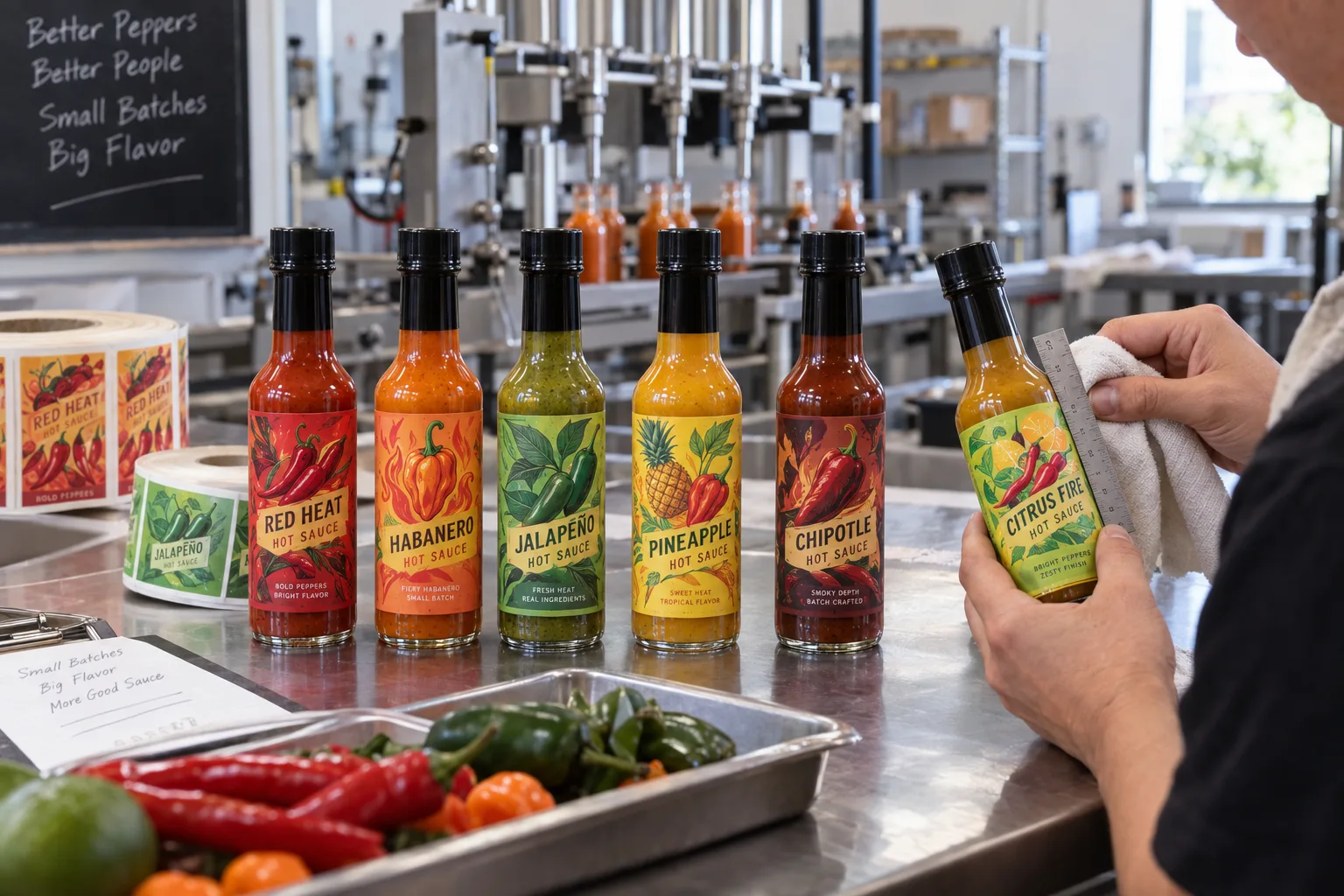
When a hot sauce project reaches our artwork desk, the first question is rarely whether the label should look bold. Most founders already know that. The useful question is what the bottle will look like after filling, wiping, capping, boxing and several rounds of handling.
Sauce can reach the outside of a bottle. Glass can arrive cold and collect condensation. Plastic bottles may flex when squeezed. A label that looked excellent on a clean empty sample can show edge lift, staining or trapped moisture in normal production. We therefore start with the filled package and work backward.
Map the Bottle Before Designing the Label
Measure the straight, usable panel rather than the full bottle circumference. Many woozy bottles narrow near the shoulder and curve toward the base. Extending a wrap into those areas asks a flat label to follow a changing diameter. The usual result is a lifting edge or a seam that refuses to stay flat.
For a full wrap, make a plain paper strip at the proposed size and place it on several bottles from the actual supply. Mark the front center, seam and any embossed glass. For front-and-back labels, check whether both panels can be applied consistently when the bottle is already filled.
| Production condition | What can go wrong | What we ask buyers to test |
|---|---|---|
| Cold-filled glass | Condensation under the label | Application temperature, dry-down time and edge bond |
| Oily sauce handling | Staining, slip or weak adhesion | Wiped bottle versus realistic production residue |
| Squeezable plastic | Wrinkles or edge stress | Repeated squeeze and recovery on a filled bottle |
| Retail shelf lighting | Glare hides the heat level | Readability at arm's length under store lighting |
Use Illustration to Make the SKU Obvious
Hot sauce is a category where original graphics should do real work. A green jalapeno leaf, orange habanero flame, red chili cluster or yellow pineapple-and-pepper illustration can separate varieties before the shopper reads fine text. Avoiding copied mascots does not mean using empty white labels.
We prefer a controlled family: one logo position, one heat-scale location and one information grid, with a different original ingredient illustration and accent color for each sauce. That structure makes the range feel related and reduces artwork-version errors when a small producer adds a new flavor.
Do Not Let the Heat Scale Become Decoration
If the front says mild, hot or extra hot, the wording should be deliberate and consistent with the product owner's decision. Pepper icons can support that message, but an unlabeled row of flames may confuse customers. The same applies to claims such as all natural, preservative free or award winning. They need business evidence and market review, not a visual shortcut.
Ingredient, allergen, net-content, manufacturer and date-code requirements vary by market and product. We can reserve space and check print readability, but the responsible seller or regulatory adviser must approve the final content.
Finish Should Support the Way the Bottle Is Sold
A gloss surface can make reds and oranges feel saturated and is easy to wipe in many packaging situations. A matte surface can reduce glare and give an illustrated craft range a quieter look. Neither finish automatically solves oil, moisture or abrasion. Those results come from the complete face material, print protection, adhesive, bottle and application process.
Before bulk production, apply labels using the same wipe procedure and timing planned for the line. Put finished bottles in dividers or cartons, handle them with slightly wet hands and inspect the seam after storage. That small trial tells us more than a request for a generic waterproof label.
Our Hot Sauce Label Test List
- Measure the straight label panel on several bottles
- Confirm glass or plastic and any surface coating
- Test on filled bottles at the real application temperature
- Simulate sauce, oil and condensation exposure
- Check front hierarchy and heat level from shelf distance
- Confirm every flavor name, color and illustration version
- Review seam position, date-code area and carton rubbing
- Keep an approved filled bottle as the reorder reference
What We Would Put in the Quote Request
Send bottle photos and dimensions, label panel size, glass or plastic type, filling and application temperature, sauce varieties, quantities by SKU, artwork, finish direction, date-coding method and packing method. Mention any oil, refrigeration or condensation that the bottle will meet.
The best hot sauce label is not the loudest design on a clean mockup. It is the one customers can recognize quickly and the packing team can apply repeatedly without fighting the bottle.