
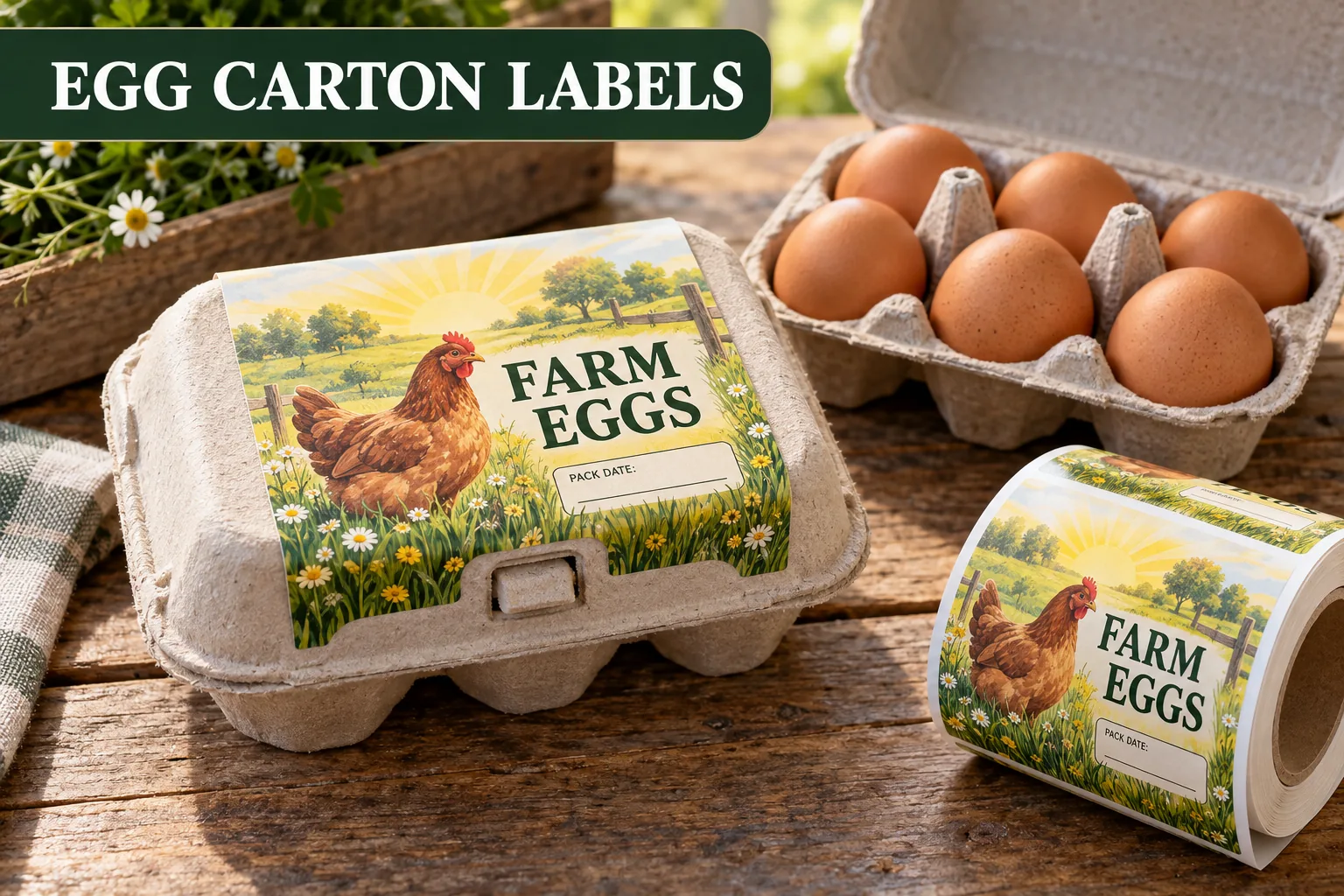
An egg carton looks flat from above, but its molded lid has shallow hills, recesses and a hinge that moves. A rectangular label can bridge the high points and lift at the low ones. I would put the actual empty carton on the table, open and close it, then draw the usable label area with low-tack tape before discussing the illustration.
For a six-pack or twelve-pack, the best label position may differ. Some cartons have a broad top panel; others need a shorter front strip. A charming original hen and sunrise drawing can make the pack recognizable, but the product name and approved details still need room at a readable size.
Measure the Carton in Three States
| State | What changes | Label check |
|---|---|---|
| Empty and closed | Lid contour is visible | Contact area and edge position |
| Filled and closed | Carton may flex | Adhesion and readable front |
| Open | Hinge and latch move | No tearing or blocked access |
| Stacked | Pressure and rubbing increase | Scuffing and label transfer |
Molded fiber is not a single uniform surface. Dust, texture and recycled-content variation can affect contact. Test a proposed adhesive and face material on a production carton after its usual storage and handling. Do not promise a particular hold from an image of a smooth paper sample.
Keep Variable and Required Information Under Control
The food business, not the sticker supplier, owns grade, origin, packing date, best-before and other market-specific statements. Decide which information is fixed in the artwork and which changes by batch. A secondary field or overprint zone may be more practical than reprinting the entire illustrated label whenever a date changes.
Make the primary identity easy to see from a refrigerated shelf or market crate. Check the final-size proof under ordinary lighting. Decorative lettering that works on a poster may become illegible on a narrow carton strip. If a seal crosses the opening, confirm whether it is simply decorative or intended as a closure indication; do not imply tamper evidence without an appropriate construction and trial.
Trial the Whole Packed Carton
Apply a small run in the same sequence the packer will use. Open, close, stack and transport representative cartons. Look for edge lift at the lid curve and for labels that catch on adjacent packs. If the cartons are chilled, include that condition in the sample test. The attractive flat proof is only the first checkpoint.
- Send photos and dimensions of the exact carton
- Mark hinge, latch and molded high points
- Supply owner-approved product copy and variable-data plan
- Proof small type at actual size
- Apply samples to filled cartons
- Open, stack and handle the labeled cartons
Compare the bakery box label guide for another paper-pack format and the variable-data overprint guide for later lot or date printing. Share the real carton and approved copy through the specification planner. The lid has the last word on the label shape.
Questions Before You Order
Will one label size fit every egg carton?
Not reliably. Lid geometry, molded texture, capacity and closure vary. Measure and test the exact carton before approving a dieline.
Can the label carry egg grade or origin claims?
Only with wording and evidence supplied and approved by the responsible food business for its target market. The printer should not invent those claims.
Is a wraparound label better than a top label?
It depends on the carton shape and opening method. Apply physical samples of both and confirm that the carton still opens, closes and stacks normally.