
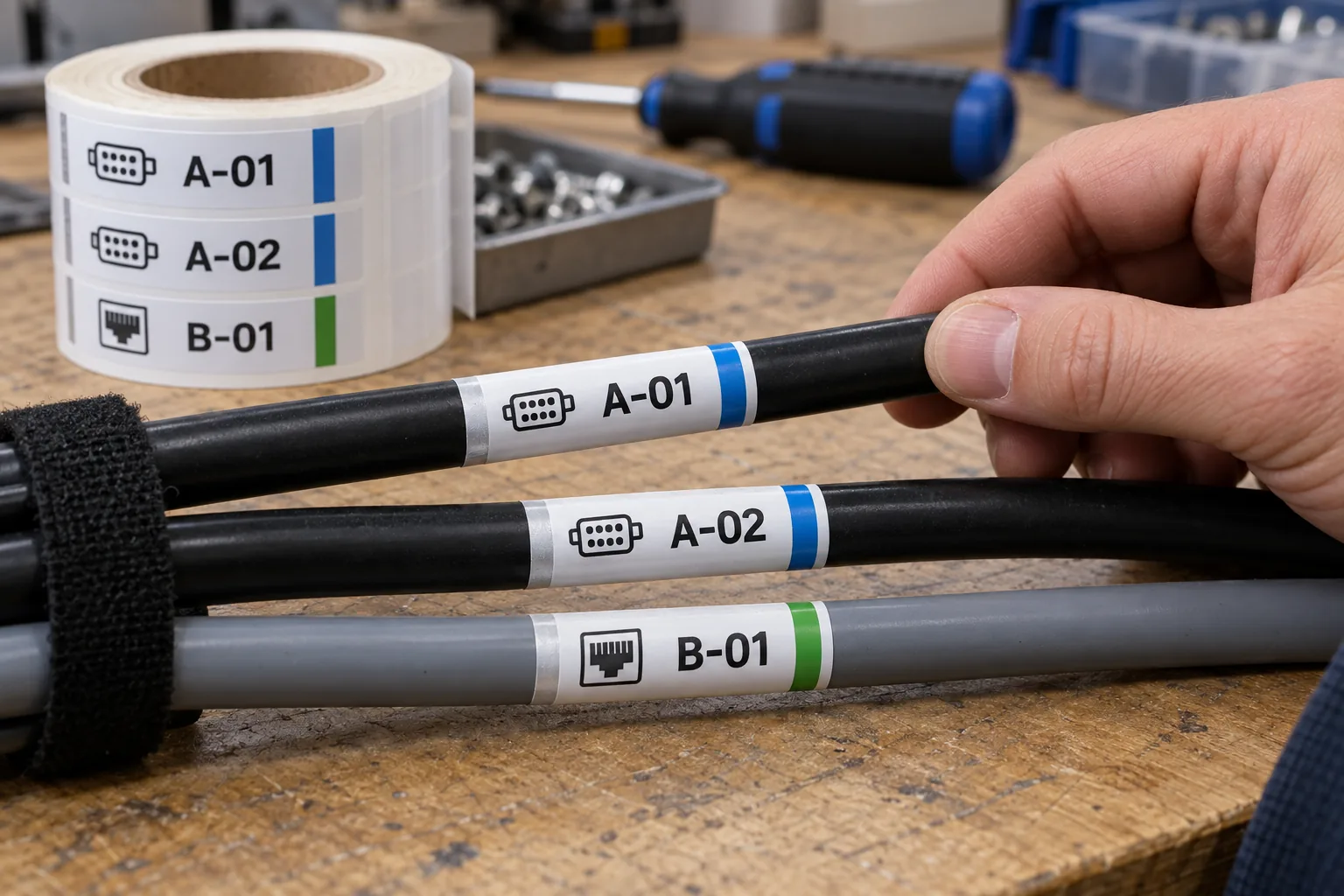
Before installation, a cable ID can look generous on a flat screen. After installation, it may sit behind a bundle with only a narrow strip visible. I would proof the label on the actual cable diameter and look at it from the technician's working position. That simple move catches more mistakes than another round of zooming into the artwork file.
The owner supplies the cable IDs, circuit meanings and any site-specific identification rules. The label supplier can plan print orientation, material and application, but should not assign technical meaning to a conductor or claim compliance without a verified specification.
Measure the Wrapped Result
| Specification | Physical check | Failure to avoid |
|---|---|---|
| Cable diameter | Wrap smallest and largest cable | ID disappears in overlap |
| Print direction | Read from service side | Text faces the wall |
| Identifier length | Use longest approved ID | Type becomes tiny |
| Edge position | Handle the bundle normally | Corner lifts or snags |
Use a clear original geometric mark or color band only as a secondary cue. Keep the approved identifier in high contrast. If the label has a clear overlaminating tail, confirm the printed area remains visible after that tail wraps over it. A barcode or QR code must be scan-tested in its final curved position, not assumed from a screen image.
Trial the Installation Conditions
Ask whether the cable is handled indoors, near heat sources, in an oily workshop or in an area with routine cleaning. Trial the proposed construction under the actual use conditions. Some applications may require a different identification method altogether. A generic durability promise is not an engineering specification.
Record the application point relative to connectors and bends. Installers need enough free cable to wrap consistently without covering manufacturer markings or making maintenance harder. Save a wrapped reference sample with the approved data file for repeat production.
Approve the Cable, Not Just the Roll
- Provide cable diameters and photos in position
- Supply owner-approved identifiers
- Proof longest ID at final wrap size
- Check viewing and print orientation
- Test edge hold after normal handling
- Scan curved codes if they are required
The small-text guide helps with legibility and the scan guide covers code verification. Send cable sizes and an annotated application photo through the specification planner. A usable ID is one a technician can find without untangling the whole bundle.
Questions Before You Order
Can one wrap label fit every cable diameter?
No. The printable area, wrap length and final overlap change with cable diameter. Test the exact sizes in the installation set.
Who defines the cable IDs?
The equipment or installation owner supplies the approved identifiers and orientation convention. The printer must not invent technical circuits or safety meanings.
Is a flat digital proof enough?
No. Wrap a physical printed sample around the cable, then check readability, edge hold and scan behavior if codes are used.