
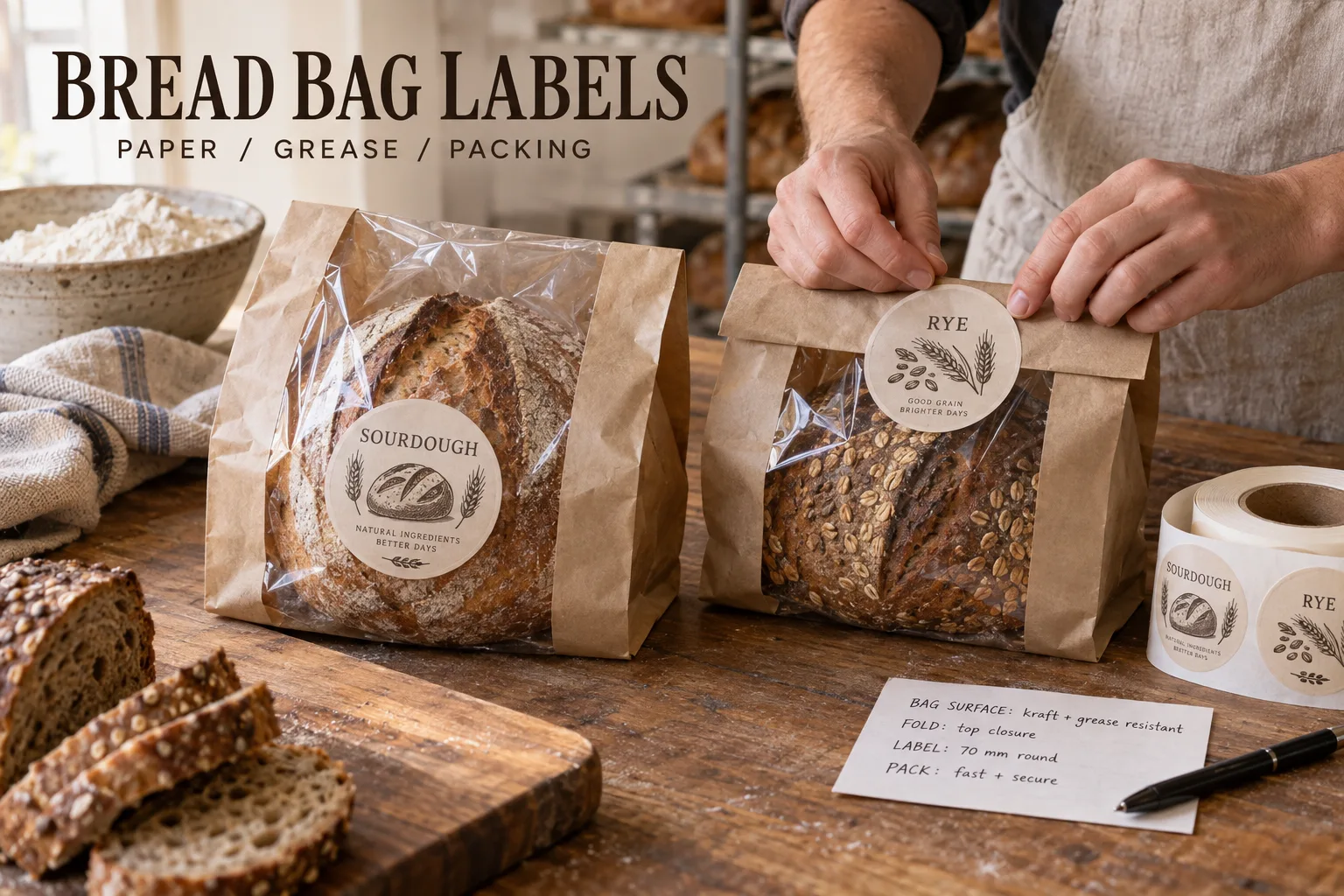
A bread bag is not a flat sheet for very long. Someone slides in a loaf, pushes out air, folds the top and reaches for a sticker while the counter is busy. A label designed only on an empty bag can land across a crease or cover the one part of the bread the buyer wants to see. I would start the artwork review with a packed bag on the table.
There is a small tension in bakery packaging. The owner wants the bag to look distinctive; the packing team wants a closure that goes on quickly and stays put. The two do not have to fight, but a decorative label should not be made to solve every packaging job at once.
Separate the Front Label From the Closure
A front label identifies the bread. A closure sticker keeps a folded paper top or film flap in place. Sometimes one sticker can do both, but that is a decision to test, not a default. If the bag size changes with the loaf, the fold may move enough to make a combined label unreliable.
I would pack the smallest and largest intended loaf before settling dimensions. Measure the usable front panel in mm after filling. Then photograph the top fold and show where hands will press the closure. A digital drawing of an empty bag cannot answer those questions.
| Bag and job | What to provide | What to check |
|---|---|---|
| Kraft paper bag | Filled bag and paper finish | Surface texture and label contact |
| Clear film bag | Exact film and packing method | Contrast, handling and fold movement |
| Front identity | Usable panel in mm | Visibility with the loaf inside |
| Top closure | Finished fold photograph | Application speed and opening |
| Changing information | Approved SKU and batch fields | Readability and version control |
Flour and Grease Belong in the Trial
A bag may reach the packing bench with flour on it. A rich loaf or pastry can also leave oil on the outside. Those are different conditions from applying a label to a clean, unused sample. I would describe what actually happens at the counter, then test a small set through that routine.
Do not reduce the choice to 'paper is natural' or 'film is waterproof.' A textured paper label can look right on kraft but still need a compatible adhesive and a clean application area. A printed film label may suit a clear bag, yet the artwork needs enough contrast over the bread. Material names are the beginning of a specification, not a performance promise.
Give the Illustration a Real Bakery Job
Original wheat drawings, scoring patterns, grain icons or a small bakery mark make a bread range recognizable. They should help a customer distinguish sourdough, rye and a seeded loaf before reaching the tiny type. Avoiding borrowed artwork is not a reason to print a blank white circle.
I would build a stable visual system and change one or two cues by loaf. If every design uses a different composition, the team may put the wrong label on the wrong bag during a busy bake. The trade-off is not between creativity and control. Good control gives the illustration room to work.
Handle Variable Text as a Versioned File
Product name, ingredients, weight, date and any required statements can vary by market and product. The bakery must approve that content. For printing, send a version list that names each SKU, final wording, bag size and quantity. If dates are added later by another process, leave a deliberate area for them rather than shrinking everything at proof stage.
As a planning example, a bakery ordering labels for three bread types should state the count for each one. 'Three designs, 3,000 labels' leaves the split unresolved. It can also conceal the fact that the smallest run needs a different packing arrangement. That arithmetic is only an example, not a minimum order claim.
Approve One Bag That Has Been Packed and Opened
- Fill and close each intended bag size
- Mark front and closure positions in a photograph
- Measure usable label areas in mm
- Test application on the real surface and packing bench
- Check the product name at hand-held distance
- Open the package and inspect the closure behavior
- Approve the final wording and quantity by SKU
Our bakery box guide covers another packaging surface; the surface matching guide helps organize material questions. Use the specification planner to send a filled-bag photo, artwork and quantity split. I would rather find a poor fold on one sample than on a full morning's production.
Questions Before You Order
Can I use one label for paper and clear bread bags?
Use one artwork system if it helps the brand, but test the proposed label construction on each actual bag surface. Paper and film can behave differently during filling, closing and handling.
Where should a bread bag label be placed?
Start with the final filled bag. Keep the main identity visible, avoid folds that change every pack, and decide whether a separate closure sticker is required.
Who approves ingredient or date information?
The responsible bakery supplies and approves the market-specific product and date information. The print review checks that approved information fits and remains readable.