
A calendar sticker sheet can be beautifully printed and still put a date under the wrong weekday. For a stationery buyer, that is a different approval problem from small lettering, writing space or an awkward peel. Before printing a dated collection, approve the calendar content independently of the decorative layout.
Start by deciding what the product supplies: loose date numbers, month headings, dated weekly strips or complete month grids. A set of numbers does not become year-specific merely because its sleeve shows a year. A grid that connects dates to weekdays does. That distinction determines what must be checked and which stock can reasonably carry forward.
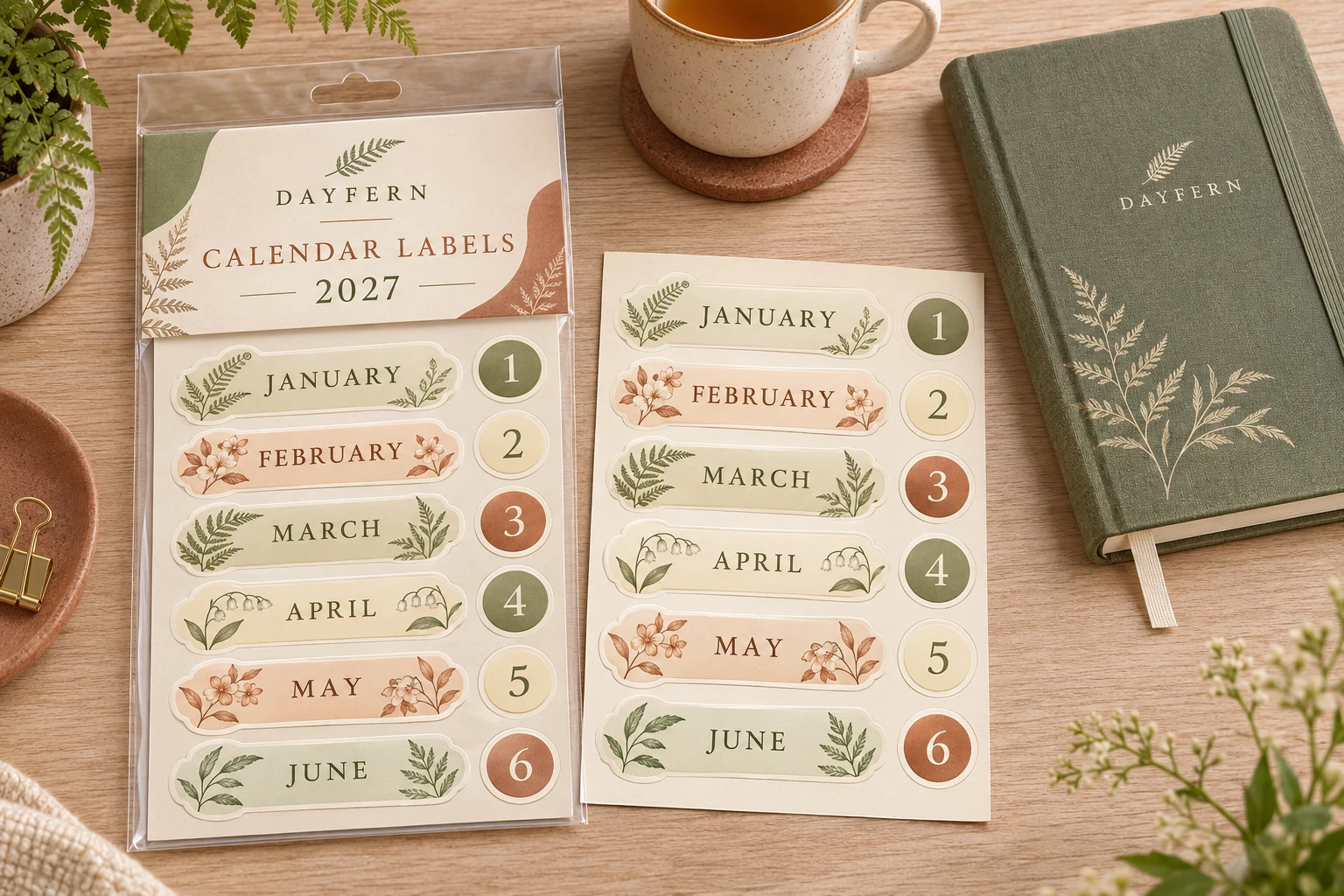
Define the calendar product before counting sheets
Write the intended date coverage, calendar system, language and first weekday in the brief where those fields apply. For a dated weekly product, identify the first and last supplied week and how weeks crossing a month or year are represented. For an undated collection, specify the pieces supplied without implying that every possible calendar arrangement has already been assembled.
Keep month names, weekday headings, numbers and decorative reminders identifiable as separate content types. If the customer places them individually, the supplied product gives the customer a task. If the printer supplies a complete dated arrangement, that arrangement needs its own content approval. Neither route is inherently better: separate pieces offer flexibility but require more placement, while a dated arrangement can be quicker to use but has a narrower applicable edition.
The custom stationery sticker range includes calendar and planner directions. Submit the actual layout, quantities and intended use for review; a category name does not establish a standard calendar kit, stock range or automatic date-checking service.
Keep a content reference separate from the attractive proof
Have the publisher or product owner approve a dated content reference before it is placed into the final artwork. Identify its year or coverage, language, week-start choice and revision. Give the person checking the final artwork that reference, rather than asking them to reconstruct the designer's intentions from a decorative sheet.
For a Gregorian calendar, February is one useful boundary check. The U.S. Naval Observatory explains the leap-year rule, including the century exception. That source supports the calendar rule, not the accuracy of a particular sticker file. The owner still needs to check the actual edition. Other calendar systems require an appropriate reference rather than importing a Gregorian assumption.
Likewise, choose the first weekday deliberately. The Python calendar documentation shows that month layouts can be generated with a specified first weekday. A software default is a layout setting, not evidence that the target audience wants that convention. The buyer supplies the intended convention; the artwork must reproduce it consistently.
Review boundaries, then reconcile the complete content
Use the following sequence as a review plan. It is not a substitute for checking every supplied dated arrangement. Boundary checks can expose an error early; a correct first week does not prove the rest of the edition is correct.
| Review input | Question to answer in the final artwork | Reason to hold the affected version |
|---|---|---|
| Approved coverage and calendar reference | Are the intended first and last dates present, without an unintended gap or duplicate? | The supplied range is ambiguous or does not reconcile. |
| Week-start and language instruction | Do headings and date positions follow the chosen convention throughout? | The heading changed but the dated positions did not. |
| Month and year boundaries | Do month endings, February and cross-year weeks match the approved reference? | An old edition's arrangement remains in any panel. |
| Holiday or event content, if included | Has its responsible owner confirmed wording, jurisdiction, date and edition? | A decorative reminder is being treated as verified local information. |
| Final exported proof and pack identity | Does each supplied sheet match its content revision and named edition? | Correct content is attached to the wrong sheet or sleeve version. |
Separate data correctness from physical legibility. A correctly assigned weekday may still be unreadable after printing or cutting. Conversely, larger type does not correct a misplaced date. The planner-sheet usability guide covers the smallest functional piece, writing and peel access. Retain that physical review beside the calendar-content record.
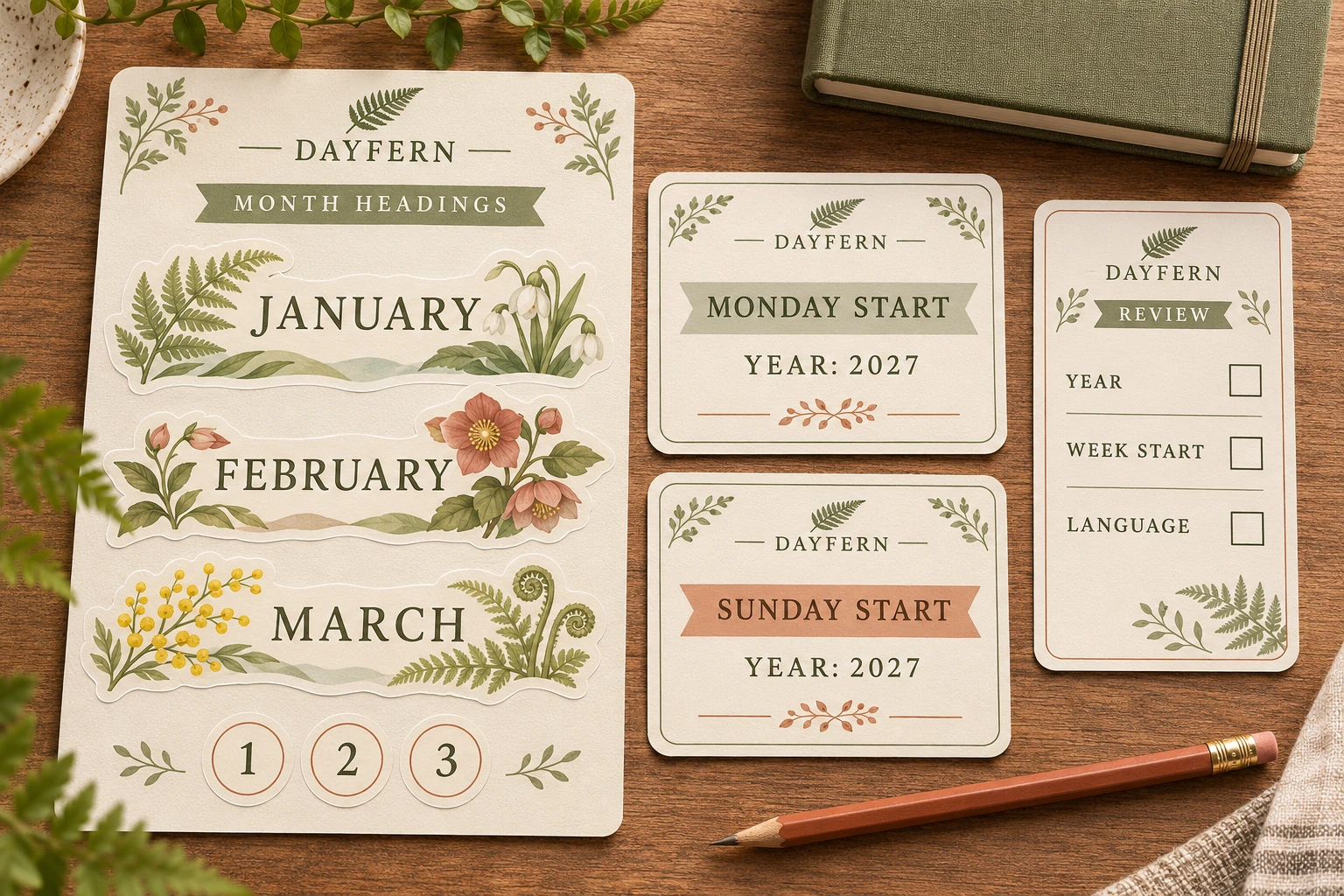
Count a usable calendar set rather than its illustrations
Map the approved contents to the finished unit being purchased. A collection with month headings on one sheet and date pieces on another needs both references in its set definition. List the pieces required for the intended coverage, the quantity on each supplied sheet and the number of each sheet per finished pack.
If one heading or date range is missing, spare decorative icons cannot complete the set. If date pieces are intentionally supplied as a reusable numerical selection rather than a prearranged full-year product, describe that content honestly. Do not infer a complete calendar yield from a large combined sticker count. The fixed-assortment pack guide explains the separate calculation of complete packs from their required components.
Treat the next edition as a content change
An unchanged botanical frame does not make next year's dated file a straight repeat. Compare calendar coverage, weekday positions, language, owner-approved events and edition markings. Retire the superseded print file and identify any retained undated components separately. Reuse a previous material approval only within its actual scope; it cannot approve dates that were absent from the sample.
If a date or local-event reference remains unresolved, hold that affected content. Compare waiting for the owner's approval with an explicitly undated product or a narrower approved range. An alternative changes the product and may affect its sleeve, instructions and quotation. Obtain agreement rather than silently deleting the difficult dates.
Send ZC Labels a calendar-sticker brief with the proposed supplied format, date coverage or undated content list, owner-approved calendar reference, language and week-start instruction, final-size artwork, quantities by sheet edition and packing needs. Mark unresolved content separately. Sample availability, represented construction, charges and timing remain subject to the project-specific sample policy.